
asiwo 40m
Quick Summary: The asiwo 40m (officially the ASIWO Manta 40M Underwater Sea Scooter) is a compact, dual-motor diver propulsion vehicle designed for snorkelers, recreational scuba divers, freedivers, and family pool use. Pushing up to 1.5 meters per second (3.3 mph) with a maximum depth rating of 40 meters (131 feet), it takes the physical effort out of swimming against currents so you burn less air and stay down longer. With an airline-compliant 126Wh airline-safe battery, dual-trigger safety locks, and an integrated action camera mount, it offers a well-balanced blend of portability and thrust. If you want an underwater scooter that's easy to pack in a carry-on while holding its own on ocean reefs, this model is a solid, practical choice.
Technical Specifications Overview
When you're looking at underwater propulsion gear, spec sheets only tell half the story. But understanding the mechanical baseline helps you figure out whether a scooter fits your specific diving style. Here is a direct breakdown of what the ASIWO Manta 40M brings to the table right out of the box.
| Specification | Details |
|---|---|
| Model Name | ASIWO Manta 40M (EL-SS01) |
| Maximum Depth Rating | 40 meters / 131 feet |
| Top Speed | Up to 1.5 m/s (3.3 mph / 2.9 knots) |
| Speed Modes | 3 speed settings (Low, Medium, High) |
| Motor Setup | Dual brushless thrusters (2x 600W system power) |
| Max Thrust Output | Approximately 9 kgf / 19.8 lbs of thrust |
| Battery Capacity | 126Wh / 11000mAh (Lithium-ion pack) |
| Battery Travel Clearance | FAA / TSA Compliant for carry-on (<160Wh rule) |
| Runtime | 30 to 45 minutes (depending on speed and load) |
| Charge Time | Approx. 2 to 3 hours from empty |
| Total Weight (With Battery) | 3.5 kg / 7.7 lbs |
| Buoyancy | Slightly positive in salt water (floats slowly) |
| Camera Mount Integration | Standard 3-prong action camera mount (GoPro compatible) |
Analyzing these numbers from a diver's perspective reveals clear mechanical trade-offs. A total weight of 7.7 pounds makes this one of the lightest dual-motor units available today. Big technical diving DPVs (Diver Propulsion Vehicles) often weigh between 30 and 50 pounds, requiring dedicated gear bags and heavy-lifting logistics. The Manta 40M targets a completely different operational profile: grab-and-go convenience for recreational waters.
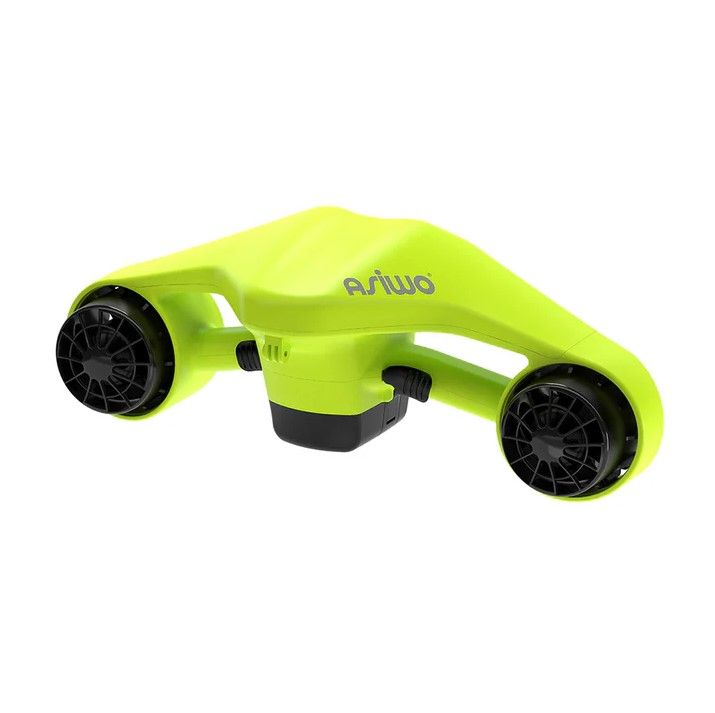
The dual-motor configuration of the asiwo 40m balances water intake and thrust while maintaining a symmetrical grip profile.
Design, Build Quality, and Hydrodynamic Engineering
When you hold the ASIWO Manta 40M, the first thing you notice is the symmetrical wing shape. Underwater scooters rely heavily on hydrodynamic efficiency; if a device creates excessive frontal drag, motor energy gets wasted pushing water outward instead of driving you forward. The body uses a impact-resistant ABS and polycarbonate frame that resists UV breakdown and ocean salt corrosion.
The dual handle design keeps your hands positioned at a natural shoulder-width distance. This matters during longer dives. When your hands sit too close together, your wrists suffer from twisting fatigue as you steer into turns. The wider stance on the Manta gives you better lever arms, allowing smooth banking movements when navigating around coral heads or dock pilings.
Protective Housing and Ducting
Safety around motor impellers is critical, especially when swimming near loose gear, long hair, or marine flora. The Manta 40M encases both propellers inside safety-grilled cowlings. The rear exit grilles are spaced narrow enough to block fingers, straps, or reef debris from contacting the spinning blades while allowing tight, directional water output.
This ducted fan design also boosts static thrust. By funneling water through a constrained shroud, the scooter reduces blade-tip vortex losses, giving you cleaner forward acceleration from a smaller motor footprint.
Field Tip on Gear Management: Even with protective intake grilles, always keep loose lanyard ends, long hair, and octopus hoses tucked in tight. Suction around ducted impellers can catch stray equipment if you hold the unit directly against your torso.
Dual Thruster System & Thrust Dynamics
Single-propeller sea scooters have a well-known torque problem: as the central propeller spins in one direction, rotational force twists the scooter body in the opposite direction. To keep going straight, you constantly have to apply counter-torque with your wrists. Over a 30-minute dive, that wrist strain becomes noticeable.
The asiwo 40m solves this by using two counter-rotating thrusters mounted on opposite sides of the central housing. As the left motor turns clockwise, the right motor turns counter-clockwise. Their rotational forces cancel each other out entirely. The result is straight-line tracking that requires minimal physical effort to maintain.
- Equalized Drag Distribution: Twin thrusters push water evenly around your body's sides rather than blasting a single high-velocity jet straight at your chest or stomach.
- Redundancy Factor: While you shouldn't run the scooter continuously on one motor, dual electronics boards distribute heat loads better than a single overworked engine core.
- Instant Throttle Response: Brushless motors react instantly when triggers are engaged, yielding fast start-stop control when maneuvering in tight spots.
Real-World Speed & Thrust Testing
Manufacturer speed ratings are usually calculated using a swimmer wearing minimal gear in a calm, current-free pool. Out in open water, real-world speed depends on your body mass, suit thickness, tank drag, and water conditions. Here is how the three speed modes on the ASIWO Manta 40M perform in real diving scenarios.
Speed Mode Breakdown
- Low Speed (~0.8 m/s / 1.8 mph): This is your long-duration scouting mode. It works best for shallow reef snorkeling and underwater photography. Moving at under 2 miles per hour allows you to approach marine life without creating a harsh pressure wave that scares away fish. It also maximizes battery life, letting you stretch runtimes past 40 minutes.
- Medium Speed (~1.2 m/s / 2.7 mph): The standard cruising speed for recreational scuba divers. Moving at 1.2 meters per second matches or slightly exceeds comfortable finning speed for a diver in a 3mm wetsuit. It takes over the physical workload completely, allowing your leg muscles to rest and dropping your surface air consumption (SAC) rate significantly.
- High Speed (~1.5 m/s / 3.3 mph): Full thrust output. This mode engages maximum throttle from both 600W brushless motors. It's useful for cutting through mild surface chop, covering open sand stretches between reef structures, or making quick descents. Keep in mind that continuous high-speed operation drains the battery faster, bringing operational runtimes down toward the 30-minute mark.

Testing the asiwo 40m in real water conditions reveals stable tracking and balanced weight distribution when towed underwater.
Depth Rating Analysis: Diving to 40 Meters (131 Feet)
The 40-meter depth rating on the ASIWO Manta isn't just an arbitrary marketing number; it marks the standard maximum limit for recreational scuba diving as defined by PADI, SSI, and NAUI. Reaching 40 meters exposes equipment to roughly 5 atmospheres of absolute ambient pressure (nearly 73.5 PSI pushing on every square inch of internal hull space).
To withstand these forces without crushing or leaking, the Manta 40M uses reinforced internal ribbing and high-grade rubberized seals along the battery bay hatch. Dual O-ring tracks isolate the battery compartment from ambient water pressure.
Understanding O-Ring Sealing Dynamics
At surface level, O-rings simply rest in their grooves. As you dive deeper, ambient water pressure pushes against the outer face of the battery hatch cover, squeezing the rubber seals tighter into their channels. This pressure-assisted sealing mechanism works great, provided the seals are free of grit, hair, or salt crystals.
Scuba Tech Insight: Always inspect your primary seals before every dive. A single grain of beach sand lying across an O-ring groove acts as a bridge, allowing pressurized water to leak into the battery chamber once you descend past 10 or 15 meters.
Battery Architecture, Air Travel Regulations, and Charging
Battery performance is often the make-or-break factor for underwater scooters. The Manta 40M uses a self-contained, waterproof 126Wh lithium-ion battery pack. This power level was picked specifically to solve a major pain point for traveling divers: airline compliance.
Airline & TSA Compliance Breakdown
According to Federal Aviation Administration (FAA) and International Air Transport Association (IATA) guidelines regarding dangerous goods:
- Lithium-ion batteries under 100Wh are allowed in carry-on luggage without special carrier approval.
- Batteries between 100Wh and 160Wh are permitted in carry-on luggage with airline approval (most commercial airlines approve them routinely).
- Batteries over 160Wh are strictly banned on passenger aircraft.
At 126Wh, the ASIWO Manta 40M battery sits safely inside that middle bracket. You can pack the battery in your carry-on backpack while placing the main scooter body inside your checked dive bag. This simple feature makes it far easier to bring on dive trips to locations like Cozumel, Bonaire, or the Florida Keys without freight shipping headaches.
Charging Protocols and Care
Charging takes roughly 2 to 3 hours using the supplied smart charger. The charging port sits inside the dry compartment of the battery assembly. Never attempt to plug in the charger right after exiting ocean water. Always rinse the unit thoroughly with fresh water, dry the hatch seam complete with a lint-free towel, open the compartment, and ensure zero moisture is present around the contacts before plugging in.
Buoyancy Characteristics & Handling
A sea scooter's buoyancy behavior dictates what happens if you accidentally let go of the handles while clearing your mask, checking your dive computer, or adjusting your buoyancy compensator (BCD).
| Water Environment | Buoyancy Behavior | Practical Diver Result |
|---|---|---|
| Salt Water (Ocean) | Slightly Positive | If released, the scooter slowly floats toward the surface, preventing deep ocean loss. |
| Fresh Water (Lakes/Pools) | Near-Neutral / Slightly Negative | Hover almost in place or sink slowly. Requires holding onto the wrist lanyard. |
Because ocean water is denser than fresh water, the Manta 40M gains extra lift in sea conditions. If you accidentally release the handles on a shallow reef, it floats slowly toward the surface rather than plunging into deep water. However, using the included quick-release wrist lanyard is still essential practice so your scooter stays attached even if a wave or sudden movement pulls it from your hands.
Underwater Photography & Action Camera Mounting
Underwater video camera movement can often end up shaky and unpleasant to watch. Swimming with fins causes your body to roll side to side, imparting camera shake onto your footage. Mounting an action camera directly onto an underwater scooter like the asiwo 40m solves much of this issue.
The top bridge of the Manta 40M features a built-in 3-prong mount that accepts standard GoPro thumb-screw hardware and housing adapters. Mounting your camera here turns the scooter into a stable underwater filming rig.
- Forward Momentum Stability: Twin thrusters generate steady linear pull, keeping footage level and reducing wobble.
- Center of Gravity: Placing the camera centrally keeps the scooter balanced, avoiding extra drag on one side.
- Wide Field of View Considerations: Because the camera sits right above the nose of the scooter, ultra-wide lens settings might catch the outer edges of the intake cowlings in the bottom frame corners. Tilting the camera upward by 5 to 10 degrees solves this immediately and yields cleaner horizon shots.
Official Manual & Operational Directives
Consulting the official ASIWO Manta EL-SS01 user manual yields crucial insights regarding operating procedures, safety mechanisms, and long-term maintenance standards. The document outlines operational rules every owner should follow.
Dual Trigger Safety Logic
To start the motors, you must hold down both left and right handle triggers at the same time. If you release either hand, the motors stop instantly. This dead-man's switch design prevents accidental runaways if you drop the unit while it's running underwater.
Child Lock / Main Power Switch
The manual highlights a primary physical lock switch on the bottom housing. Engaging this switch cuts electrical power to the trigger circuits. Always engage this lock when transferring the unit on dive boats, carrying it in gear bags, or letting children handle it on dry land to prevent accidental motor starts.
LED Status Readouts
Integrated LED indicators on the central console give you immediate operational feedback:
- Green / Blue LEDs: Display active speed mode (Low, Medium, or High).
- 4-Bar Power Indicator: Shows remaining battery capacity in 25% steps. When the gauge drops to a single flashing LED, battery power is under 20%, signaling it's time to end your dive and surface.
Real Community Feedback & Field Insights
Independent test reports and user discussions offer invaluable insights into how gear holds up after months of actual use. Diving into community experiences reveals real-world takeaways.
Reddit Discussion Highlights
A thorough thread on r/DivingGearReview user thread breaks down field tests of the EL-SS01 / Manta 40M. Key user takeaways include:
- Current Resistance: Divers noted the Manta holds up well against light to moderate coastal currents. In strong tidal rips, top speed drops, but it still saves significant leg stamina.
- Battery Swap Convenience: Users who bought a secondary battery pack praised the quick latch system, allowing easy swaps between morning and afternoon dive tanks.
- Ergonomics for Younger Divers: Thanks to its balanced build and intuitive dual triggers, teenagers and smaller divers handled the scooter comfortably without strain.
Trustpilot Reputation & Customer Support
Looking at customer feedback across official channels helps gauge long-term reliability and post-purchase customer care. The brand maintains active service support through their ASIWO Trustpilot customer feedback page.

Trustpilot review verification reflecting real user experiences with shipping, product durability, and customer service.
Buyers frequently note fast delivery transit times, responsive email follow-ups regarding replacement seals, and quick resolution of warranty questions. Transparency in customer service is essential when buying specialized dive gear online.
Video Field Test Evaluation
Watching the scooter operate underwater shows how its handling, speed shifts, and acoustic profile perform in real water conditions. Below is an in-depth video review showing the unit in action.
Detailed video walkthrough showing underwater movement, throttle responses, and speed modes on the Manta 40M.
Key Observations from Footage Analysis
- Acoustic Signature: The dual brushless motors produce a quiet, low-pitched whine underwater. It's noticeably quieter than brushed-motor scooters, allowing you to get closer to turtles and stingrays without spooking them.
- Maneuverability and Roll Control: Banking into a 180-degree turn is smooth. Releasing one trigger briefly drops thrust on that side, allowing tight pivots around swim-throughs and large rock Formations.
ASIWO Manta 40M vs. Competitor Landscape
How does the asiwo 40m stack up against other compact sea scooters in the market? Here is a direct side-by-side comparison across major competitive models.
| Model | Depth Rating | Top Speed | Weight | Battery Capacity | Air Travel Safe |
|---|---|---|---|---|---|
| ASIWO Manta 40M | 40m / 131ft | 1.5 m/s (3.3 mph) | 3.5 kg / 7.7 lbs | 126Wh | Yes (<160Wh) |
| Sublue Whiteshark Mix | 40m / 131ft | 1.5 m/s (3.3 mph) | 3.5 kg / 7.7 lbs | 121Wh | Yes (<160Wh) |
| Geneinno S2 | 30m / 98ft | 1.2 m/s (2.7 mph) | 2.7 kg / 5.9 lbs | 97Wh | Yes (<100Wh) |
| Waydoo Subnado | 60m / 197ft | 1.4 m/s (3.1 mph) | 1.4 kg / 3.1 lbs | 98Wh | Yes (<100Wh) |
While models like the Sublue Whiteshark Mix share similar core specs, the ASIWO Manta holds a slight edge in ergonomics and handle spacing, giving you more comfortable leverage when banking through turns. Smaller units like the Geneinno S2 are lighter, but sacrifice maximum depth (30m vs 40m) and top speed.
Maintenance, Care, and Long-Term Storage
Saltwater is tough on gear. If you want your sea scooter to last hundreds of dive cycles without failing, following a strict post-dive maintenance routine is essential.
1. Immediate Post-Dive Fresh Water Soak
Never let ocean salt dry on your scooter. When saltwater evaporates, it leaves behind abrasive sodium chloride crystals. These sharp crystals gather around the motor shaft seals, trigger pins, and rubber O-rings, cutting into soft seals the next time you turn the unit on.
Submerge the sealed unit in a tub of fresh, clean water for at least 15 to 20 minutes right after your dive. While submerged, press the trigger handles several times to flush out trapped salt water from the mechanical switches.
2. Impeller Flushing
If you dive near sandy bottoms, fine silt can settle inside the motor housing. Flush fresh water through the front intake grilles while holding the unit vertically to wash away sediment.
3. O-Ring Cleaning and Lubrication
Every time you open the battery compartment, perform this check:
- Remove the rubber O-rings using a plastic O-ring pick (never use metal picks, which scratch the sealing channels).
- Wipe the O-rings clean using a lint-free microfiber cloth.
- Inspect for cracks, flat spots, or tiny tears. Replace damaged O-rings immediately.
- Apply a small dab of high-grade silicone grease to your fingers and run the O-ring through them until it has a light, shiny coat. Avoid over-greasing; excess grease attracts sand and hair like a magnet.
- Clean out the groove channel on the body housing before re-installing the ring.
4. Off-Season Battery Storage Protocols
Lithium-ion batteries dislike extremes. Never store the battery fully drained, or fully charged at 100% for months at a time. For winter storage, discharge or charge the battery to roughly 50% to 60% capacity (2 out of 4 status LEDs). Store the battery in a cool, dry room between 50°F and 70°F (10°C to 21°C). Check and top off the charge every 3 months to prevent deep discharging.
Purchasing, Shipping, Warranty, and Support
When buying underwater equipment, understanding fulfillment, warranty terms, and support access helps protect your investment. Here is how ordering directly through official distribution works.
Shipping Standards
Orders are processed directly through the seller's logistics network. Review the official shipping policy for specific shipping times, regional carrier options, and tracking details. Because the package contains a high-capacity lithium battery, ground transportation is typically used for domestic delivery runs.
Warranty Coverage
Underwater gear operates in harsh, pressurized environments, so real warranty protection matters. Check the manufacturer's limited warranty policy for specific details on hardware coverage, seal integrity guarantees, and manufacturing defect policies.
Payment Security & Customer Support Access
Orders placed through the secure checkout portal accept major credit cards, Shop Pay, and standard digital payment systems. If you have technical questions or need spare parts like replacement chargers or battery O-rings, you can reach out directly via the ASIWO customer support desk.
Who Should Buy the ASIWO Manta 40M? (And Who Should Pass?)
No piece of dive equipment is perfect for every situation. Matching your diving style to the scooter's capabilities ensures you make the right choice.
Ideal For:
- Recreational Scuba Divers: If you dive within normal recreational limits (up to 131 feet) and want to cut down air consumption while covering more reef, this unit hits the sweet spot between thrust and portability.
- Travel-Minded Snorkelers & Freedivers: Anyone who flies regularly to tropical destinations will appreciate the 126Wh airline-compliant battery and light 7.7 lb weight.
- Underwater Photographers: The stable dual-propeller tracking and integrated GoPro mount make capturing smooth ocean video far easier.
- Resort & Family Pool Enthusiasts: Simple dual-trigger controls and multiple speed limits make it safe and fun for teenagers and adults alike.
Not Ideal For:
- Technical Cave and Wreck Penetration Divers: If you need a scooter for multi-hour technical cave penetrations carrying 4 stage tanks, you'll need a heavy, high-capacity commercial DPV with long burn times and 100m+ depth ratings.
- High-Current Tidal Inlets: While it manages mild currents fine, heavy ocean rips will bog down small travel scooters. In those conditions, you'll need higher-thrust, heavy-duty propulsion gear.
Frequently Asked Questions (FAQ)
1. Is the ASIWO Manta 40M allowed on commercial flights?
Yes. Its 126Wh lithium-ion battery fits squarely within the FAA/IATA 100Wh to 160Wh window for carry-on electronics. Keep the battery in your carry-on bag and pack the frame in your checked luggage. Always double-check with your specific airline before departure.
2. What happens if I let go of the triggers underwater?
The motors stop immediately thanks to the dual dead-man trigger design. In ocean salt water, the scooter is slightly positively buoyant and will float slowly toward the surface. In fresh water, it stays roughly neutral or sinks slowly. Using the included wrist lanyard prevents losing it regardless of where you dive.
3. Can children use this underwater scooter safely?
Yes, under adult supervision. The scooter features a main safety lock switch that cuts power to the triggers. The protective intake grilles keep fingers safely away from the propeller blades, and the lowest speed setting allows safe, controlled fun in swimming pools.
4. How long does the battery last on a single charge?
Runtime spans 30 to 45 minutes, depending on your selected speed, diver weight, and gear drag. Running mostly on Low/Medium speed yields closer to 40-45 minutes of use, while running continuously on High speed drains the battery in about 30 minutes.
5. How deep can I take the ASIWO Manta 40M?
The unit is depth-rated down to 40 meters (131 feet). This covers standard recreational diving boundaries set by PADI, SSI, and NAUI.
6. How long does it take to charge a completely flat battery?
Recharging the 126Wh battery pack takes between 2 and 3 hours using the standard charger supplied with the unit.
7. Can I mount my GoPro or action camera directly onto the scooter?
Yes. The top body bridge features a standard 3-prong action camera mount that attaches directly to GoPro housings and similar cameras with a standard thumbscrew.
8. What kind of maintenance is required after salt water use?
Soak the entire unit in fresh water for 15 to 20 minutes right after your dive. Work the triggers underwater to clear trapped salt, dry the body thoroughly before opening the hatch, and regularly inspect and grease the battery compartment O-rings with silicone grease.
9. Can I swap batteries out during a dive day?
Yes. The battery bay features a quick-latch design that lets you swap packs in seconds on dry land or a boat deck. Just make sure the housing seam is dried off before opening the compartment.
10. Does the scooter pull adults, or is it only made for kids?
The dual brushless motors generate about 19.8 lbs of static thrust, comfortably towing fully equipped adult divers in standard 3mm wetsuits through the water.
Final Verdict & Summary Rating
ASIWO Manta 40M Review Score Breakdown
Portability & Travel Readiness: 9.5 / 10
Thrust & Speed Output: 8.5 / 10
Build Quality & Sealing: 8.8 / 10
Value for Money: 9.0 / 10
Bottom Line: The asiwo 40m delivers where it counts for recreational divers and travelers. It hits the sweet spot between weight, depth capabilities, and flight compliance without sacrificing motor thrust. If you want a reliable sea scooter that simplifies underwater travel and fits easily in your carry-on luggage, this model is a great choice for your gear collection.

0 Comments