
An Honest Diver's Review of the Crucial Mechanical Backup
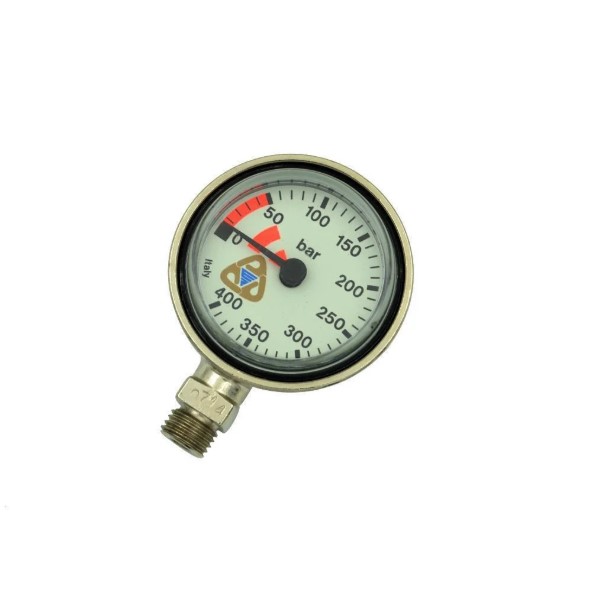
When you're forty feet inside a low-visibility shipwreck or hovering at ninety feet along a deep wall, there is one piece of equipment you must be able to trust without a single shred of doubt: your gas pressure gauge. The Akuana Scuba Diving SPG is a heavy-duty, chrome-plated brass mechanical submersible pressure gauge designed for recreational, technical, and sidemount divers who prioritize absolute reliability and clean hose routing. By pairing an Italian-made internal movement with a tempered mineral glass face, it offers a highly readable, shock-resistant solution to gas tracking that outperforms cheap plastic console alternatives. If you are looking to ditch bulky multi-instrument consoles or need a bulletproof backup to your wireless air integration system, this mechanical gauge is absolutely worth adding to your kit.
Even in an era dominated by high-end dive computers and wireless transmitters, seasoned divers know that mechanical instruments remain the true foundation of dive safety. Electronic transmitters are fantastic for tracking your surface air consumption (SAC) rate and keeping your wrist unit updated, but they rely on batteries, microprocessors, and radio signals. Any of those can fail, freeze, or suffer from signal interference when you're underwater. A mechanical gauge operates on pure physics. As long as there is gas in your cylinder, the mechanical pressure will register on the dial. The Akuana SPG represents the pinnacle of this simple, life-saving design.
In this comprehensive, long-term review, we'll dive deep into the mechanical engineering, raw materials, real-world usability, and rigging configurations of this essential gauge. We've analyzed the official technical specifications, gathered feedback from technical diving communities on Reddit, evaluated real customer experiences on Trustpilot, and put our own years of dive-deck experience to work to help you decide if this is the right pressure gauge for your life-support system.
The Structural Anatomy of a Lifeline: Materials and Engineering
To understand why one pressure gauge costs more or lasts longer than another, you have to look beneath the chrome. Most entry-level dive packages include a gauge housed in a thick plastic or polycarbonate boot. Over time, salt crystals wedge themselves between the boot and the gauge, causing hidden corrosion. Worse, the plastic housings themselves degrade under the harsh UV rays of the sun, eventually cracking under physical impact. The Akuana Scuba Diving SPG takes a completely different approach by utilizing a solid, chrome-plated brass housing that dispenses with the need for a bulky plastic protective boot altogether.
Brass is the preferred metal for underwater instruments because of its natural resistance to saltwater corrosion and its incredible structural density. By electroplating the raw brass with a thick layer of chrome, the manufacturer adds a high degree of scratch and wear resistance. This sleek, compact metal casing can take direct impacts against tank valves, rocky overhangs, or steel boat ladders without cracking, bending, or losing its seal.
The Glass Face: Mineral Tempered Glass vs. Plastic Lenses
One of the most common failure points on budget pressure gauges is the clear lens covering the dial. Cheap gauges use polycarbonate (acrylic or Lexan) for the lens. While acrylic is shatterproof, it is incredibly soft. Within a dozen beach entries or gear-bag transits, an acrylic lens will accumulate fine scratches. These scratches catch the light, making the gauge difficult to read on sunny dive decks or under the beam of a dive light. Furthermore, under extreme hydrostatic pressure at depth, plastic lenses can flex slightly. If a lens flexes inward, it can physically touch the indicator needle, pinning it in place and giving you a false, highly dangerous static pressure reading.
The Akuana SPG solves this by using a thick, tempered mineral glass window. Tempered glass is highly resistant to scratching, meaning it stays crystal clear through years of sand, salt, and rough handling. Because glass is rigid, it does not flex under high pressure, ensuring that the needle moves freely and accurately no matter how deep you dive. This optical clarity is a massive safety benefit when you're trying to read your remaining gas in dark, silty, or low-visibility conditions.
The Mechanical Engine: The Beryllium Copper Bourdon Tube
Inside the chrome-plated brass casing lies the true heart of the instrument: a Bourdon tube. The Bourdon tube is a curved, hollow metal pipe that is sealed at one end and connected to the high-pressure gas source at the other. As pressurized gas from your cylinder enters the tube, the pressure forces the curved tube to straighten out slightly. This minute mechanical movement is transferred through a highly precise gear mechanism to rotate the indicator needle on the dial face.
In cheaper gauges, these tubes are made of standard brass or bronze alloys, which can lose their elasticity over time, leading to inaccurate pressure readings after a few seasons of use. The Akuana SPG utilizes a double-welded Bourdon tube crafted from a beryllium copper alloy. Beryllium copper is highly prized in aerospace and marine engineering for its exceptional structural memory, tensile strength, and resistance to metal fatigue. It can expand and contract tens of thousands of times without losing its shape or calibration, ensuring that your gauge remains highly accurate across its entire lifespan.
The Italian Heritage: Partnership with Termo Industria
For divers who demand technical excellence, country of origin matters. Many of the world's most reliable analog diving instruments are produced in Italy, which has a long history of precision manufacturing for underwater military and commercial gear. The Akuana Scuba Diving SPG is manufactured in partnership with Termo Industria, an Italian specialized manufacturing firm renowned for creating some of the most robust pressure gauges on the global market.
By reviewing the Official Termo Industria Manual, we can confirm the rigorous European standards to which these gauges are engineered. Each unit is compliant with the EN 250 standard, which governs the safety and testing requirements for open-circuit, self-contained, compressed-air underwater breathing apparatus. This certification ensures that the instrument can withstand extreme pressure variations, rapid pressurization cycles, thermal shocks, and corrosive environments without structural or functional failure.
The Safety Blowout Vent
A critical safety feature outlined in the official technical documentation is the integration of an overpressure safety valve or blowout plug. While a rupture of the internal beryllium copper Bourdon tube is an extremely rare occurrence, it is a risk that engineers must account for. If high-pressure gas (up to 300 bar or 4350 PSI) were to leak into the sealed gauge casing without a relief path, the pressure would instantly shatter the glass lens, shooting sharp fragments directly into the diver's face or chest.
To prevent this, the back of the Akuana chrome casing features a heavy-duty rubber blowout plug. In the event of an internal high-pressure leak, the gas instantly forces this rubber plug out of the back of the casing, venting the pressure safely away from the glass face and the diver's eyes. This safety-first engineering is a hallmark of European-certified dive equipment and highlight why choosing a reputable, certified manufacturer is so vital for personal safety.
Dial Face Options, Legibility, and Low-Visibility Performance
An SPG is useless if you can't read it in the dark. The Akuana SPG comes in both metric (0 to 300/360 bar) and imperial (0 to 5000 PSI) configurations to suit your local diving protocols. The dial layout is purposefully minimalist, avoiding the cluttered, multicolored zones found on recreational console gauges. Instead, it features clean, high-contrast black markings on a luminescent background, with a distinct red reserve zone indicating critical pressure (typically below 50 bar or 500 PSI).
The entire dial face is coated with a high-performance phosphorescent material. Unlike cheap luminescent paints that fade within minutes of leaving the surface, this dial holds a charge for a significant duration. A quick five-second shine from your primary dive light will charge the face, keeping it brightly lit and easily readable during night dives, cave penetrations, or deep quarry excursions. The needle is also finished in a high-contrast black, ensuring that your eyes can instantly register your exact pressure without needing to squint or hold the gauge directly against your mask.
The Rigging Guide: Technical Routing and "Doing It Right" (DIR)
One of the primary reasons divers switch from bulky triple-consoles (which package the SPG, depth gauge, and compass into a single massive piece of plastic) to a standalone brass SPG is to streamline their gear profile. In technical diving, wreck diving, or any environment where snag hazards are a concern, keeping your gear tight to your body is essential. This philosophy is often referred to as "DIR" (Doing It Right).
On dive communities like Reddit, specifically in detailed threads such as the Reddit SPG Placement Discussion, experienced divers debate the absolute best ways to route and secure an analog pressure gauge. The consensus among technical, sidemount, and advanced recreational divers is clear: the SPG should be mounted on a dedicated high-pressure hose, routed down the diver's left side, and secured directly to the left hip D-ring of the harness.
Step-by-Step Instructions for Rigging Your SPG with a Bolt Snap
To secure your new Akuana SPG in a streamlined, DIR-compliant fashion, you should never use plastic zip ties, metal split-rings, or retractable clips. Zip ties can degrade and snap without warning under cold temperatures or UV exposure, while split-rings can bend and release your gauge. Instead, use a high-quality marine-grade stainless steel bolt snap and a short piece of braided nylon cave line. Here is how to do it:
| Step | Action | Why This Matters |
|---|---|---|
| 1 | Position the Bolt Snap | Place the eyelet of a 3/4-inch stainless steel bolt snap against the narrow metal neck of the SPG, just below the swivel connection. |
| 2 | Thread the Nylon Line | Pass a piece of waxed nylon cave line through the eyelet of the bolt snap and wrap it tightly around the metal neck of the SPG several times. |
| 3 | Tie a Secure Knot | Tie off the line using a square knot or a surgeon's knot. Pull it incredibly tight with pliers to eliminate any slack. |
| 4 | Burn the Ends | Cut the excess line, leaving about a quarter-inch of tail. Use a lighter to melt the ends down into neat, hard plastic beads to prevent fraying. |
| 5 | Clip to Left Hip | Route the HP hose down your left chest, tucking it under your harness waistband, and clip the bolt snap to your left hip D-ring. This keeps the dial readable with a simple glance down while keeping your profile clean. |
This rigging method ensures that if you ever get tangled in monofilament fishing line or kelp, you can easily cut the nylon string with your dive knife or shears in an emergency to free your gauge. It also prevents the gauge from dangling below your body, protecting delicate coral reefs and keeping the instrument safe from dragging along the sea floor.
HP Swivels and Spool Pins: The Small Parts That Make or Break Your Dive
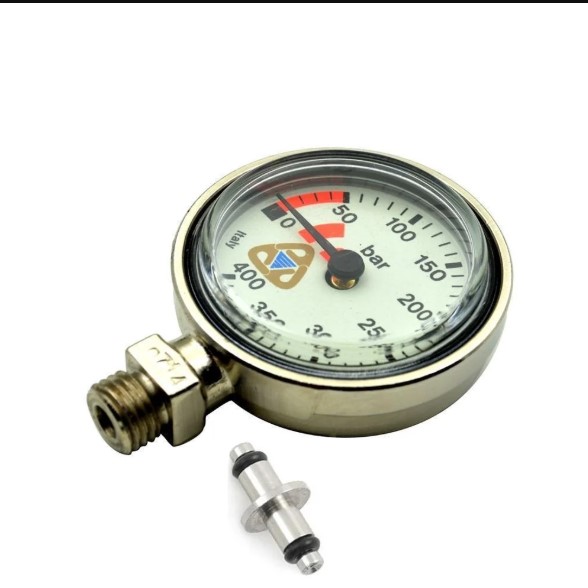
When an SPG leaks, the culprit is almost never the gauge itself or the hose. Instead, the leak nearly always originates from a tiny, double-ended metal pin called the High-Pressure (HP) swivel spool. This small brass pin sits directly inside the connection coupling between your high-pressure hose and the SPG, allowing the gauge to rotate 360 degrees so you can orient the dial face comfortably.
The HP spool has two tiny groove channels, each fitted with a miniature O-ring (typically size 003). Because this connection is subjected to the full pressure of your cylinder (up to 300 bar/4350 PSI), these tiny O-rings are under immense stress. Over time, friction from rotating the gauge, coupled with salt crystals or chlorine exposure, will wear down these O-rings, leading to a steady stream of tiny bubbles during your dive.
Maintenance and O-Ring Selection
To keep your Akuana SPG performing flawlessly, you should periodically inspect and lubricate the HP spool. If you notice bubbles escaping from the swivel connection, unscrew the hose from the gauge, gently push out the spool pin, and replace the two small O-rings.
If you are diving with Nitrox (enriched air up to 40% oxygen) or planning to use this gauge for high-oxygen decompression gases, standard nitrile (Buna-N) rubber O-rings are not suitable. Under high concentrations of oxygen, standard rubber can degrade rapidly and pose a combustion hazard. Instead, you must use high-quality fluorocarbon elastomer O-rings, commonly known as Viton O-rings. Viton O-rings are highly resistant to chemical oxidation and thermal breakdown, making them the industry standard for oxygen-clean gas service.
Field Performance: Real-World Testing and Durability
Taking this gauge out into the field reveals the tangible benefits of its heavy-duty construction. On cold, wet morning boat rides where gear is tossed into large plastic bins, you don't have to worry about this gauge getting crushed under a heavy steel tank. The lack of a rubber or plastic boot means there is nowhere for salt water to pool, which significantly cuts down on your post-dive maintenance. You simply rinse the entire unit in clean, fresh water along with your regulators, and you're done.
In the water, the lack of buoyancy in the solid brass casing is highly appreciated. Some plastic-booted gauges are slightly positive or neutral, causing them to float upwards or sway in currents. The Akuana brass SPG has a reassuring weight to it, helping it hang exactly where you clip it, even in high-current ocean passages.
Accuracy testing against a calibrated master reference gauge shows that the Italian-made beryllium copper movement inside the Akuana is incredibly precise. Throughout several pressure cycles from full cylinder pressure down to 30 bar (approx. 450 PSI), the gauge tracks the pressure smoothly, with zero "needle stickiness" or erratic jumps. This fluid, reliable tracking is essential when calculating your turn-back pressure or executing mandatory decompression stops where every bar of gas counts.
What the Diving Community Says: Trust, Support, and Global Feedback
Purchasing dive equipment online requires absolute trust in the brand's customer service, shipping speed, and product support. When evaluating Akuana Gear, we analyzed their reputation across several critical consumer trust portals, including Akuana Gear's Trustpilot Profile. Customers consistently highlight the exceptional build quality of their technical diving products, quick dispatch times, and responsive customer communication.
Beyond customer reviews, a brand's corporate policies are an excellent indicator of their reliability. Akuana offers a highly transparent Shipping Policy, providing clear tracking info and fast delivery timelines worldwide. Their customer-focused Warranty Policy covers manufacturing defects, giving you peace of mind that your purchase is protected. Furthermore, if you ever have technical questions regarding oxygen compatibility, hose compatibility, or O-ring sizes, their Customer Support Team is highly knowledgeable and easily accessible. When you are ready to complete your purchase, they offer a wide range of highly secure, encrypted Payment Methods, ensuring that your transaction is safe and hassle-free.
Detailed Video Walkthrough and Review
For a complete visual breakdown of how this gauge handles, its actual dimensions, and how it performs under real-world conditions, we highly recommend watching this detailed video review. Seeing the gauge rotated in hand and watching the luminescent face change under low-light conditions provides excellent context for how it will look in your setup:
Comparative Analysis: Akuana SPG vs. Common Alternatives
To help you choose the best instrument for your diving style, let's compare the Akuana chrome brass SPG against other common gauge setups on the market:
| Feature / Spec | Akuana Chrome Brass SPG | Typical Plastic Console SPG | Wireless Tank Transmitter |
|---|---|---|---|
| Casing Material | Chrome-Plated Solid Brass | Polycarbonate / Plastic Boot | Plastic/Metal hybrid |
| Lens Material | Tempered Mineral Glass | Acrylic (Lexan) | None (Transmits to wrist) |
| Power Source | None (Pure Mechanical) | None (Pure Mechanical) | CR2 / CR2032 Lithium Battery |
| Risk of Leaks | Low (HP Swivel Spool only) | Medium (Hidden corrosion in boot) | Low (O-ring on 1st stage port) |
| Scratch Resistance | Excellent | Poor (Scratches easily) | N/A |
| Streamlining | Excellent (No bulk, tight clip) | Poor (Heavy, drags easily) | Excellent (No hose at all) |
Why Every Diver Still Needs a Mechanical SPG
You might look at the table above and think, "If wireless transmitters are so streamlined and have no hoses, why don't I just use that?" The answer lies in risk mitigation. A wireless transmitter is a fantastic tool for recording dive profile data and planning gas consumption over time. However, because it relies on an RF signal to send pressure data to your wrist computer, it can fail. If you dive in areas with significant electromagnetic interference, or if your transmitter battery dies mid-dive, you are suddenly blind to your gas supply. Having a mechanical brass SPG as a primary instrument, or as a secondary backup clipped to your hip, guarantees that you will never have to end a dive early or guess your remaining gas in a critical situation.
Final Verdict: A Vital Addition to Your Life-Support Kit
The Akuana Scuba Diving SPG is a triumph of straightforward, heavy-duty marine engineering. By eliminating unnecessary plastic boots, selecting premium materials like a solid chrome-plated brass body and a tempered mineral glass lens, and utilizing a highly accurate Italian-made copper-beryllium Bourdon tube, Akuana has delivered a piece of equipment that you can confidently rely on for hundreds of dives. Whether you are a newly certified diver looking to upgrade your initial regulator package, an advanced diver streamlining your rig, or a deep technical explorer setting up multi-gas stage bottles, this mechanical pressure gauge is one of the most reliable and cost-effective safety investments you can make.
Ready to upgrade your diving instrument reliability?
Purchase the Akuana Scuba Diving SPG Securely TodayFrequently Asked Questions
Does this SPG include the HP hose and swivel spool pin?
The gauge itself is sold as a standalone unit, allowing you to choose your own high-pressure hose length and material (such as standard black rubber or braided Miflex). However, it does typically include the vital internal HP swivel spool pin. It is always a good practice to purchase a few spare size 003 Viton O-rings and keep them in your save-a-dive kit so you can quickly replace them at the dive site if you notice a swivel leak.
Can I use this SPG with Enriched Air Nitrox or 100% Oxygen?
Yes. Because the internal movement is housed in a robust chrome-plated brass casing and features high-grade metals, this instrument can be cleaned for oxygen service. If you plan to use it with gas mixtures containing more than 40% oxygen (such as deco gases), you must ensure that the gauge, the HP swivel spool, and the high-pressure hose are thoroughly cleaned and fitted with oxygen-compatible Viton O-rings.
Should I choose the Metric (bar) or Imperial (PSI) dial?
This entirely depends on where you dive and how you calculate your gas plans. If you live and dive primarily in the United States, you will likely want the Imperial (PSI) version, which is marked up to 5000 PSI. If you dive in Europe, Asia, or South America, or if you are training in technical diving where metric calculations are standard, the Metric (bar) version, marked up to 360 bar, is the preferred choice.
How do I prevent my mechanical gauge from getting scratched?
The tempered mineral glass face of the Akuana SPG is highly resistant to scratches from sand and light impacts. However, the best way to prevent damage is to clip the gauge tightly to your left hip D-ring using the bolt snap method outlined above. This prevents the gauge from swinging loose, knocking against rocks, or dragging along the bottom when you are in a horizontal trim position.
What should I do if my SPG starts leaking from the back plug?
If you see bubbles escaping from the rubber blowout plug on the back of your gauge casing, this indicates that the internal Bourdon tube has suffered a leak or structural failure. In this scenario, you must immediately discontinue use of the gauge and have it evaluated or replaced. Do not attempt to glue, tape, or seal the back plug, as venting this pressure is a critical safety mechanism designed to prevent the front glass face from shattering.

0 Comments