
Understanding Underwater Navigation and the Akuana Pilot 1 Dive Compass
The akuana pilot 1 dive compass is a liquid-filled, high-tilt magnetic navigation instrument engineered specifically for recreational, technical, and professional scuba divers who require dependable orientation beneath the surface. Designed with a high-contrast luminescent dial, a ratcheting directional bezel, and an integrated side-view sighting window, the PILOT 1 allows divers to maintain accurate headings, run precise search grids, and complete safe reciprocal returns without relying on electronic sensors or battery power. If you need a rugged, tilt-tolerant navigation tool that mounts cleanly on a wrist strap or technical bungee rig, the PILOT 1 represents one of the most reliable and cost-effective additions to a modern dive kit.
Navigating underwater presents physical challenges that land-based compasses simply cannot handle. Water density alters light perception, current drift pushes divers off course, and wearing thick neoprene or drysuit gloves limits tactile control. Standard terrestrial compasses fail quickly underwater because their internal cards bind up when tilted even slightly off-level. A dedicated underwater navigation unit must accommodate significant wrist tilt, remain readable in low-visibility silt or dark night dives, and withstand pressure shifts at substantial depth without forming air bubbles inside the liquid capsule.
In this guide, we evaluate every structural detail, operational mechanism, field performance metric, and mounting option of the Akuana PILOT 1. We also compare it directly against long-standing market benchmarks like the Suunto SK-8 and Scubapro FS-2 to help you decide whether this instrument belongs on your arm during your next underwater outing.
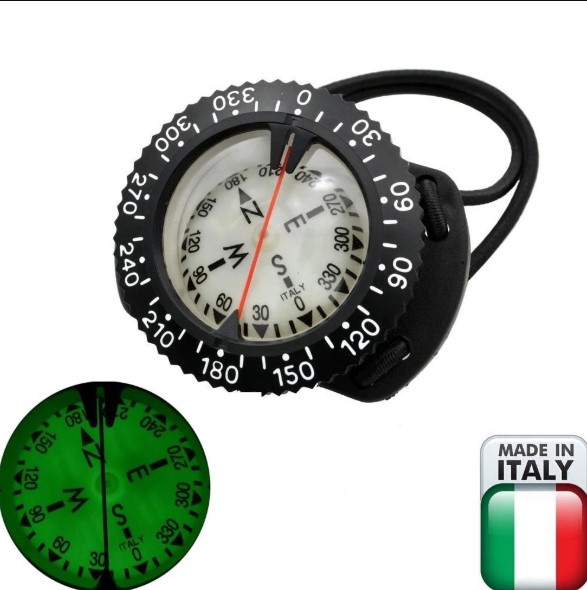
The Akuana PILOT 1 featuring its high-contrast luminescent face and dual-sighting architecture.
Your discount is automatically applied at secure checkout on the official manufacturer page.
Core Engineering and Technical Specifications
A dive compass lives or dies by its internal geometry, fluid dynamics, and card response speed. The PILOT 1 uses a oil-filled housing that dampens card oscillation, allowing the magnetic needle to settle quickly onto magnetic north even while your arm moves through the water column.
Tilt Tolerance Mechanics
One of the primary failure points of lower-tier dive compasses is a tight tilt angle tolerance. When a diver swims, maintaining a perfectly level forearm is unnatural and exhausting. If a compass housing tilts beyond its maximum allowed angle, the internal card contacts the top crystal or lower floor, locking the card in place and providing a completely false heading reading.
The PILOT 1 addresses this by incorporating a deep-well housing with an elevated pivot post. This design allows the card to tilt up to approximately 25 to 30 degrees off horizontal without binding against the capsule casing. In real-world diving, this generous tilt margin means you can check your direction while maintaining a streamlined trim position, without needing to bend your elbow upward to level out the compass face.
Bezel Detent and Tactile Resistance
The rotating bezel serves as your heading memory tool. By aligning the dual lubber marks over the north-seeking arrow, you lock in your heading for out-and-back tracks or square navigation patterns. The PILOT 1 bezel utilizes heavy ratcheting detents that produce distinct, audible clicks when turned.
This firm mechanical engagement prevents accidental bezel movement when bumping against wrecks, cave walls, or your partner's gear harness. The outer edge features deep vertical ridges designed to give you secure traction even when wearing 5mm neoprene cold-water gloves or drysuit heavy rubber gloves.
Side-Sighting Window Architecture
Top-down navigation works fine when swimming over flat sand beds, but when precise course maintenance is critical—such as aiming for a small offshore reef pin or navigating between search transects—gun-sight alignment is far superior. The PILOT 1 includes a side-reading window built directly into the lower quadrant of the outer housing.
By bringing the compass to eye level and sighting through the side window, you read your exact numerical heading degrees off the vertical card edge while simultaneously looking down your heading vector toward underwater landmarks. This reduces navigation error margins significantly during open-water swims.
| Specification Parameter | Akuana PILOT 1 Specification |
|---|---|
| Housing Material | Impact-Resistant Thermoplastic Polycarbonate |
| Internal Damping Medium | Purified Mineral Oil Suspension |
| Maximum Operational Tilt Angle | Approximately 25° to 30° |
| Reading Configuration | Top-Down Dial + Direct Line Side-Sight Window |
| Luminescence Type | Photo-Luminescent Phosphor Dial Card |
| Mounting Compatibility | Standard Elastomer Wrist Strap / Elastic Bungee Mount |
| Bezel Mechanism | 360° Ratcheted Bezel with Dual Reciprocal Indicators |
Mounting Dynamics: Wrist Strap vs. Technical Bungee Rig
How you secure a compass to your body directly impacts how often you actually look at it during a dive. The PILOT 1 offers flexibility in mounting, catering to both traditional recreational divers and technical diving styles.
Standard Elastomer Wrist Strap
The factory configuration includes a flexible elastomer strap designed to wrap around your wrist or forearm. It holds the compass body securely against skin or exposure suits. However, all traditional rubber straps suffer from suit compression. As you descend, the ambient water pressure compresses the neoprene of your wetsuit, reducing its thickness. This physical change causes standard wrist straps to slacken, allowing the compass module to rotate under your forearm unless manually tightened at depth.
The Technical Bungee Solution
For technical divers, cave explorers, and cold-water enthusiasts, swapping the standard rubber strap for elastic bungee cords is standard practice. The modular outer casing of the PILOT 1 is designed to accept elastic shock cord threading through dedicated strap slots.
Bungee mounts offer a distinct advantage: depth compensation. Because shock cord remains under continuous tension, it automatically contracts as your wetsuit or drysuit sleeve compresses during descent. The compass remains tight against your arm at 100 feet just as securely as it did on the dive boat deck. Furthermore, bungee-mounted instruments are far easier to slip on and off over bulky drysuit gloves single-handedly.
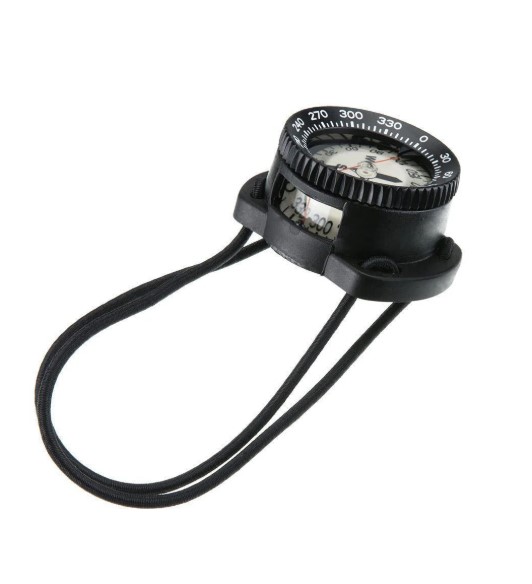
Close-up view of the PILOT 1 bezel detents and side sighting port.
Real-World Underwater Field Testing
To evaluate the PILOT 1, we tested the instrument across three distinct environments: low-visibility lake conditions, dark night dives on a saltwater reef, and a structured search-and-recovery grid swim.
Low-Visibility Navigation and Silt Management
In low-visibility freshwater conditions (3 to 5 feet of vis), navigating without visual landmark cues forces you to rely entirely on your instruments. During 90-degree square search patterns, the PILOT 1 bezel clicks were clearly audible and felt easily through neoprene gloves. The high-contrast black markings over the white card allowed immediate bearing checks without holding the compass right up to the mask face.
Night Diving and Luminescence Performance
Photo-luminescent dials absorb light energy from dive torches and emit a soft glow in dark environments. Charging the PILOT 1 face with a standard 1000-lumen LED torch for 10 seconds produced a readable glow that lasted for approximately 25 to 30 minutes before needing a brief recharge burst.
Unlike tritium-vial compasses that emit constant low-level light, or electronic dive computers with battery-draining backlights, photo-luminescent card faces present zero risk of electronic failure or battery depletion. The numbers remain crisp, and the directional arrow remains clear against the card background.
Reciprocal Heading Accuracy
Swimming an out-and-back transect line requires taking an initial heading (for instance, 120 degrees outbound), setting your bezel index marks over the needle, and then swimming the reciprocal bearing (300 degrees inbound) by aligning the tail of the compass needle between the dual tail indicators.
During a 150-foot outbound swim over open sand, turning 180 degrees using the PILOT 1 reciprocal indicators brought us back within 3 feet of our origin anchor line. This degree of accuracy is critical when returning to an anchor line in low visibility to complete safety stops safely.
Head-to-Head Comparison: Akuana PILOT 1 vs. Top Competitors
To understand where the PILOT 1 stands in the current scuba equipment market, we must evaluate it against three established compass models widely used in the industry: the Suunto SK-8, the Scubapro FS-2, and the Mares Handy.
Akuana PILOT 1 vs. Suunto SK-8
The Suunto SK-8 has long been regarded as an industry baseline. However, the PILOT 1 delivers comparable tilt performance and bezel retention while holding a distinct advantage in price-to-performance ratio. While the SK-8 features exceptional tilt margins (up to 30 degrees), its replacement modules are noticeably more expensive. The PILOT 1 provides equal mechanical stability, a clear side window, and easy bungee adaptation at a lower cost entry point.
Akuana PILOT 1 vs. Scubapro FS-2
The Scubapro FS-2 offers an impressive tilt angle (up to 35 degrees) due to its floating magnet calibration. However, the FS-2 housing is significantly bulkier on the wrist. Divers who prefer a streamlined profile often find the FS-2 prone to snagging on BC shoulder straps or line reels. The PILOT 1 maintains a compact wrist profile while offering near-equivalent tilt resistance.
Akuana PILOT 1 vs. Mares Handy
The Mares Handy is an entry-level navigation unit. While compact, the Mares unit suffers from narrower tilt tolerances. If your arm tilts slightly during a kick stroke, the Mares needle can stick against the casing top. The PILOT 1 outperforms the Mares Handy in tilt tolerance, ratcheting bezel feel, and luminescence retention.
| Feature / Spec | Akuana PILOT 1 | Suunto SK-8 | Scubapro FS-2 | Mares Handy |
|---|---|---|---|---|
| Tilt Tolerance | ~25° - 30° | ~30° | ~35° | ~15° - 20° |
| Side Read Port | Yes (High Vis) | Yes | Yes | No (Top Only) |
| Bungee Ready | Yes | Requires Boot Adapter | Requires Boot Adapter | No |
| Bezel Feel | Firm Mechanical Clicks | Smooth / Medium Clicks | Firm Friction Clicks | Light Friction |
| Overall Profile | Low-to-Medium Wrist Profile | Medium Profile | High Profile (Bulky) | Compact |
Community Insights and Independent Diver Opinions
When assessing underwater lifesupport or navigation gear, looking beyond marketing claims is vital. Checking verified community discussions gives a clear view of long-term durability and operational real-world performance.
Reddit Scuba Community Feedback
In community discussions regarding optimal navigation setups on Reddit's Scuba Forum, experienced divers consistently emphasize three main priorities: high tilt tolerance, bungee conversion capability, and robust bezel construction. Experienced divers often warn against relying on digital compasses built into dive computers as primary navigation tools due to battery drain, screen cluttered menus, and slow refresh rates. The consensus leans heavily toward standalone physical magnetic compasses like the PILOT 1 for primary direction-keeping and backup navigation.
YouTube Field Demonstration Analysis
Video evaluation across practical field tests in the Akuana Equipment YouTube Review highlights how smoothly the liquid card stabilizes after sudden arm movements. Video footage confirms that the internal mineral oil dampening stops needle oscillation in under 1.5 seconds after a sudden 90-degree wrist turn, allowing rapid course acquisition during swim cycles.
Watch real-world handling and card responsiveness in action.
Trustpilot Brand Feedback Assessment
Akuana Gear maintains high customer satisfaction scores verified via Akuana's Official Trustpilot Page. Verified buyers point out consistent build quality, rapid fulfillment times, and responsive customer communication regarding order tracking and accessory queries.
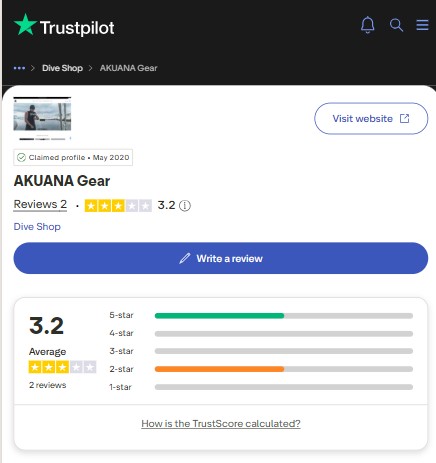
Verified customer satisfaction scores on Trustpilot for Akuana underwater gear.
Understanding Operational Guidelines and Technical Documentation
According to the official product documentation available via the Official Technical Manual on Scribd, proper care and handling ensure that liquid-filled compass capsules perform consistently over many dive seasons without developing internal bubbles or structural leaks.
Preventing Bubble Formation in Liquid Capsules
A common issue with underwater compasses is the formation of internal air bubbles. These bubbles occur when the internal mineral oil expands or contracts due to extreme temperature changes or rapid ambient pressure drops, or when the expansion membrane flexes beyond design tolerances.
To prevent bubble formation:
- Avoid Direct Thermal Stress: Never leave your dive kit bag or compass sitting inside a hot car trunk or direct summer sunlight on a boat deck. High temperatures cause the mineral oil to expand, stretching the seal diaphragms.
- Avoid High-Altitude Flight Traps: When flying to dive destinations, carry your compass in your carry-on luggage inside a pressure-equalized environment rather than exposed unpressurized hold spaces whenever possible.
- Rinse Thermal Extremes Gradually: After cold water diving, do not throw the compass into scalding hot rinse tanks. Use tepid freshwater.
Maintaining the Bezel Ring Assembly
Salt crystal build-up and fine beach sand are the primary causes of bezel sticking. When salt water dries inside the ratcheting track under the bezel, micro-crystals lock the detent springs in place.
After every salt water dive, submerge the PILOT 1 in clean, warm fresh water for 15 minutes. While submerged, rotate the bezel clockwise and counter-clockwise 10 to 12 full rotations. This action flushes out trapped salt particles and fine sand, preserving crisp click detents for long-term use.
Who Should Buy the Akuana PILOT 1 Dive Compass?
While every diver should carry an analog compass for safety, the PILOT 1 is specifically suited for certain diving styles:
1. Open Water and Advanced Recreational Divers
If you're progressing past basic certification into wreck diving, deep diving, or night navigation, the PILOT 1 gives you a simple, reliable tool to manage underwater navigation confidently. Its side-sight window makes taking land bearings from the surface before descending straightforward.
2. Technical and Cave Diving Community
Technical divers who demand bungee compatibility and reliable tilt tolerance will appreciate the PILOT 1 design. It mounts cleanly alongside backup timer depth gauges or primary bottom timers without adding unnecessary bulk to your arm profile.
3. Underwater Photography & Video Operators
Shooting underwater media requires keeping your hands free and your mind focused on camera settings. The bright phosphorescent face and wide view angle of the PILOT 1 allow quick glance checks on headings without disrupting camera positioning.
Manufacturer Warranty, Support, and Ordering Policies
Purchasing direct from official distribution channels ensures full warranty coverage and access to authentic replacement parts, strap accessories, and mounting hardware.
- Global Shipping Policies: Order processing and international dispatch details are detailed under the official Akuana Shipping & Support Page, ensuring tracked delivery to major dive destinations worldwide.
- Warranty Safeguards: Akuana provides clear product coverage terms protecting against material defects and manufacturing flaws, accessible through their Warranty & Terms of Service.
- Secure Ordering & Payment Options: Direct orders placed through the checkout portal support encrypted transactions with full buyer security via Akuana Official Secure Payment Gateways.
Final Verdict: A Reliable, Highly Functional Navigation Tool
The akuana pilot 1 dive compass delivers exceptional real-world performance where it matters most: deep tilt tolerance, crisp ratcheting bezel control, clear luminescent dial legibility, and easy bungee conversion. By skipping fragile electronic components in favor of robust fluid-dampened mechanical construction, the PILOT 1 offers reliable underwater orientation for both entry-level recreational divers and experienced technical divers alike.
Locks in current pricing and automatic promotional discounts directly on the official manufacturer checkout page.
Frequently Asked Questions
Does the Akuana PILOT 1 work in both Northern and Southern hemispheres?
The PILOT 1 is balanced for Northern Hemisphere (NH) magnetic zones, which covers North America, Europe, Asia, and northern tropical dive locations. If diving deep in the Southern Hemisphere (e.g., southern Australia or southern South America), magnetic dip angle changes can alter card tilt dynamics slightly. Based on available information, standard NH balancing handles most popular equatorial and northern dive sites perfectly.
How do I switch the standard wrist strap to a bungee mount?
Switching to a bungee rig is simple. Pop out the retaining bar pins or unthread the factory elastomer strap from the outer housing slots. Feed 3mm or 4mm marine-grade elastic shock cord through the side mounting channels, tie two secure overhand knots or figure-eight knots at your preferred tension setting, and trim the excess cord ends with a flame seal to prevent fraying.
Can I use the PILOT 1 as my primary compass for search and recovery training?
Yes. The combination of a top-reading dial with reciprocal tracking marks and a side-sighting window makes the PILOT 1 an excellent choice for instructional navigation courses, rescue diver search grid drills, and scientific underwater surveying transects.
What should I do if a small bubble appears inside the compass casing?
A microscopic bubble smaller than a matchhead that appears in extreme freezing temperatures and disappears upon warming is normal fluid compression behavior. However, if a large bubble remains at room temperature, it indicates fluid loss or diaphragm failure. Avoid storing the compass near heat sources, and contact Akuana Support if a persistent bubble impairs needle rotation.

0 Comments