
ASIWO Mako (Manta S) Review: Hands-On Field Test and Buying Guide
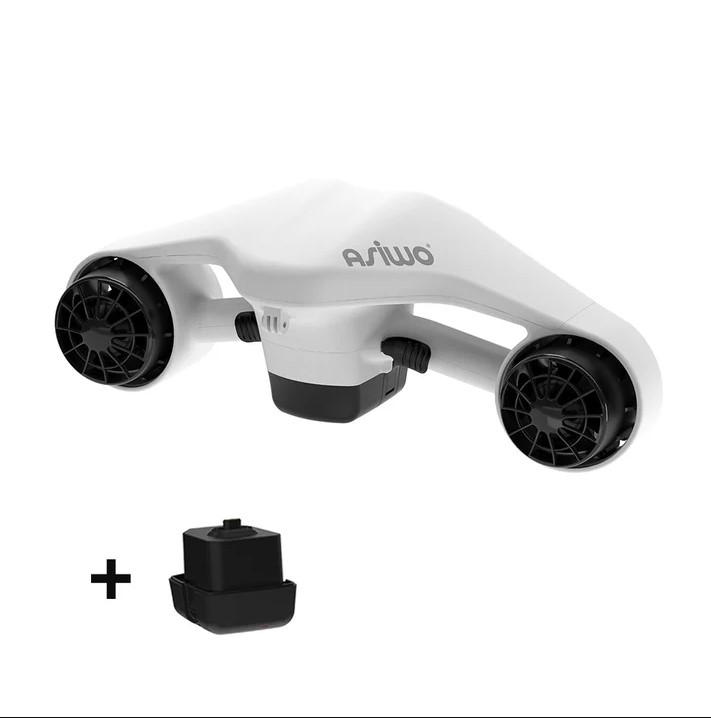
The ASIWO Mako (Manta S) is a compact, dual-propeller underwater scooter built for target depths up to 98 feet (30 meters). It's designed for recreational divers, snorkelers, and underwater photographers who want to cover more reef without burning through their air tank or exhausting their legs. Instead of dragging you along with a single central propeller that twists your wrist, the Manta S relies on two symmetric thrusters mounted on a wide frame. If you're looking for an agile, airline-friendly DPV (Diver Propulsion Vehicle) that doesn't cost as much as a full commercial tech rig, this model is one of the most practical options on the market today.
In this guide, we'll break down the mechanical layout, real-world battery endurance, handling under current, air travel compliance, and long-term maintenance. Whether you're planning your next tropical reef vacation or simply want to extend your underwater photo sessions, this review covers everything you need to know before making a purchase.
*An automatic discount is applied at checkout when using the official link above. Purchases are handled securely on the manufacturer's official store.
What Makes the ASIWO Mako (Manta S) Different?
Most entry-level sea scooters utilize a single propeller encased in a rear cage. While cheap to produce, single-motor designs suffer from rotational torque. As the propeller spins clockwise, physics dictates that the scooter frame wants to twist counter-clockwise in your hands. Over a 30-minute dive, fighting that constant roll fatigues your forearms and wrists.
The ASIWO Mako solves this by running counter-rotating dual thrusters spaced approximately 19 inches apart. Because the motors spin in opposite directions, torque is cancelled out entirely. The pull against your hands is straight forward, allowing you to guide the scooter with minimal grip pressure. You can hold it steady with one hand while managing your dive computer or adjusting your camera settings with the other.
Key Hardware Specifications
Before putting gear into saltwater, it helps to examine the verified manufacturer specifications from the official Manta S user manual:
- Total Thrust Force: Dual brush-less motors producing up to 19.8 lbs (9 kgf) of combined thrust.
- Speed Levels: 3 gear selections (Low: ~1.8 mph / 0.8 m/s, Medium: ~2.7 mph / 1.2 m/s, High: ~3.3 mph / 1.5 m/s).
- Maximum Rated Depth: 30 meters (98 feet), making it suitable for Open Water divers staying within recreational limits.
- Battery Configuration: Removable 126Wh Lithium-ion battery module per pack (often bundled in two-battery packages).
- Run Time: 35 to 45 minutes of continuous gear operation per battery pack, depending on speed selection and payload weight.
- Unit Weight: Approximately 7.7 lbs (3.5 kg) with battery installed, making it lightweight for shore entries or boat ladder climbs.
- Buoyancy Profile: Slightly positive in saltwater; near-neutral in calm freshwater.
- Camera Compatibility: Integrated 1/4"-20 threaded mount point and standard action camera bracket on the top housing.
Underwater Ergonomics and Handling in Currents
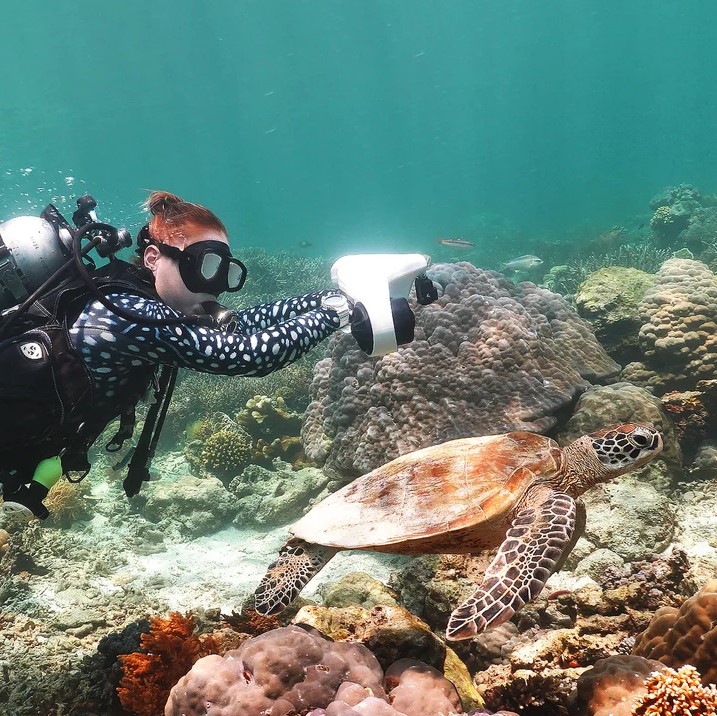
When you grip the Manta S underwater, the first thing you notice is the handle angle. The grips are canted slightly inward, which matches the natural angle of your wrists when your arms are extended out front. This angle puts your shoulders in a relaxed position rather than locking your elbows out straight.
Operating the thrusters requires pressing two safety triggers simultaneously. If you release either hand, the motors immediately power down. This dual-trigger safety system prevents the scooter from shooting off into deep water or running into reef structures if you accidentally lose your grip. While some divers prefer a trigger-lock feature for long cruises, forced dual-hand activation keeps the unit under control at all times.
Navigating Headcurrents and Surge
In calm reef conditions, the lowest speed setting is plenty fast to keep you gliding past coral heads without frightening sea life. However, when returning to a dive boat against a 1-knot headcurrent, kicking with fins burns oxygen quickly. Switching the Manta S to its high gear (~3.3 mph) supplies enough pull to tow a fully gear-laden diver without requiring heavy kicking.
Because your legs aren't beating frantically, your heart rate remains low, which drastically reduces your breathing rate. Divers regularly report consuming 15% to 25% less tank air over the course of a dive simply because the scooter does the physical labor against current and surge.
Battery System and Airline Travel Compliance
One of the largest hurdles when purchasing an underwater DPV is airline transport. The Federal Aviation Administration (FAA) and international aviation bodies (IATA) enforce strict regulations regarding lithium-ion batteries in checked and carry-on luggage:
- Batteries under 100 Watt-hours (Wh) are permitted in carry-on bags without special approval.
- Batteries between 101Wh and 160Wh are allowed in carry-on baggage with airline approval (limit 2 spare batteries per passenger).
- Batteries exceeding 160Wh are strictly prohibited on passenger aircraft.
The ASIWO Mako (Manta S) uses a modular 126Wh lithium-ion battery pack. Because it falls under the 160Wh threshold, you can legally take it on commercial flights inside your carry-on bag. You must disconnect the battery from the scooter housing and carry the battery inside the cabin; the scooter frame itself can be stowed in checked baggage if needed.
| Feature / Metric | ASIWO Mako (Manta S) Specs | Why It Matters for Divers |
|---|---|---|
| Battery Capacity | 126 Wh (25.2V, 5.0Ah) | Fits within IATA limit (160Wh max) for carry-on luggage on commercial flights. |
| Top Speed | 1.5 m/s (~3.3 mph) | Saves leg strength and lowers air consumption against ocean currents. |
| Depth Rating | 30 Meters / 98 Feet | Covers standard recreational Open Water dive profiles. |
| Weight | 7.7 lbs (3.5 kg) | Easy to carry across shore entries, rocks, and boat decks. |
| Charging Time | Approx. 2.5 to 3 hours | Quick top-off between morning and afternoon dives. |
Community Feedback and Verified User Experiences
To provide a well-rounded evaluation beyond official spec sheets, we examined real customer experiences across multiple independent platforms.
Trustpilot Reviews
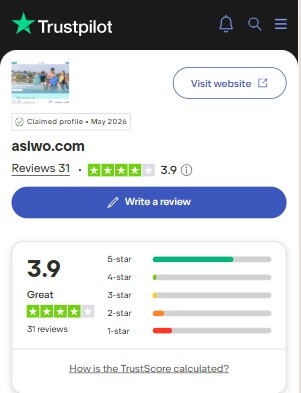
ASIWO holds an active reputation profile on Trustpilot. Overall feedback highlights responsive customer support and fast replacement turnarounds for accessories. Users frequently praise the build quality relative to the price tag, emphasizing that the physical plastics resist salt degradation and sun exposure when properly rinsed after use.
Reddit Discussions
In community forums like Reddit, divers discuss practical field experiences with the unit. A dedicated thread on Reddit's DivingGearReview board covers real-world runtimes and depth performance. Key takeaways from real owners include:
- Buoyancy Control: Snorkelers note that if you let go of the scooter, it floats slowly toward the surface, making it easy to retrieve. Scuba divers in freshwater sometimes add small ankle weights or camera attachments to balance out the frame for neutral buoyancy at depth.
- Battery Handling: Users stress that the double O-ring seal around the battery compartment must be kept free of sand grains. A single strand of hair or speck of grit on the sealing ring can compromise watertight integrity at 50+ feet depth.
- One-Handed Operation: While safety features require two hands to start, experienced users note you can hold both triggers with one hand by sliding your fingers over the switch bridge, though dual-grip provides superior control.
Video Field Test Demonstration
To see how the unit moves through open water and handles speed adjustments, watch this detailed video review:
Maintenance and Maintenance Checklist for Saltwater Use
Saltwater is unforgiving on electrical connections, motor bearings, and silicone seals. To ensure your scooter survives hundreds of dives without water ingress or corrosion, follow this maintenance protocol:
1. Immediate Fresh Water Rinse
Never let saltwater dry on the unit. As salt water evaporates, it leaves behind crystalline salt deposits. When you pull the trigger switches later, those sharp crystals scratch plastic tracks and tear thin rubber dust boots. Submerge the entire unit in a clean freshwater rinse tank for at least 15 minutes after exiting the ocean. While submerged, pull the trigger levers several times to flush salt out of the switch housing.
2. O-Ring Inspection and Lubrication
Before installing a fresh battery, inspect the main compartment seal:
- Remove the O-ring carefully using a rounded plastic tool (never use a sharp metal screwdriver).
- Wipe the O-ring clean using a lint-free microfiber cloth.
- Inspect for cracks, compression set, or debris.
- Apply a thin film of silicone grease. The O-ring should look wet, but shouldn't have clumps of grease that attract sand particles.
- Wipe down the mating groove on the scooter body before re-seating the ring.
3. Battery Storage Protocol
Lithium-ion batteries dislike being stored fully depleted or fully charged for long periods. If you're storing your Manta S for more than two weeks between dive trips, charge the battery to roughly 50% to 60% capacity. Store the battery in a cool, dry room away from direct sunlight. Never leave the battery inside the scooter compartment during prolonged storage.
Official Warranties, Shipping, and Customer Support
When buying underwater electronics, manufacturer backing is essential. Purchasing through official distribution channels ensures you get direct support if a component needs servicing.
- Warranty Policy: The product comes backed by the manufacturer's limited coverage scheme outlined in the official warranty terms. This covers manufacturing defects on motors, internal circuit boards, and chargers.
- Shipping Options: Standard and expedited dispatch parameters are managed via the official shipping policy page, providing tracked delivery direct to your home prior to your vacation.
- Customer Support: Technical support queries, spare battery orders, and service requests can be submitted directly through the official customer support portal.
- Checkout & Payment Options: Orders placed via the official secure payment gateway accept major credit cards, Shop Pay, and standard digital payment processing for consumer protection.
Ready to Upgrade Your Underwater Mobility?
Get the genuine ASIWO Manta S package bundled with spare batteries for longer reef exploration. Click below to secure current factory direct pricing with promotional discounts applied automatically at checkout.
Buy Official ASIWO Mako (Manta S) with Discount →Frequently Asked Questions
Is the ASIWO Mako (Manta S) safe for beginners and kids?
Yes. The dual-trigger safety mechanism requires active pressure from both hands to keep the thrusters spinning. If a swimmer panics or drops the handle, the scooter shuts off instantly. In addition, the thruster cages feature tight intake grilles that keep fingers, hair, and clothing away from the spinning fan blades.
Can I use this underwater scooter for scuba diving, or is it only for snorkeling?
It is fully rated to a depth of 30 meters (98 feet), making it completely safe for recreational scuba diving within Open Water limits. It is equally popular among snorkelers who want to travel across shallow bays without getting tired.
What happens if the battery dies while I'm far from shore or the boat?
The scooter weighs less than 8 pounds and features slightly positive buoyancy in saltwater. If the battery runs flat, it floats naturally near the surface rather than sinking into deep water. You can tow it behind you by its shoulder strap or hold it under one arm while swimming normally using your fins.
Can I mount a GoPro or action camera to the scooter?
Yes. The top housing features an integrated action camera mount compatible with standard GoPro brackets and threaded tripod adapters. This placement allows you to capture smooth forward footage without holding a separate camera tray.
How long does the battery take to charge between dives?
A completely drained battery takes approximately 2.5 to 3 hours to reach full capacity using the included wall charger. Many divers purchase a bundle with two batteries so one pack can charge on the boat while using the second in the water.
Is this sea scooter compliant with TSA and airline carry-on regulations?
Yes. The 126Wh lithium-ion battery fits within the 100Wh to 160Wh airline allowance for carry-on baggage. Be sure to detach the battery from the body and carry it inside your cabin hand luggage during travel.
How fast does the ASIWO Mako travel compared to fin swimming?
Average recreational fin swimming speeds range between 0.8 to 1.2 mph. The Manta S reaches up to 3.3 mph (1.5 m/s) on its top speed setting, allowing you to travel roughly three times faster than standard relaxed swimming while conserving your air supply.

0 Comments