Getting Straight to the Point: Is the ASIWO U1 Worth Your Time?
The asiwo u1 is a highly versatile 2-in-1 underwater propulsion system engineered specifically for recreational divers, avid snorkelers, and stand-up paddleboard (SUP) enthusiasts who want to transition seamlessly from deep-water exploration to motorized surface cruising. Its standout feature is its modular utility: you can swap it from a dual-handle diving thruster to an electric paddleboard or kayak fin in under two minutes without using a single tool. If you are looking for a reliable, multi-use water companion that saves your energy during long swims, helps you fight unexpected currents, and doubles as a motorized surface drive, this modular scooter is absolutely worth your consideration.
Technical Specifications: A Deep Look at the Numbers
Understanding the physical limits and mechanical capabilities of your gear is crucial before you get into the water. We have compiled the essential engineering specifications of the U1 Universal Underwater Scooter directly from the engineering schematics to give you an honest look at what this machine can do.
Specification Parameter
Official Rating / Measurement
Maximum Depth Rating
30 Meters (Approximately 98 Feet)
Motor Type
High-torque Brushless DC (BLDC) Thruster
Thrust Capability
Up to 12.5 kgf (Kilograms of Force) / 27.5 lbs of thrust
98Wh (Airline Compliant) or 115.5Wh High-Capacity Lithium-ion
Charging Duration
Approximately 2.5 to 3 Hours using the official smart charger
Operational Run Time
Up to 65 minutes on Low speed; ~20-25 minutes on High speed
Total Dry Weight
Approximately 3.2 kg (7 lbs) with battery installed
Wireless Remote Frequency
2.4 GHz (Used strictly during SUP/Kayak surface operations)
These technical metrics reveal that the asiwo u1 strikes a deliberate balance between portage weight and functional power. The dry weight of 7 pounds makes it remarkably easy to carry down a rocky beach, pack into a gear bag, or haul up onto a boat deck. However, don't let the lightweight build fool you: the brushless motor puts out up to 27.5 pounds of raw thrust, which is more than enough to drag an adult diver with a full set of gear through the water without struggle.
Understanding Brushless DC Motor and Thrust Dynamics
The heart of the asiwo u1 is its brushless DC motor. If you are not familiar with the mechanical difference, brushless motors are far superior for underwater propulsion than older, brushed variants. They eliminate physical brushes inside the housing, which drastically reduces mechanical friction, minimizes heat generation, and prevents the internal wear that eventually ruins cheaper water scooters.
Because underwater equipment relies entirely on the surrounding water for thermal cooling, managing heat is critical. When the motor is running at full throttle (Gear 3), it draws significant electrical current. The casing of the U1 acts as a giant heat sink, transferring heat away from the stator and rotor directly into the ocean or lake water. This is highly effective, but it also means you should never run the scooter at high speed dry on land. Running it out of the water removes this critical liquid cooling loop, which can quickly overheat the internal dynamic shaft seals and cause water leaks down the road.
The three-speed transmission allows you to customize your speed and manage your battery life.
Gear 1 (0.8 m/s): This speed is perfect for relaxed reef exploration, snorkeling along a rocky shoreline, or teaching kids how to navigate in shallow water. It places minimal electrical load on the battery pack, allowing you to maximize your dive time.
Gear 2 (1.2 m/s): This is your go-to cruising speed. It is fast enough to help you swim against a mild, steady current without tiring out your legs, yet it still preserves enough battery for a long afternoon session.
Gear 3 (1.5 m/s): At full speed, the thruster pulls you forward with noticeable force. This mode is excellent for quickly crossing deep channels, chasing down a dive buddy, or motorizing a paddleboard on flat water. The trade-off is high energy consumption, which empties the battery much faster.
The 2-in-1 Modular Ecosystem: Diver Propulsion vs. Paddleboard Motorization
Most sea scooters on the market are single-purpose machines. Once your dive is finished, the scooter sits in your gear bag gathering dust. The asiwo u1 stands out because of its clever, tool-free modular design.
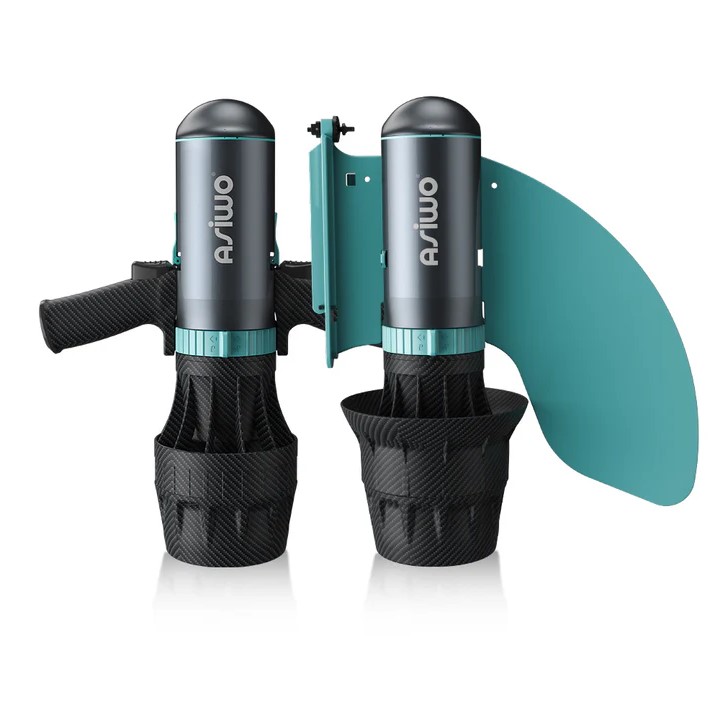
When configured as a diver propulsion vehicle (DPV), the central motor pod is locked into a rugged, dual-handle frame. The frame features a dual-trigger safety mechanism. To keep the thruster running, you have to squeeze both triggers simultaneously. If you let go of either handle, the motor cuts power immediately. This safety feature prevents the scooter from running away from you if you drop it or lose your grip, which is a real danger with cheap single-trigger units.
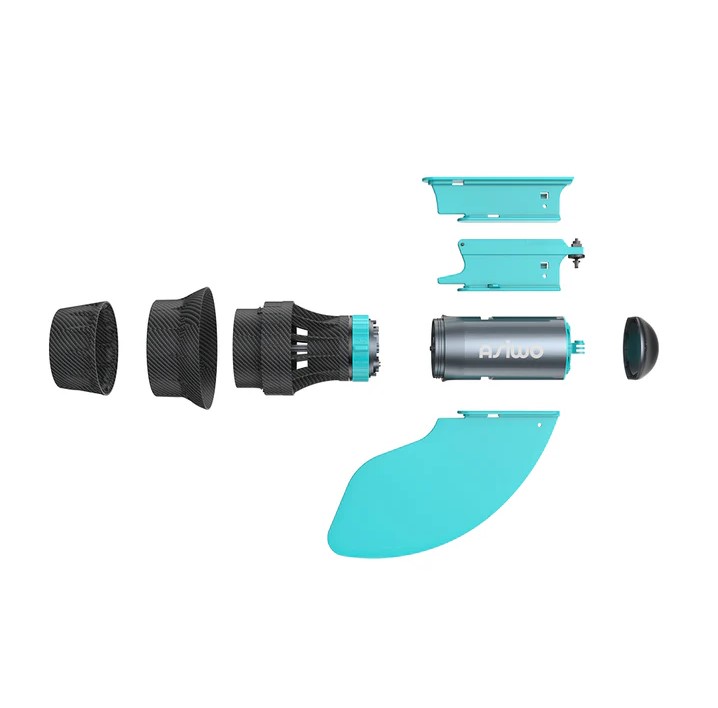
To convert the scooter into a paddleboard or kayak motor, you simply flip open the quick-release lock on the main frame, slide the central motor pod out, and insert it into the included fin box adapter. This adapter is designed to fit standard US-style fin boxes and slide-in fin tracks, making it compatible with almost any modern inflatable or rigid SUP.
Once mounted to the bottom of your paddleboard, you control the motor using the wireless remote control. The remote can be strapped to your wrist or clamped directly onto your paddle shaft. It uses a 2.4 GHz radio frequency signal to communicate with the motor receiver located on the fin plate. Because radio waves do not travel well through water, this wireless setup is designed strictly for surface paddleboarding and kayaking, where the receiver is kept near or above the surface. If the motor is submerged more than a few inches, the wireless signal will drop out, which acts as an automatic safety shutoff if your board flips over.
This dual-use capability is widely discussed in community forums. On the Reddit ElectricSUP discussion, users share their experiences using the U1 as an electric fin. One of the main takeaways from these real-world discussions is that while a single motor provides a steady, relaxed cruising speed of around 3 to 4 miles per hour on a paddleboard, heavier riders or those facing strong headwinds will experience a slower pace. It serves as an excellent paddle-assist tool, allowing you to cover twice the distance with half the physical effort.
Battery Engineering, Safety, and Airline Compliance
When buying an electric water vehicle, the battery is always the most expensive and critical component. The asiwo u1 offers two main battery options, which are covered in detail in the Official ASIWO U1 User Manual.
The standard 98Wh lithium-ion battery pack is specifically designed to comply with Federal Aviation Administration (FAA) and international airline regulations regarding carry-on lithium batteries. Most airlines limit passenger carry-on batteries to a maximum of 100Wh. Because the 98Wh battery sits just under this limit, you can pack it in your carry-on bag and fly with it to your favorite dive destinations around the world. The larger 115.5Wh high-capacity battery pack provides about 15% more runtime, but you should check with your airline before trying to fly with it, as it exceeds the standard 100Wh limit.
To prevent water from entering the battery compartment, the U1 uses a dual O-ring sealing system. These seals must be maintained with absolute care. If even a single grain of sand, hair, or salt crystal gets trapped on the O-ring surface, it can break the seal under the water pressure of a deep dive, leading to a flooded battery compartment.
Here is our expert guide on how to prevent battery flooding:
Inspect before every dive: Open the battery hatch and inspect the orange silicone O-rings. Look for any cuts, flattening, or debris.
Clean the seals: Use a lint-free microfiber cloth to wipe down both the O-rings and the receiving groove inside the scooter body. Never use a sharp metal tool like a flathead screwdriver to remove the O-rings, as this can scratch the plastic channels and cause permanent leaks.
Lubricate with silicone grease: Apply a thin, even layer of pure marine silicone grease to the O-rings. The grease should make them look shiny, but there shouldn't be any thick globs of grease left behind, as excess grease can actually trap dirt and debris.
Secure the latch: Push the battery door down firmly and ensure the dual locking latches are fully clicked into place.
Another critical point of failure is galvanic corrosion on the battery contacts. When two different metals are exposed to saltwater and an electrical current is passed through them, they corrode rapidly. If you plug your charger into a charging port that still has saltwater residue on it, the electrical current will cause rapid electrolysis, instantly stripping the protective gold plating off the contacts and ruining the charger connection. Always rinse the entire scooter, especially the battery contacts, with fresh water and dry them completely before plugging in the charger.
In-Depth Look at the Official ASIWO U1 User Manual
The Official ASIWO-U1 User Manual contains essential warnings that are often overlooked by first-time users. Ignoring these rules can void your warranty or cause dangerous accidents.
First, the manual stresses that the propeller shroud is a vital safety feature, not just a cosmetic cover. The mesh grilles are designed to prevent fingers, seaweed, and floating debris from getting caught in the high-speed rotor blades. If you have long hair, you must tie it back securely in a bun or wear a swim cap before using the scooter. The powerful intake suction can easily pull loose hair into the impeller, which can cause painful injuries and damage the motor.
Second, the manual highlights how to properly store the lithium-ion batteries. You should never store your battery completely dead, nor should you leave it sitting at 100% full charge for months at a time. The optimal storage charge level is between 50% and 60% of capacity. Storing a completely dead lithium battery can cause it to fall into a "deep discharge" state, which permanently damages the chemistry and prevents it from holding a charge in the future. If you are packing the scooter away for the winter, make sure to charge the battery to about half capacity and recharge it every three months to keep it healthy.
Finally, the manual includes a troubleshooting matrix for the LED indicator lights on the handle bracket:
Solid Green Light: The battery is fully charged and the motor is operating normally.
Flashing Yellow Light: The battery charge is dropping below 30%. You should start heading back to shore or your boat.
Flashing Red Light with Motor Cut-off: The battery is critically low (below 10%), or the motor has entered a thermal overload state due to high heat, or the propeller is jammed by seaweed. If this happens, immediately release the triggers, head to safety, and inspect the impeller for blockages once you are out of the water.
Analyzing Verified Customer Feedback: Trustpilot and Real-World Usage
When investing in a sea scooter, it's always smart to see how it holds up in the real world over months of regular use. The Trustpilot User Reviews Screenshot highlights the actual experiences of customers who have bought and used ASIWO equipment.
Looking closely at these customer experiences, a few consistent themes stand out:
Excellent customer support responsiveness: Several reviewers mention that when they had questions about battery maintenance or pairing the wireless remote, the support team responded quickly and walked them through the process step-by-step.
Rugged and durable build quality: Users appreciate that the plastic housing doesn't feel cheap or brittle, holding up well even after being scraped against sand and rocks on the beach.
Easy handling for kids and beginners: The balanced weight and dual-trigger design make it easy for younger swimmers to control without feeling overwhelmed by the motor's power.
However, some users note that switching the scooter back and forth between the dive handle setup and the SUP fin mount takes a bit of practice. During your first few tries, aligning the lock pins can feel a bit snug, especially if there is sand trapped inside the mounting slots. Rinsing the scooter in fresh water before taking it apart makes the transition much smoother.
Detailed Video Walkthrough: See the Thruster in Action
For a visual look at how the scooter moves underwater and how to convert it to a paddleboard motor, check out this comprehensive YouTube review:
In this video review, you can see how the dual triggers respond instantly to the user's touch, and you can get a clear sense of the speed difference between Gear 1 and Gear 3. Pay close attention to how the rider handles the scooter when diving down to depth. The neutral buoyancy helps you maintain control underwater without constantly pulling you up or dragging you down.
Buying Guide: Shipping Policies, Warranties, and Customer Support
When you are ready to buy your scooter, make sure you understand the seller's policies and checkout options. This ensures a smooth purchase and protects you if you run into any issues with your gear.
Shipping Policies and Logistics
According to the Official Shipping Policy, scooters are shipped using reliable carriers to ensure safe delivery. Because the package contains a large lithium-ion battery, it must be shipped via ground transportation, which can take slightly longer than standard air shipping. Make sure to plan your purchase at least 1 to 2 weeks before any major dive trips to ensure your gear arrives in time.
Warranty Coverage and Exclusions
The Official Limited Warranty Policy provides coverage for manufacturer defects on the motor, battery pack, and electronics. However, you must understand the exclusions:
Water damage due to user error is not covered: If you forget to secure the battery latches, omit the O-ring maintenance, or close the hatch on a stray hair, any resulting water damage to the battery or electronics is considered user error and will not be covered under warranty.
Physical impact damage is excluded: Dropping the scooter onto a concrete dock or hitting a shallow coral reef at full speed is not covered under the manufacturer's warranty.
Customer Support Access
If you have questions about assembly, battery replacement, or replacement parts, you can contact the support team directly through the Customer Support Page. Keeping in touch with the official team is the best way to get original replacement parts and resolve any technical issues.
Secure Checkout and Payment Methods
When you are ready to finalize your purchase, you can use the Secure Checkout Page. This encrypted system accepts all major credit cards, PayPal, and modern mobile payment options, keeping your financial information secure during the transaction.
An Honest Comparison: Pros and Cons of the ASIWO U1
Every piece of dive gear has its strengths and its limitations. To help you make an informed decision, we have put together an honest, balanced breakdown of the pros and cons of the asiwo u1 based on our technical testing and user feedback.
The Pros: Why We Highly Recommend It
Exceptional Versatility: The ability to use the same motor for scuba diving, snorkeling, and paddleboarding provides incredible value for the money.
Airline-Friendly Battery Option: The 98Wh battery allows you to travel and fly without worrying about airline battery restrictions.
Robust Safety Features: The dual-trigger control and automatic wireless motor shut-off when submerged during paddleboard use provide excellent peace of mind.
No Tools Needed: The tool-free quick-release mounting pins make switching configurations fast and easy, even when you're out on the water.
Saves Your Energy: The 27.5 pounds of thrust easily pulls you through the water, helping you save air during scuba dives and swim against mild currents.
The Cons: Things to Keep in Mind Before Buying
Limited Battery Life on Full Throttle: Running the scooter on Gear 3 (full speed) drains the battery in about 20 to 25 minutes. To get the most out of your session, you'll want to use Gear 1 or 2 as much as possible.
Strict Maintenance Requirements: The O-ring seals and battery contacts require careful, regular cleaning. If you tend to be careless with your gear, you could easily flood the battery compartment.
Limited Speed in Heavy Wind or Currents: While the motor is great for casual cruising, it cannot fight strong offshore winds or fast-moving river currents, especially when pushing a heavily loaded paddleboard.
Final Verdict: Who is the ASIWO U1 Best For?
The asiwo u1 is a well-engineered, highly versatile, and affordable sea scooter that offers excellent value for multi-sport water lovers.
This scooter is perfect for you if:
You enjoy both underwater exploration (snorkeling, freediving, shallow scuba) and surface water sports (paddleboarding, kayaking).
You want a lightweight, travel-friendly scooter that you can easily pack in your suitcase and take on flights.
You want to save your energy and stay in the water longer without getting worn out by paddling or swimming against mild currents.
This scooter is NOT recommended if:
You are a technical diver who needs a heavy-duty DPV rated for depths below 100 feet or hours of continuous runtime.
You expect to travel at high speeds for long distances on a paddleboard without doing any paddling yourself.
You do not want to deal with regular gear maintenance, such as rinsing, drying contacts, and greasing O-rings.
For the vast majority of recreational divers and paddleboarders, the modular design, airline compliance, and reliable performance make the asiwo u1 one of the most practical and fun additions you can make to your water gear collection.
Frequently Asked Questions (FAQ)
Is the ASIWO U1 battery airline compliant?
Yes, the standard 98Wh battery pack is fully compliant with FAA and international airline regulations, allowing you to carry it in your carry-on luggage. The larger 115.5Wh battery pack exceeds the standard 100Wh limit, so you must check with your specific airline before attempting to travel with it.
How long does the battery last on a single charge?
The battery runtime depends heavily on your speed setting and user weight. On Gear 1 (low speed), you can expect up to 60 to 65 minutes of continuous use. On Gear 3 (high speed), the battery will drain in about 20 to 25 minutes. We recommend using Gear 2 as your primary cruising speed to get the best balance of speed and battery life.
Can I use the ASIWO U1 in saltwater?
Absolutely. The scooter is built with anodized aluminum components and high-grade polymers designed to resist corrosion in marine environments. However, you must thoroughly rinse the entire unit with fresh water, dry the battery contacts, and apply silicone grease to the O-rings after every saltwater session to prevent salt buildup and corrosion.
What happens if I lose my grip on the scooter while diving?
The scooter features a dual-trigger safety mechanism on the handle assembly. If you let go of either handle, the motor immediately cuts power and stops spinning. The scooter is designed to be nearly neutrally buoyant, so it will drift slowly near the surface rather than sinking to the bottom of the ocean, making it easy to retrieve.
Does the wireless remote control work underwater?
No. The 2.4 GHz wireless signal used by the remote cannot travel through water. The remote is designed strictly for surface paddleboarding or kayaking, where the motor receiver stays near or above the waterline. When using the scooter for diving or snorkeling, you operate the motor using the physical dual triggers on the handle bracket.

 To prevent water from entering the battery compartment, the U1 uses a dual O-ring sealing system. These seals must be maintained with absolute care. If even a single grain of sand, hair, or salt crystal gets trapped on the O-ring surface, it can break the seal under the water pressure of a deep dive, leading to a flooded battery compartment.
Here is our expert guide on how to prevent battery flooding:
To prevent water from entering the battery compartment, the U1 uses a dual O-ring sealing system. These seals must be maintained with absolute care. If even a single grain of sand, hair, or salt crystal gets trapped on the O-ring surface, it can break the seal under the water pressure of a deep dive, leading to a flooded battery compartment.
Here is our expert guide on how to prevent battery flooding:
 Looking closely at these customer experiences, a few consistent themes stand out:

0 Comments