
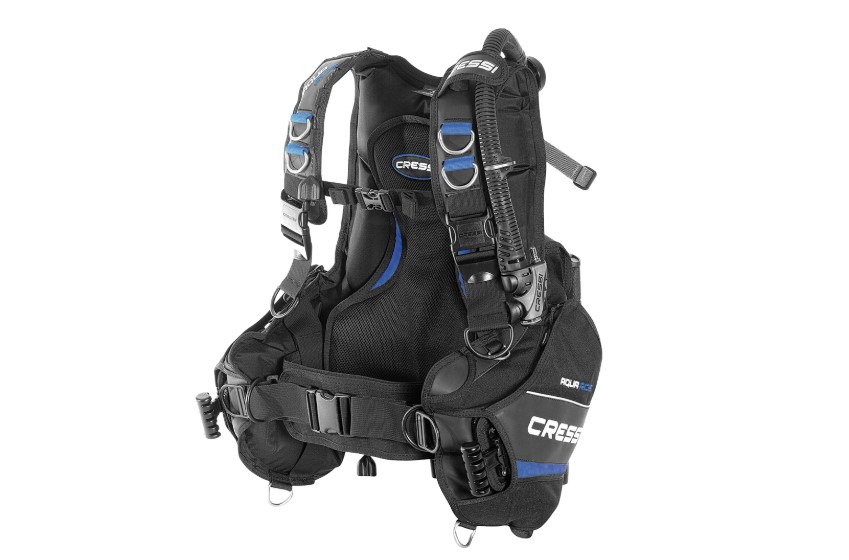
The Cressi Aquaride BCD is a rugged, traditional jacket-style buoyancy control device engineered for recreational divers seeking high stability, physical comfort, and an efficient integrated weight system. It features a robust wrap-around bladder and a highly ergonomic harness system that keeps you perfectly upright at the surface and trim underwater. If you're looking for a reliable, hard-wearing BCD that handles everything from local quarry dives to warm-water reef exploration, it is absolutely worth your consideration. In this comprehensive cressi aquaride bcd review, we will dissect its design, real-world utility, and long-term durability.
Why Buoyancy Control Matters and Where the Aquaride Fits
Buoyancy control isn't just about floating or sinking; it's the core skill that dictates your air consumption, protects fragile marine life, and determines how exhausted you feel at the end of a two-dive day. When you're constantly fighting your gear to stay horizontal, your respiratory rate spikes, and you burn through your gas supply. A well-designed jacket-style BCD like the Aquaride is engineered to prevent this struggle by positioning the air cell wraps around your torso. This layout provides an incredibly stable "cradle" both at depth and while waiting at the surface for the dive boat to pick you up.
Unlike back-inflation wings that tend to push a diver's face forward into the water when fully inflated on the surface, the jacket-style design keeps you resting in an effortless vertical position. For newer divers, dive professionals who spend a lot of time briefing students at the surface, or anyone who simply prefers the reassuring "hug" of a wrap-around bladder, this layout is highly preferred. The Aquaride refines this classic concept by adding structural adjustments that keep the bladder from squeezing your rib cage when fully inflated, a common complaint with older jacket designs.
Material Science: 420 and 500 Denier Construction
When you're climbing up a rocky shore entry, squeezing through a tight swim-through, or rubbing against the carpeted gunwale of a dive boat, your BCD takes a beating. The longevity of your buoyancy control device depends entirely on the weight and weave of its fabric. Cressi constructed the Aquaride using a strategic combination of 420 Denier nylon and 500 Denier Cordura. If you've ever wondered what those numbers mean, denier refers to the fiber thickness of the individual threads used to weave the fabric.
Many heavy-duty commercial BCDs use 1000 Denier fabric. While highly puncture-resistant, 1000 Denier makes a BCD stiff, heavy, slow to dry, and extremely bulky to pack into a flight bag. On the other end of the spectrum, ultra-lightweight travel BCDs often drop down to 200 Denier, which can easily tear on sharp coral or metal wreck edges. By blending 420 and 500 Denier materials, Cressi hit the sweet spot. The higher-stress zones, like the outer pockets and shoulder panels, utilize the tougher 500 Denier weave, while the internal bladder components leverage the lighter, more flexible 420 Denier fabric. This choice keeps the dry weight of the unit manageable for travel without sacrificing the ruggedness you expect for years of active diving.
Understanding the Harness and Weight Distribution
A major design challenge with jacket BCDs is preventing the heavy scuba cylinder from shifting side-to-side on your back during a dive. If the harness isn't secure, the cylinder acts like a pendulum, rolling you left and right and forcing you to use your core muscles to stay balanced. The Aquaride addresses this issue with its semi-rigid, heavily padded backplate. This backplate features a rigid upper carrying handle and a stiff lower spine support plate, but leaves the sides flexible to contour to your waist.
This design transfer the heavy weight of the cylinder directly to your hips rather than hanging it off your shoulders. To further customize the fit, the BCD features an elasticated, adjustable cummerbund. As you descend, your wetsuit or drysuit compresses under hydrostatic pressure, shrinking in thickness. If your cummerbund is rigid, your BCD will become loose and start sliding up toward your throat at depth. The elastic properties in the Aquaride's cummerbund allow it to contract naturally along with your exposure suit, keeping the harness locked firmly to your hips throughout the entire profile of your dive.
The Flat-Lock-Aid Weight Integration System
For decades, divers relied on traditional lead weight belts. While simple, weight belts have a nasty habit of slipping down your hips as your wetsuit compresses, or shifting during a vertical climb up a boat ladder. Modern integrated weight systems solve this by building weight pockets directly into the sides of the BCD. The Aquaride utilizes Cressi's proprietary Flat-Lock-Aid weight system, which is widely regarded as one of the most reliable mechanical release systems on the market.
The "Flat-Lock" name refers to the low-profile design of the weight pockets. They sit flush against the side lobes of the BCD, minimizing frontal area and reducing drag as you swim. Inserting the pockets is incredibly intuitive: you slide the loaded weight zippered pouch into the holster until you hear a clear, mechanical "click." That physical click is your confirmation that the weight pocket is locked in place. To ditch the weights in an emergency, you grab the high-visibility red handles and pull straight out. The mechanical release overrides the lock smoothly, allowing you to drop your ballast instantly and establish positive buoyancy at the surface. Each pocket holds up to 10 pounds (4.5 kg) of lead, giving you plenty of capacity even when wearing thick cold-water undergarments.
Buoyancy and Trim Pocket Placement
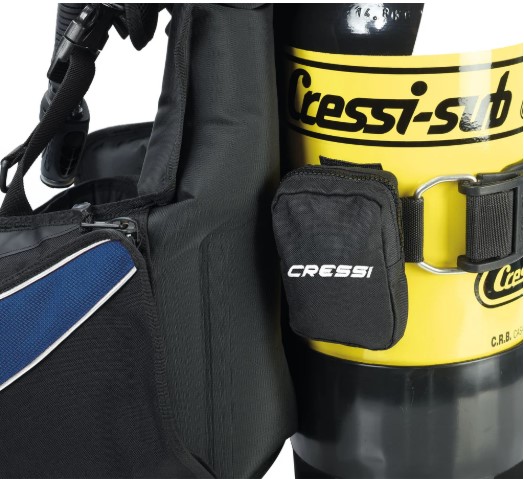
Good horizontal trim—staying completely flat in the water like a skydiver—is the hallmark of an efficient diver. Achieving this can be difficult if all your weight is concentrated at your waist, which can cause your hips to sink and your knees to drop. To counteract this, the Aquaride features rear trim weight pockets positioned on the tank band on either side of the cylinder. These non-releasable pockets hold up to 5 pounds (2.2 kg) of lead each.
By moving a portion of your ballast higher up your body and further back, you balance out the natural buoyancy of your lungs and the lower half of your exposure suit. This makes maintaining a perfect horizontal trim position almost effortless. You won't have to constantly kick your fins or scull your hands to keep your feet from dragging. According to the technical guidelines found in the Cressi User Manual, properly balancing your active ballast between the releasable front pockets and the fixed rear trim pockets drastically improves the handling and stability of the BCD in all orientations.
Valve Mechanics and Inflation Systems
The lung of your BCD—the air bladder—is only as good as the valves that control it. The Aquaride comes equipped with Cressi's anatomical inflator group. The power inflator head is contoured to fit naturally in your hand, allowing you to easily locate the inflation button (for adding air) and the deflation/oral inflation button without looking. The inflation valve utilizes a durable internal Schrader valve mechanism that connects via a standard quick-disconnect low-pressure hose to your regulator's first stage.
To dump air, you have three distinct options, which is critical for safety when you need to quickly control an ascent rate:
- The Inflator Pull Dump: Tugging down on the entire inflator hose pulls an internal cable that opens a gasket-sealed valve at the left shoulder. This is the fastest way to vent air when you are swimming in a standard vertical or slightly head-up position.
- The Right Shoulder Dump: A dedicated pull-dump valve located on the right shoulder, activated by a high-visibility pull knob. This is incredibly useful when you want to dump air without raising your left arm, helping you maintain a stable profile.
- The Right Rear Lower Dump: Located at the bottom right corner of the bladder. If you are swimming head-down along a reef or looking under a ledge and realize you are starting to float, pulling the rear dump string vents air from the highest point of the bladder in that inverted position, preventing a dangerous feet-first uncontrolled ascent.
Real-World Storage and Accessory Attachments
When you transition from pool training to open-water diving, you quickly realize how much gear you need to carry. Backup lights, slates, signaling devices, surface marker buoys (SMBs), and pocket reels all need a secure home. Some BCDs offer pockets that become completely useless and crushed when the bladder is fully inflated. Cressi solved this by utilizing a gusseted pocket design on the Aquaride.
The pockets are designed to expand outward, meaning that even when your BCD bladder is fully pumped with air at the surface, you can still easily slide your hands inside to retrieve your gear. The zippers are heavy-duty plastic teeth that resist saltwater crystallization and jamming. Additionally, the Aquaride features six angled, high-grade stainless steel D-rings. These are placed strategically along the shoulder straps and lower lobes, allowing you to clip off heavy accessories like action cameras, dive lights, or even a stage bottle without worrying about the plastic breaking or bending under load. There are also built-in grommet holes on the left lobe, designed specifically for mounting a Cressi dive knife directly to the BCD, keeping it within easy reach while eliminating the need for awkward leg straps.
Community Consensus and Video Evidence
Before purchasing any heavy-duty dive gear, it is smart to see what other divers are saying. Independent video reviews offer a clear, unedited look at how the BCD moves and functions in real-world scenarios. In the video below, you can see exactly how the harness wraps around the shoulders and how easy the Flat-Lock-Aid weight pockets are to handle during gear assembly.
When researching manufacturing tolerances and structural longevity, dive gear enthusiasts often discuss the precision mold tolerances of major European scuba brands. While digging through highly technical threads online, you'll sometimes find incredibly detailed discussions about exact engineering dimensions. For instance, I even ran across an online debate comparing industrial mechanical tolerances on Reddit when searching for precise sizing specifications, proving that modern gear geeks will go to any length to understand the hardware they trust their lives with.
Purchasing Logistics: Shipping, Warranties, and Vendor Trust
Diving equipment is an investment in your safety and comfort, which is why where you buy your gear is just as important as what gear you buy. Purchasing from a reputable, authorized dealer like Dive Right In Scuba ensures you receive genuine products backed by full manufacturer support. Dive Right In Scuba has earned an exceptional reputation in the global diving community, as demonstrated by their stellar ratings on Trustpilot.
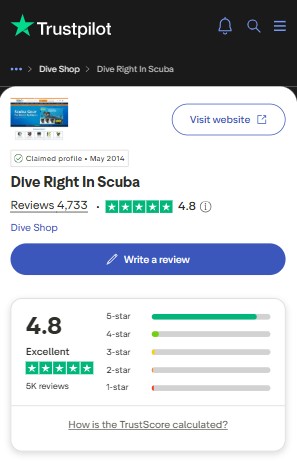
When you purchase from them, you benefit from a highly reliable Shipping Policy that guarantees prompt delivery, ensuring your new BCD arrives in perfect condition before your next scheduled dive trip. They also offer a clear, worry-free Warranty Policy. Although they are highly famous for their lifetime drysuit warranty program, their customer service and coverage on technical BCDs and life-support gear are equally comprehensive, protecting you against any unexpected structural or manufacturing defects.
To make the purchase even easier on your budget, they offer flexible financial arrangements. By reviewing their Payment Methods and Price Match Policy, you can see how simple it is to set up payment plans or match lower advertised prices from other authorized dealers. If you ever have a technical question regarding sizing, lift capacities, or hose routing, their dedicated team of active divers is easily reached through their direct Customer Support channel.
In-Depth Specification Breakdown
To help you compare the Aquaride against other options on the market, here is a detailed breakdown of its exact physical specifications and sizing metrics. Note how the lift capacity scales up with the size of the BCD to match the physical volume of larger divers.
| Specification | Details & Metrics |
|---|---|
| Primary Material | 420 Denier & 500 Denier Nylon / Cordura Blend |
| Weight System | Flat-Lock-Aid Integrated (Up to 20 lbs / 9 kg releasable) |
| Trim Weight Capacity | Up to 10 lbs / 4.5 kg total non-releasable rear capacity |
| D-Rings | 6 Stainless Steel Angled D-Rings |
| Dump Valves | 3 (2 shoulder pull dumps, 1 lower rear dump) |
| Lift Capacity (Size M) | 29.3 lbs / 13.3 kg of positive lift |
| Lift Capacity (Size XL) | 42.7 lbs / 19.4 kg of positive lift |
The Pros and Cons of the Cressi Aquaride BCD
Every piece of diving gear is a balance of trade-offs. What makes a BCD excellent for a recreational reef diver might make it less ideal for a technical cave explorer. Here is an honest, practical look at the strengths and limitations of the Aquaride.
What We Live About It
- Superb stability at the surface; keeps you vertical without pushing you forward.
- Mechanical "click" on the Flat-Lock weight pockets provides high peace of mind.
- Gusseted expansion pockets are genuinely usable even when the bladder is fully inflated.
- Durable, high-grade stainless steel D-rings hold heavy gear without bending.
- Excellent padded backplate significantly reduces cylinder-to-spine impact.
What to Consider Before Buying
- It is bulkier and heavier than minimalist, dedicated warm-water travel wings.
- The traditional jacket design generates more drag than a streamlined backplate-and-wing setup.
- The bladder wraps completely around your waist, which some divers feel is restrictive.
Jacket-Style vs. Back-Inflation: Which Should You Choose?
If you're trying to decide between the Aquaride and a back-inflation BCD, it helps to understand how they behave in the water. A back-inflation BCD, or "wing," places the entire air bladder behind your torso on either side of the scuba tank. This leaves your chest completely open and uncluttered, and it naturally holds you in a horizontal, swimming position when you are underwater. However, when you surface at the end of a dive, a back-inflation wing continues to push air behind you, which tends to tilt your body forward. You have to actively lean back and kick slightly to stay vertical at the surface, especially in choppy waves.
The Aquaride's jacket-style design does the opposite. By wrapping air around your waist and under your arms, it provides a stable "cushion" that keeps you resting upright at the surface with your face well clear of the water, requiring zero effort on your part. Underwater, a well-balanced jacket BCD like the Aquaride still allows you to achieve excellent horizontal trim, provided you utilize the rear trim pockets to distribute your ballast weight correctly. If you prioritize comfort, surface stability, and the secure feeling of a wrap-around harness, the jacket-style is the clear winner.
Essential Maintenance for Long-Term Durability
A BCD is a critical life-support device, and proper post-dive care will dramatically extend its lifespan. Saltwater is incredibly destructive; as seawater evaporates, it leaves behind sharp salt crystals that can puncture the internal bladder lining and cause the mechanical dump valves to stick. Follow this quick checklist after every day of diving:
- Rinse the Exterior: Thoroughly soak the BCD in fresh water. Pay close attention to the inflator button assembly, the quick-disconnect nipple, and the physical release mechanisms of the Flat-Lock weight pockets to flush out any trapped sand or salt.
- Flush the Internal Bladder: Depress the oral inflator button and hold it against a freshwater tap to fill the inside of the bladder with warm, clean water. Shake the BCD vigorously to coat the internal walls, then turn it upside down and dump the water out through the oral inflator hose while pressing the button.
- Inspect the Valves: Unscrew the rapid exhaust valves on the shoulders and check the rubber diaphragms for any dirt or salt buildup. A tiny grain of sand can prevent the valve from sealing, causing a slow, frustrating air leak during your dive.
- Store Semi-Inflated: Partially inflate the bladder with air before hanging it up to dry on a heavy-duty, wide-shoulder hanger. This keeps the internal plastic linings from sticking together during storage. Always store your gear in a cool, dry place away from direct sunlight and ozone sources like water heaters.
Frequently Asked Questions
Is the Cressi Aquaride suitable for cold-water diving?
Yes, the Aquaride is highly suited for cold-water diving. Its robust 500 Denier Cordura construction withstands the harsh environments of cold-water quarries and ocean shores. Crucially, the BCD offers generous lift capacities—up to 42.7 lbs (19.4 kg) in size XL—which is necessary to offset the heavy thermal undergarments and thick neoprene wetsuits or drysuits required for cold water. The Flat-Lock-Aid system also provides ample weight capacity to handle the extra ballast needed for thick suits.
Can I travel easily with this BCD?
While the Aquaride can certainly be packed for a dive vacation, it is a full-featured, traditional jacket BCD with a semi-rigid padded backplate, which makes it heavier and bulkier than dedicated, minimalist travel wings. If you're flying on commercial airlines with strict baggage weight limits, you'll need to pack it carefully. However, for divers who want one single BCD that can handle both local cold-water diving and tropical dive travel, the Aquaride is a highly versatile option that doesn't compromise on features.
What is the benefit of the Flat-Lock-Aid weight system over others?
The main benefit of the Flat-Lock-Aid system is its mechanical locking security. Some integrated weight systems rely strictly on hook-and-loop (Velcro) closures. Over time, Velcro degrades, collects sand, and can accidentally release, causing a dangerous, rapid ascent. The Flat-Lock system uses a physical plastic buckle that mechanically locks inside the holster. You will hear an audible "click" when it is safely secured, and it can only be released by a deliberate, firm pull on the high-visibility red handle, virtually eliminating accidental weight drops.
How do I choose the correct size?
Choosing the correct BCD size is critical for both comfort and safety. You should refer to the official sizing chart provided by Cressi, which takes into account your height, weight, chest circumference, and waist size. Keep in mind the thickness of the exposure suit you plan to wear most often. If you are on the boundary between two sizes, we generally recommend sizing down if you plan to dive primarily in thin warm-water wetsuits, or sizing up if you will be wearing thick cold-water suits or drysuits that add physical girth to your torso.
Final Verdict: A Reliable Companion for the Active Diver
The Cressi Aquaride BCD proves that you don't need to reinvent the wheel to build an outstanding piece of dive gear. By focusing on material strength, refining the ergonomics of the harness, and implementing a highly secure weight integration system, Cressi has produced a workhorse BCD that performs flawlessly in almost any recreational diving scenario. Whether you are a newly certified open-water diver or a seasoned divemaster racking up hundreds of dives a year, the Aquaride provides the comfort, durability, and reliable buoyancy control you need to relax and fully enjoy your time underwater.

0 Comments