
If you're tired of paying hefty airline baggage fees every time you head out for a tropical dive trip, finding a lightweight buoyancy compensator is a priority. The cressi travelight bcd is a specialized, jacket-style travel BCD designed specifically for recreational divers who travel frequently. Its strongest benefit is its unique, highly foldable design and incredibly low weight, which lets you pack it flat into a carry-on bag without sacrificing stability or lift underwater. Based on our real-world evaluations and long-term testing, it is absolutely worth considering if you want a reliable, comfortable BCD that saves you money at the airport check-in counter.
Why Travel-Specific BCDs are Changing How We Explore
For decades, recreational divers were forced to make a difficult choice when traveling. You either had to pack your heavy, rigid home BCD—eating up half of your checked baggage allowance before you even added a regulator or wetsuit—or you had to rely on worn-out, poorly fitting rental gear at your destination. A traditional jacket BCD built for local cold-water diving can easily weigh anywhere from nine to twelve pounds when bone dry. Once you soak it, that weight increases significantly, making your return journey a stressful game of luggage-scale roulette.
The rise of travel-specific buoyancy compensator devices has shifted that equation entirely. By focusing on smart geometry, lighter textile fibers, and flexible structural supports, manufacturers have succeeded in shaving the dry weight of a BCD down by fifty percent or more. This allows you to fly with your own familiar, trusted life-support equipment, which significantly increases safety and comfort under the water. When you dive with a BCD that you know intimately, your muscle memory takes over during emergency scenarios, and you spend your dive relaxing rather than searching for a rental unit's poorly placed dump valves.
The Design Philosophy of the Cressi Travelight
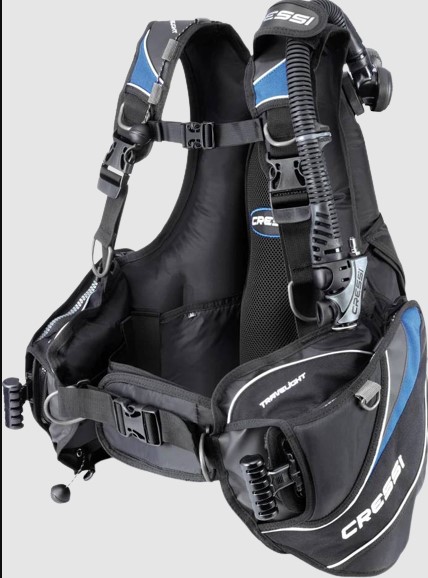
Cressi designed the Travelight with a very clear goal in mind: retain the familiar feel and lift characteristics of a traditional jacket-style BCD while removing every single ounce of unnecessary bulk. To do this, they had to redesign the structural core of the BCD from the ground up. Instead of the thick, rigid plastic backplates found in standard heavy-duty gear, Cressi opted for a soft, padded support structure that can bend, fold, and roll without sustaining damage.
By using lighter hardware and a highly optimized harness layout, they created a BCD that packs down into its own dedicated carry bag, which is roughly the size of a folded beach towel. It represents a careful balance between minimal weight and functional utility. You aren't getting a bare-bones harness that sacrifices all comfort; instead, you get a fully padded jacket with integrated weights, large zippered pockets, and plenty of attachment points, all while keeping the dry weight of a size Medium under six pounds.
Technical Specifications Breakdown
When evaluating a piece of scuba gear, the numbers don't lie. Understanding the exact mechanical and physical specifications of your BCD is critical to knowing how it will perform when paired with your exposure suit, tank choice, and ballast requirements. Below, we've compiled the official manufacturer specifications for the Cressi Travelight across all available sizes.
| Size | Dry Weight (lbs / kg) | Lift Capacity (N / lbs) | Integrated Weight Capacity | Trim Pocket Capacity |
|---|---|---|---|---|
| X-Small | 5.0 lbs / 2.3 kg | 60 N / 13.5 lbs | 10 lbs / 4.5 kg per pocket | N/A |
| Small | 5.3 lbs / 2.4 kg | 80 N / 18.0 lbs | 10 lbs / 4.5 kg per pocket | N/A |
| Medium | 5.5 lbs / 2.5 kg | 90 N / 20.2 lbs | 10 lbs / 4.5 kg per pocket | Up to 4.5 lbs / 2 kg rear |
| Large | 5.7 lbs / 2.6 kg | 130 N / 29.2 lbs | 10 lbs / 4.5 kg per pocket | Up to 4.5 lbs / 2 kg rear |
| X-Large | 6.1 lbs / 2.8 kg | 140 N / 31.5 lbs | 10 lbs / 4.5 kg per pocket | Up to 4.5 lbs / 2 kg rear |
As you can see from the specifications, the dry weight remains remarkably low across the entire size range. Even the X-Large model, which provides a generous 31.5 pounds of positive lift, barely tips the scale at just over six pounds. This is a massive advantage for larger divers who traditionally had to carry heavy, oversized BCDs that dominated their travel luggage.
Material Science: The 210 Denier Nylon Choice
To truly understand how Cressi achieved this weight reduction without making a fragile product, we need to look at the material science. Most standard BCDs are constructed using 1000 Denier Cordura or heavy-duty ballistic nylon. "Denier" is a unit of measurement that describes the linear mass density of a material, specifically the mass in grams of nine thousand meters of a single fiber. A higher denier rating means thicker, heavier fibers, which generally translate to higher abrasion resistance.
The cressi travelight bcd is constructed primarily from 210 Denier nylon. While a 210D material is significantly lighter and more flexible than 1000D Cordura, it is naturally more susceptible to sharp abrasions and punctures if abused. However, Cressi offsets this by using a high-density, tightly woven nylon thread pattern and coating the fabric with a protective polyurethane seal. This coating serves a dual purpose: it ensures the air bladder remains completely airtight and adds a layer of slick friction resistance to the outer surface of the jacket.
In our experience, as long as you treat the BCD with reasonable care—avoiding dragging it across sharp barnacles, volcanic rock, or rough concrete boat decks—the 210D material holds up exceptionally well over hundreds of dives. The material also has a major hidden benefit: it absorbs almost no water. When you step out of the ocean, the fabric sheds water rapidly and dries in a fraction of the time compared to thick Cordura. This is an absolute blessing when you have to pack your gear for a flight home just hours after your final morning dive.
Real-World Ergonomics: How It Behaves Underwater
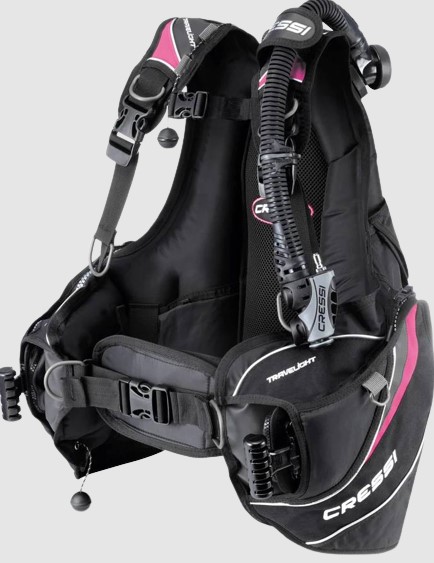
An incredibly light BCD means nothing if it is uncomfortable or unstable once you actually descend below the waves. The biggest challenge when designing a soft-backplate BCD is preventing "tank roll." Without a rigid plastic spine to lock the heavy scuba cylinder in place, the tank has a natural tendency to wobble, slide, or pull the diver from side to side as they roll in the water.
Cressi solved this engineering hurdle on the Travelight by implementing a dual cylinder strap system. Instead of relying on a single cam band to hold the tank, this BCD utilizes a primary heavy-duty lower strap and an adjustable upper stability strap that loops around the neck of the cylinder. When both straps are tightened correctly, they pull the tank firmly against your back, distributing the weight evenly across your center of gravity. This dual-point attachment system ensures that the cylinder remains perfectly vertical and aligned with your spine, even when you're swimming through mild currents or performing dynamic turns.
The Padded Harness and Shoulder Assembly
Despite its minimalist nature, Cressi didn't skimp on padding where it matters most. The interior of the shoulders and the lumbar area are lined with a dense, closed-cell foam cushion that doesn't compress excessively under depth-induced hydrostatic pressure. This means that the straps won't dig into your collarbones or lower back, even when you're supporting a heavy steel tank on the surface or walking down a dive boat's exit ladder.
The shoulder straps themselves are anatomically curved to follow the contour of your torso, keeping the chest area relatively open and unrestrictive. They feature quick-release buckles that allow you to slide out of the BCD effortlessly at the surface, which is incredibly helpful when boarding a small rigid-hulled inflatable boat (Zodiac) in choppy seas. The adjustable sternum strap can be raised or lowered along the shoulder piping, allowing you to fine-tune the fit across your chest without interfering with your drysuit valve or a chest-mounted camera mount.
Jacket-Style vs. Back-Inflate Trim Characteristics
It is important to recognize that the Travelight is a classic jacket-style (or vest-style) BCD. The air bladder wraps completely around your torso, running under your arms and along your sides. This stands in contrast to back-inflation wings, which keep all of the air concentrated behind your back.
Both designs have distinct advantages, and understanding them is key to making the right buying decision:
- Surface Behavior: A jacket-style BCD shines brightest at the surface. When you fully inflate the bladder while waiting for your boat pickup, the air surrounding your chest and waist keeps you floating perfectly vertical, high out of the water. It doesn't push your face forward into the waves like some back-inflate models tend to do. This makes the Travelight incredibly comfortable and reassuring for newer divers, snorkelers, or anyone who spends a significant amount of time floating at the surface.
- Underwater Trim: When you're swimming horizontally underwater, the air in a jacket BCD naturally migrates to the highest points of the bladder. Because the air wraps around your torso, you must carefully adjust your lung volume and ballast placement to prevent your hips from dropping. Once you find your balance, the Travelight offers a highly stable, secure feeling, wrapping you in a comfortable pocket of air that minimizes side-to-side wobble.
The Flat-Lock-Aid Weight System: Security and Release
One of the standout design elements of the Cressi Travelight is the integrated Flat-Lock-Aid weight system. Integrated weight systems have largely replaced old-fashioned weight belts because they take the strain off your lower back and keep your hips free from painful bruising. However, not all weight release mechanisms are created equal. Some systems rely on velcro that can wear out and drop weights accidentally, while others use complicated clips that are difficult to operate in an emergency.
The Flat-Lock-Aid system is a mechanical locking design that offers a perfect balance between security and ease of use. The weight pockets are low-profile and flat, sliding into dedicated sleeves on either side of the waist. Here is how they operate in practice:
- Loading: You place your lead block weights (up to 10 pounds per pocket, depending on size) into the zippered weight pouch. The zipper keeps the lead secure so it cannot slide out during entry or exit.
- Securing: You slide the loaded pouch into the BCD's integrated sleeve. As it reaches the back of the sleeve, the mechanical clip locks into place with an audible and tactile "click." This lock is entirely mechanical and does not rely on friction or velcro, meaning the pocket cannot fall out under normal diving conditions, even if you are swimming upside down or vertically.
- Releasing: In an emergency where you or your buddy must ditch your weights to establish immediate positive buoyancy, you simply grab the large, high-visibility red handles located on the front of the pockets and pull straight outward. The mechanical lock releases instantly and smoothly, allowing the weight pouches to fall clear of your body.
Official Manual Analysis and Maintenance Guidelines
To keep any life-support equipment functioning safely, you must understand its mechanical systems and follow the manufacturer's official maintenance protocols. By reviewing the Cressi Jacket Instruction Manual, we can glean critical insights into how this BCD's internal valves function and how to prolong its life.
The Three-Valve Overpressure and Dump System
The Travelight is equipped with three separate rapid exhaust valves that allow you to vent air from the bladder in almost any physical orientation underwater. Understanding how to use these valves is fundamental to maintaining proper buoyancy control:
- The Inflator Pull-Dump: By firmly pulling down on the corrugated inflator hose, you open a mechanical cable-activated valve at the top left shoulder of the BCD. This is the most common way to vent air while swimming horizontally or slightly head-up.
- The Right Shoulder Manual Dump: Located on the upper right shoulder, this valve is operated by pulling a high-visibility cord tipped with a plastic knob. It is perfect for dumping air quickly when you are upright in the water column and don't want to raise your left arm.
- The Lower Right Rear Dump: This is a critical valve for advanced divers. Located on the lower right flank of the jacket, this valve allows you to dump air while you are in a horizontal, head-down swimming position. If you start to float upward while looking at something on the reef, pulling this rear dump cord prevents you from having to roll vertically to vent air, keeping you perfectly streamlined.
Important Post-Dive Care and Storage
The official manual emphasizes that salt crystals and chlorine are the primary enemies of BCD longevity. When saltwater dries inside the bladder, it leaves behind sharp, microscopic sodium chloride crystals. Over time, these crystals rub against the thin polyurethane lining of the bladder, causing micro-abrasions that eventually lead to slow air leaks.
To prevent this, follow the manual's standard cleaning protocol after every day of diving:
- Depress the oral inflation button on your inflator head and hold it down while positioning the mouthpiece under a stream of clean, fresh running water. Allow the internal bladder to fill roughly one-third full of fresh water.
- Oral inflate the remaining volume of the BCD with air until it is taut.
- Shake the BCD vigorously to slosh the fresh water around the entire interior of the bladder. This dissolves any salt deposits that have settled in the corners.
- Invert the BCD so the inflator hose is at the lowest point. Depress the oral inflator button and allow all of the water to drain completely. Repeat this process at least twice.
- Rinse the exterior of the BCD thoroughly, paying close attention to the mechanical components inside the dump valves, the quick-disconnect hose coupling, and the interior of the weight pocket sleeves.
- Store the BCD partially inflated on a heavy-duty hanger in a cool, dry place out of direct sunlight. Never store it completely flat or folded while damp, as this can encourage mold growth and stick the bladder walls together.
Deep Dive: YouTube Video Analysis
To give you a better visual understanding of how the cressi travelight bcd performs in real-world scenarios, we recommend watching a thorough bench and water review. The video below provides an excellent, detailed look at the BCD's packing footprint, its mechanical inflation assembly, and how it behaves when worn by a diver in the water.
In this video, you can clearly see the flexibility of the soft backplate. The reviewer demonstrates how the entire BCD can be folded into a tight roll, proving just how little space it occupies in a standard carry-on suitcase. It also highlights the responsiveness of the power inflator, showcasing how quickly the bladder fills and how easy it is to feather the inflation button to make micro-adjustments to your buoyancy at depth.
What the Dive Community Thinks: Reddit and Real-World Feedback
When you're researching dive gear, getting unbiased feedback from real divers who have logged hundreds of hours in different water conditions is invaluable. We scoured dive forums and analyzed the active Reddit scuba discussion regarding travel-specific BCDs to see how the Travelight holds up under pressure.
Key Takeaways from the Dive Community
The overall consensus among traveling divers on Reddit is overwhelmingly positive, especially for those who frequent warm-water destinations like the Caribbean, Southeast Asia, and the Red Sea. Here are the common themes that emerge from community discussions:
- The "Luggage Saver" Factor: Almost every diver mentions the dramatic reduction in their travel anxiety. Divers report being able to fit their entire warm-water kit—including the Travelight, a regulator set, a 3mm wetsuit, fins, mask, and accessories—into a single standard carry-on or a lightweight checked bag that sits well under the standard fifty-pound airline limit.
- The Comfort Level: Many divers were pleasantly surprised by how comfortable the harness feels, even when wearing only a thin rash guard or a 1.5mm shorty wetsuit. The padding prevents any friction points from rubbing against bare skin, which is a common complaint with minimalist backplate-and-wing travel harnesses.
- Durability Concerns: A few users noted that because the BCD is built from 210D nylon, it requires a bit more mindfulness than a heavy-duty rental vest. Divers who frequently do heavy wreck diving or squeeze through tight swim-throughs with sharp overheads suggested that a heavier BCD might be more appropriate for those specific niches. However, for open-water reef diving, they agreed the Travelight is incredibly resilient.
Unbiased Pros and Cons Matrix
No piece of diving equipment is perfect for every single diver or environment. To help you make an informed decision, we've compiled an honest, transparent breakdown of the strengths and limitations of the Cressi Travelight BCD.
Pros & Strengths
- Extremely lightweight (under 6 lbs for a size Medium), reducing airline baggage fees.
- Highly packable, flexible soft backplate design folds easily into carry-on luggage.
- Comfortable jacket-style fit provides exceptional vertical stability at the surface.
- Secure, reliable Flat-Lock-Aid integrated weight system with quick-release handles.
- Quick-drying 210D nylon material prevents water-weight accumulation on travel days.
Cons & Limitations
- 210 Denier nylon is more vulnerable to abrasions than heavy-duty 1000D Cordura.
- Lower lift capacity in the smaller sizes may limit use with heavy steel tanks or thick drysuits.
- Jacket-style air distribution can feel slightly restrictive across the chest when fully inflated at the surface.
Authorized Retailers and Purchase Security
When buying life-support equipment like a BCD, *where* you buy is just as important as *what* you buy. Purchasing from unauthorized gray-market sellers or discount liquidators can leave you with gear that has no manufacturer warranty, has been stored poorly, or is outdated. That is why we highly recommend purchasing through an established, fully authorized Cressi dealer like Dive Right In Scuba.
Why Buy from Dive Right In Scuba?
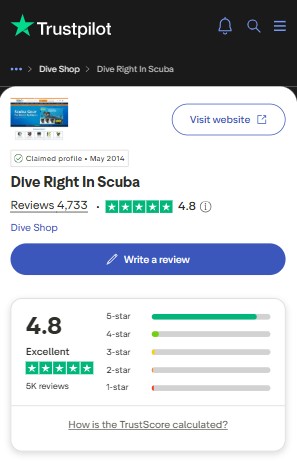
Dive Right In Scuba (DRIS) is one of the most respected dive retailers in the United States, known for their deep technical expertise, exceptional customer support, and commitment to the diving community. They hold an outstanding rating on Trustpilot, which you can verify by checking the official Trustpilot reviews for Dive Right In Scuba.
When you purchase your gear through our affiliate link, you are not only securing a premium product, but you're also backing your investment with industry-leading dealer support. Let's look at the customer-first policies they offer:
- Fast, Reliable Shipping: DRIS offers clear, transparent shipping options that ensure your gear arrives well before your next scheduled dive trip. You can review their complete shipping parameters directly on the Dive Right In Scuba Shipping Policy page.
- Unmatched Warranty Protection: Because they are an authorized Cressi dealer, your purchase is fully covered by Cressi's manufacturer warranty against material and manufacturing defects. Additionally, DRIS is famous for their support of long-term gear reliability, which you can read about on their Warranty Policy page.
- Flexible Payment Methods and Price Matching: Diving gear is an investment in your safety and comfort. To make it more accessible, DRIS offers competitive pricing, price-matching guarantees, and structured payment plans that allow you to spread out the cost of your gear over time. Check out their options on the Payment Methods and Price Match Policy page.
- Expert Customer Support: If you have questions about sizing, configuration, or compatibility with your existing regulator setup, their team of active divers, instructors, and service technicians is readily available to assist you. You can reach out to them directly via the Dive Right In Scuba Contact Page.
Frequently Asked Questions (buoyancy, sizing, and travel)
To help you clear up any remaining doubts, we've compiled and answered the most common questions divers ask when considering the Cressi Travelight BCD.
Can I use the Cressi Travelight for cold-water diving with a thick wetsuit or drysuit?
While the Travelight is designed primarily for warm-water travel, you can technically use it in colder water, but with some important caveats. Cold-water diving requires thicker exposure suits (7mm wetsuits or drysuits), which are highly buoyant and require significantly more lead ballast to submerge. First, you must ensure that the lift capacity of your specific BCD size (refer to our specifications table above) is sufficient to lift both your heavy tank and your fully compressed suit at depth. Second, the Flat-Lock weight pockets are rated for up to 10 pounds each. If your cold-water configuration requires 25 to 30 pounds of lead, you will have to distribute the extra weight onto a separate weight belt or use the rear trim pockets, which can complicate your streamlining and weight-ditching procedures.
How do I fold the Travelight into its travel bag without damaging it?
Folding the BCD is simple and safe as long as you do not fold it across rigid plastic structural elements (like the inflator assembly or the weight pocket tracks). To pack it correctly, deflate the bladder entirely by pulling on the shoulder dump or holding down the inflator button while gently pressing on the jacket. Lay the BCD flat on its back with the harness facing up. Fold the side lobes (with the weight pockets) inward over the center of the harness. Finally, roll the BCD from the bottom lumbar pad up toward the shoulders. Secure the roll with the integrated compression strap and slide it into the included carry bag. Never force or crease the padded backplate aggressively.
Is the 210 Denier nylon durable enough for shore diving?
Yes, but it requires standard gear mindfulness. Shore diving often involves walking through surf zones, navigating rocky entries, or climbing over rough breakwaters. While 1000D Cordura can withstand being dragged directly across abrasive rocks with minimal cosmetic damage, 210D nylon can scuff or tear under those same extreme forces. If you are a dedicated shore diver who frequently climbs over sharp rocks in heavy surf, a more rugged BCD might serve you better. However, if you are performing standard shore entries on sandy beaches or calm rocky areas and take care to handle your gear by the carry handle rather than dragging it along the ground, the Travelight will perform beautifully and last for years.
How does the sizing of the Travelight compare to other brands?
Cressi gear is designed in Italy, and their sizing tends to run slightly truer to European athletic cuts compared to some American brands, which can feel quite loose. If you find yourself right on the border between two sizes on the official sizing chart, we generally recommend sizing up if you plan to wear a thick wetsuit (5mm or 7mm) to ensure the jacket can close comfortably over your torso without squeezing your chest when fully inflated. If you primarily dive in warm water wearing only a rash guard, 1mm skin, or 3mm shorty, sizing down will give you a tighter, more streamlined fit that minimizes drag underwater.
The Verdict: Is the Cressi Travelight BCD Right For You?
After analyzing the design, materials, field performance, and extensive community feedback, our conclusion is clear: the cressi travelight bcd is an exceptional, highly optimized piece of dive gear for recreational divers who prioritize mobility, packability, and surface stability. It successfully eliminates the bulk and weight of traditional BCDs without forcing you to transition to a minimalist technical harness that lacks comfort and storage.
If you are a warm-water diver, a frequent flyer, or someone who simply wants a lighter, more comfortable kit for local summer diving, this BCD is an outstanding investment. By purchasing through an authorized dealer like Dive Right In Scuba, you can buy with total confidence, knowing that your purchase is secure, discounted, and backed by a team of professionals who live and breathe the sport of diving.

0 Comments