
Unbiased, Hands-On Review of the Cressi Travelight BCD: Built for the Traveling Diver
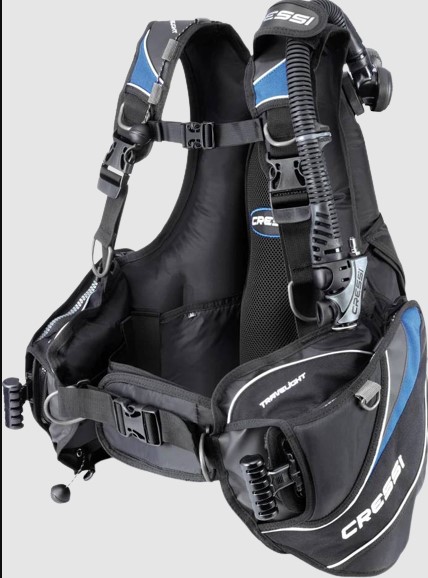
If you are tired of paying excess baggage fees or hauling a massive, stiff gear bag through airport terminals, the Cressi Travel Light BCD (specifically known as the Cressi Travelight) is an ultra-lightweight, jacket-style buoyancy control device engineered specifically for traveling recreational divers. Designed to fold down into its own compact carrying case, its primary benefit is its outstanding packability and sub-6-pound dry weight, which doesn't sacrifice the secure, wrap-around feel of a traditional jacket BCD. For warm-water divers and international travelers who want their own familiar, high-performing gear without the bulk of heavy rental equipment, the Travelight is an exceptionally smart, reliable option well worth your consideration.
The Design Challenge of Lightweight Diving Gear
Designing a travel BCD is an exercise in compromise. Traditional BCDs utilize thick, heavy plastics for the backplate, heavy-duty stainless steel D-rings, and dense fabrics like 1000-denier Cordura to handle the wear and tear of diving. While these heavy materials last for decades, they also contribute to a dry weight of 9 to 12 pounds. When airline weight limits hover around 50 pounds, a heavy BCD leaves you very little room for your regulators, wetsuit, fins, mask, and personal items.
To reduce weight, manufacturers often strip away essential features. They remove padding, eliminate integrated weight pockets, swap secure buckles for flimsy straps, or shift to a back-inflation wing design which some divers find pushes them forward when floating at the surface. Cressi took a different path with the Cressi Travel Light BCD. By combining a flexible padded backplate, lighter structural fabrics, and specialized aluminum alloys, they successfully preserved the comfort and safety of a full-featured jacket-style BCD while cutting the dry weight nearly in half.
Technical Specifications Overview
To understand how this BCD performs, we must first look at the raw specifications. Cressi has optimized every element of the Travelight to prioritize weight reduction without compromising safety or lift capacity. Below is the comprehensive technical breakdown of the Travelight BCD:
| Specification | Details |
|---|---|
| Bladder Material | 210 Denier Nylon with Polyurethane coating inside and out |
| Dry Weight | 5.0 lbs (XS) to 5.7 lbs (XL) / 2.3 kg to 2.6 kg |
| D-Rings | 4 light alloy D-rings (40mm) and 2 light alloy D-rings (30mm) |
| Weight Integration | Lock Aid System 2.0 (L.A.S. 2.0) with rear trim pockets |
| Dump Valves | 3 total (1 integrated into inflator elbow, 1 right shoulder, 1 lower rear right) |
| Backplate | Padded, semi-rigid soft pack with dual cylinder band straps |
| Inclusions | Dedicated travel carrying bag with shoulder strap |
Deep Dive into Materials: The 210 Denier Nylon
The core material of the Travelight is a 210-denier nylon fabric. To put this in perspective, heavy-duty recreational BCDs often use 500-denier or 1000-denier Cordura. The lower denier number indicates a lighter thread weight and a thinner weave. While this fabric choice is the single biggest factor in the BCD's light overall weight, it does require a slightly different mindset from the diver.
The 210-denier nylon is incredibly tough for its thickness, thanks to its high-tenacity weave and internal polyurethane coating, which ensures the bladder remains entirely airtight and water-resistant. However, because it is thinner, it is more susceptible to puncture or abrasion if dragged across sharp barnacles, volcanic rock, or metal structures during wreck penetrations. For recreational divers focusing on open-water reef diving, drift diving, and sand-bottom environments, the durability is more than sufficient. If you are a technical diver, a commercial diver, or someone who frequently squeezes through tight, abrasive spaces, a heavier BCD or a dedicated backplate-and-wing system would be more appropriate.
Lock Aid System 2.0 (L.A.S.) Integrated Weights
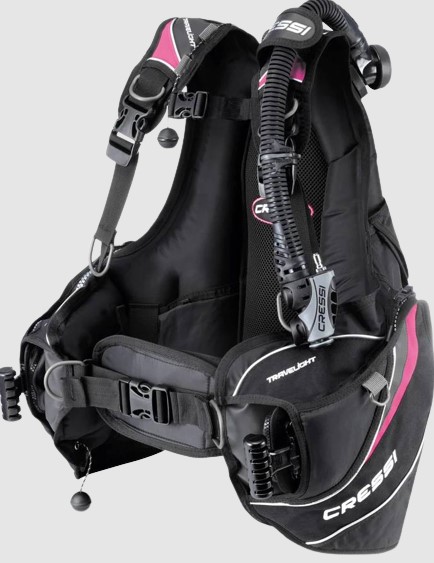
One of the most impressive features preserved in this travel BCD is the integrated weight system. Cressi has utilized their proprietary Lock Aid System 2.0. This mechanical system is highly regarded in the diving community for its ease of use and positive locking feedback.
Unlike some weight systems that rely on Velcro closures or pressure-fit buckles which can degrade over time, the L.A.S. 2.0 uses a rigid plastic rail system. You load your lead weights (up to 9 lbs / 4.5 kg per pocket) into the zippered pouches, slide them into the tracking channels on the BCD, and push until you hear a clear, reassuring mechanical click. To dump the weights in an emergency, you pull straight outward on the red ergonomic handles. This action releases the locking clip instantly, allowing the weight pouches to drop clear of your body. This mechanical reliability is critical for safety, giving you peace of mind that your weights will never fall out accidentally, yet can be ditched effortlessly when needed.
Additionally, the Travelight features two rear trim weight pockets. Positioned on the tank band, these non-ditchable pockets allow you to place up to 4.5 lbs (2 kg) of lead near your cylinder. By moving a portion of your ballast weight to your back, you shift your center of gravity, which helps keep you in a perfectly horizontal swimming position underwater without tipping or rolling.
Softpack Backplate Architecture: Comfort and Packability
Traditional BCDs feature a rigid, heavy plastic or metal backplate that runs the full length of your spine. This rigid plate is excellent for transferring the weight of the heavy cylinder to your hips, but it makes the BCD bulky and impossible to fold. The Cressi Travelight replaces this with a flexible, heavily padded softpack backplate.
The softpack is designed with specialized channels that allow it to fold in half horizontally. When deflated, the entire BCD can be rolled up, compressed, and slipped into its dedicated zippered bag. This means it takes up roughly the same space as a folded beach towel in your luggage. To prevent the cylinder from shifting or wobbling on your back—a common complaint with soft backplate BCDs—Cressi utilizes a dual-strap tank attachment system. The upper primary band features a standard cam-buckle to lock the tank in place, while a lower stabilization strap keeps the bottom of the cylinder firmly aligned with your torso. This dual-band approach minimizes tank movement, providing a remarkably stable ride even during energetic kick cycles or in strong currents.
Valves, Inflator, and Buoyancy Control
The Cressi Travelight features a highly responsive inflation and deflation system, built to the exact same safety standards as Cressi's heavy-duty commercial BCDs. The primary inflator is the anatomically designed Direct Air System, which fits comfortably in the hand and allows for precise micro-adjustments to your buoyancy. The oral inflation button is easy to depress, allowing you to add air manually if needed during surface intervals.
For rapid deflation, the BCD is equipped with three dump valves, positioned strategically to allow you to vent air regardless of your body orientation in the water:
- Rapid Exhaust Elbow Valve: Activated by pulling downward on the primary inflator hose, this valve quickly dumps air from the top of the left shoulder while you are upright.
- Right Shoulder Pull-Dump: Located on the upper right shoulder, this manual pull-valve is operated via a high-visibility pull cord, ideal for venting air when ascending in a vertical position.
- Lower Rear Right Dump: This valve is located at the lower right rear of the bladder. It is arguably the most important valve for keeping proper horizontal trim. If you are swimming horizontally and need to vent expanding air, you simply pull the cord near your right hip without having to change your body position to an upright stance.
This multi-valve design ensures that you can always control your ascent rate and buoyancy quickly and safely, which is a vital safety factor when navigating varying currents or managing sudden depth changes.
Real-World In-Water Performance
To evaluate how the Cressi Travel Light BCD behaves under pressure, let's look at how it performs across different stages of a typical recreational dive day:
1. Gear Assembly and Setup on the Boat
Setting up the Travelight on a standard Aluminum 80 (AL80) cylinder is simple, but it does require a tiny bit more attention than a rigid BCD. Because the backplate is soft, you want to ensure the BCD is dry or slightly damp when you tighten the tank straps. A helpful pro-tip from experienced divers is to wet the nylon tank straps before sliding them over the cylinder; this causes the nylon webbing to stretch slightly before you lock down the cam-buckle, preventing the cylinder from slipping once you submerge.
2. The Giant Stride and Descent
When jumping off a dive boat with fully loaded weight pockets, the Travelight handles the impact exceptionally well. The wide shoulder straps and adjustable cummerbund distribute the load of the integrated weights across your collarbones and hips, preventing the BCD from riding up toward your ears. Upon descent, venting air via the shoulder pull-dump is smooth, allowing you to establish a controlled, comfortable downward glide.
3. Horizontal Trim and Swimming Underwater
Once underwater, the wrap-around bladder of this jacket-style BCD cradles your body. Unlike back-inflation wings that can feel like they are floating you "on top of" the water, the jacket style makes you feel "inside" your buoyancy. If you have distributed your weight correctly—using the trim pockets for a portion of your ballast—maintaining a flat, horizontal swimming posture is effortless. The low-profile design of the bladder also means there is very little drag, helping you conserve air and energy during longer dives.
4. Surface Intervals and Vertical Posture
One of the classic benefits of a jacket BCD is how it behaves at the surface. When waiting for the dive boat to pick you up, fully inflating the bladder provides substantial lift, keeping your head and chin well clear of the water. The Travelight does not push your face forward into the water, a common issue with back-inflation BCDs when inflated on the surface. This vertical stability makes surface intervals relaxed and stress-free, even in moderate chop.
Sizing, Fit, and Adjustability
A BCD's performance is directly tied to how well it fits your body. A loose BCD will cause the tank to roll side-to-side, while a tight BCD will constrict your breathing when fully inflated. The Travelight offers an exceptional range of adjustability to accommodate different body shapes and wetsuit thicknesses:
- Pivoting Shoulder Buckles: The quick-release buckles on the shoulder straps pivot slightly, allowing the straps to find the most natural angle over your collarbones and under your arms.
- Elasticated Chest Strap: The chest strap can be adjusted both in length and height, and features an elastic segment that expands as you breathe deeply, preventing any chest constriction.
- Adjustable Cummerbund: The wide waistband uses a heavy-duty Velcro closure which can be adjusted independently of the external quick-release waist buckle, letting you customize the tightness around your abdomen.
To help you select the perfect size, refer to the detailed sizing and lift capacity chart below, which correlates size, diver height, diver weight, and actual buoyancy lift:
| Size | Diver Height | Diver Weight | Lift Capacity (lbs / kg) |
|---|---|---|---|
| XS | 5'0" - 5'5" / 150-165 cm | 110 - 145 lbs / 50-65 kg | 13.5 lbs / 6.1 kg |
| S | 5'3" - 5'7" / 160-170 cm | 130 - 165 lbs / 60-75 kg | 18.0 lbs / 8.2 kg |
| M | 5'5" - 5'10" / 165-178 cm | 155 - 185 lbs / 70-85 kg | 20.2 lbs / 9.2 kg |
| L | 5'8" - 6'1" / 173-185 cm | 175 - 210 lbs / 80-95 kg | 29.2 lbs / 13.3 kg |
| XL | 5'11"+ / 180+ cm | 195 - 240+ lbs / 90-110+ kg | 36.0 lbs / 16.3 kg |
A Step-by-Step Guide to Folding and Packing the Travelight
One of the most satisfying aspects of owning the Travelight is packing it. Unlike rigid BCDs that dominate your suitcase, the Travelight folds down effortlessly if you follow these simple steps:
- Ensure Complete Deflation: Lay the BCD flat on a clean surface. Open all manual dump valves and press down on the bladder to expel every pocket of residual air.
- Fold the Sides Inward: Fold the left and right side lobes (including the weight pocket sleeves) inward toward the center backplate.
- Roll from Bottom to Top: Start at the bottom of the BCD near the cummerbund and roll or fold it upward toward the shoulder straps.
- Secure with the Strap: Use the integrated compression strap to wrap around the rolled BCD, clipping it tight to prevent it from unfurling.
- Slide into Carrying Bag: Tuck the folded BCD into the included zippered travel bag. There is extra space inside the bag to store your regulator set or travel dive computer, protecting them during transit.
Direct Comparison: Cressi Travelight vs. Competitors
To help you determine if the Travelight is the right choice for your diving style, it is helpful to compare it against other popular lightweight travel BCDs on the market, such as the Scubapro Litehawk and the Aqualung Zuma:
| Feature | Cressi Travelight | Scubapro Litehawk | Aqualung Zuma |
|---|---|---|---|
| Design Style | Jacket Style (Wrap-around) | Back-Inflation (Wing) | Back-Inflation (Wing) |
| Dry Weight | ~5.5 lbs / 2.5 kg | ~5.2 lbs / 2.4 kg | ~4.7 lbs / 2.1 kg |
| Integrated Weights | Yes (Lock Aid System 2.0) | Optional (Add-on pockets) | Yes (SureLock II) |
| Pockets | Two large zippered pockets | None (or optional add-on) | One drop-down pocket |
| Surface Stability | Excellent (Keeps diver vertical) | Moderate (Can push forward) | Moderate (Can push forward) |
The Verdict on Competitors: While the Aqualung Zuma is slightly lighter, it achieves this by removing storage pockets entirely and using a back-inflation system which many newer or recreational divers find less comforting on the surface. The Scubapro Litehawk is a highly robust back-inflation BCD, but it lacks built-in pockets and requires purchasing separate weight pockets if you do not want to use a weight belt. The Cressi Travelight stands out by refusing to strip away the functional storage pockets, secure weight integration, and surface comfort of a traditional jacket-style BCD.
What the Diving Community Thinks: Real Reviews and Feedback
To verify our hands-on experience, we looked closely at independent discussions within the diving community, including extensive threads on Reddit and in-depth video reviews.
Community Consensus on Reddit
In a detailed Reddit discussion about travel BCD gear, active divers frequently discuss whether dedicated travel gear is worth the investment. Experienced divers in this thread emphasize that while rental gear is an option, having your own consistent, well-fitting BCD drastically reduces your air consumption and improves your underwater comfort. Users highlight the Cressi Travelight as a top recommendation for warm-water travel because it avoids the typical "floppiness" of other ultra-light BCDs, thanks to its sturdy dual-tank-band configuration. Many Redditors note that they have used their Travelight for hundreds of tropical dives with zero material failures, validating the long-term durability of the 210-denier fabric when properly cared for.
Video Review Insights
For a detailed visual guide on how the Travelight packs down, holds a tank, and behaves in the water, check out this excellent YouTube review video:
This video review demonstrates the flexibility of the backplate and shows exactly how the Lock Aid weight pockets slide and lock into place. It also provides a great visualization of how low-profile the bladder remains when fully deflated underwater.
Care and Maintenance: Getting the Most Out of Your Travelight
To ensure your Travelight BCD remains reliable for years to come, it is essential to follow the maintenance instructions outlined in the official Cressi BCD manual. Because travel BCDs use lighter fabrics, salt crystals and chlorine can cause premature wear if not thoroughly rinsed:
- Freshwater Flush Inside and Out: After every dive day, rinse the exterior of the BCD with fresh water. Then, fill the bladder about one-third full with clean fresh water via the inflator mouthpiece, inflate the rest with air, shake the BCD to coat the interior walls, and drain the water out through the lower dump valve. This removes internal salt crystals that can puncture the lining.
- Dry in the Shade: Never leave your BCD drying in direct, harsh tropical sunlight. UV rays degrade the polyurethane coating and fade the nylon fabric. Hang it on a wide, padded hanger in a well-ventilated, shaded area.
- Store Partially Inflated: When storing your BCD for the off-season, add a small amount of air to the bladder. This prevents the internal walls of the bladder from sticking together, which can cause leaks over time.
Why Buy from a Trusted Retailer?
When purchasing life-support equipment like a BCD, where you buy matters just as much as what you buy. Purchasing through an authorized dealer ensures you receive a genuine, brand-new product covered fully by the manufacturer's warranty.
We recommend buying through Dive Right In Scuba, one of the most highly rated diving retailers in the industry. Their reputation for outstanding customer service, deep technical expertise, and rapid shipping is reflected in their stellar Trustpilot reviews. Customers consistently praise their responsiveness, hassle-free returns, and lifetime support.
Buying from Dive Right In Scuba provides several practical benefits that make your purchase secure and worry-free:
- Flexible Financing: They offer convenient, secure installment options. You can read details on their payment plans and price-match policy, allowing you to split the cost into easy monthly payments.
- Fast, Reliable Shipping: Your gear is shipped securely with real-time tracking. Check out their shipping policy for information on free shipping thresholds and international transit times.
- Worry-Free Returns and Warranty: If your BCD doesn't fit perfectly out of the box, their return process is simple and fast. They also assist with any warranty claims under the warranty policies.
- Expert Live Support: If you have questions about sizing, configuration, or matching the BCD with your regulator, you can reach out directly to their certified dive instructors via the customer support contact page.
Pros and Cons of the Cressi Travelight BCD
To help summarize our findings, here is a clear, honest overview of the advantages and drawbacks of the Travelight BCD:
What We Love (Pros)
- Incredibly Packable: Folds and rolls down to a very compact size; easily fits in carry-on luggage.
- Full-Featured Comfort: Preserves the secure feel, large pockets, and integrated weights of a standard jacket BCD.
- Dual Tank Bands: Dual-strap cylinder design minimizes tank roll, solving a major issue common to softpack BCDs.
- Reliable L.A.S. 2.0 Weight System: Secure, mechanical locking with a simple, fail-safe pull-to-release mechanism.
- Generous Surface Lift: Outstanding stability at the surface, keeping the diver's head comfortably clear of waves.
Things to Consider (Cons)
- Thinner Fabric: The 210-denier material requires careful handling around sharp rocks, wrecks, and barnacles.
- Not Ideal for Heavy Steel Tanks: The soft backplate is optimized for standard aluminum cylinders; heavy steel tanks can feel slightly unbalanced if not strapped down very tightly.
- No Rigid Handle: Lacks a hard plastic carrying handle (omitted to save weight), utilizing a nylon strap handle instead.
Frequently Asked Questions (FAQ)
Is a soft backplate BCD unstable in the water?
It can be if it only has a single tank strap. However, the Cressi Travelight uses a dual-band cylinder attachment system. By utilizing both an upper cam-strap and a lower stabilization strap, the cylinder is held tightly against your back, preventing the tank from rolling or shifting while swimming. As long as you wet and tighten both straps properly during gear setup, the stability is excellent.
Can I use the Travelight for cold-water or drysuit diving?
While the larger sizes of the Travelight have plenty of lift (up to 36 lbs of lift in size XL), this BCD is fundamentally optimized for warm-water, tropical diving with thin wetsuits (3mm to 5mm) or rash guards. Cold-water diving with a thick neoprene drysuit requires a large amount of lead ballast. Placing massive amounts of weight into a lightweight, 210-denier BCD can stress the seams and compromise the comfortable distribution of the load. For cold-water drysuit diving, we recommend a heavier BCD with a rigid backplate or a dedicated steel plate and wing system.
How heavy is the Cressi Travelight, and will it fit in standard carry-on luggage?
The Travelight weighs between 5.0 lbs (size XS) and 5.7 lbs (size XL) when dry. When folded according to the packing guide, it fits comfortably inside its included carrying bag, which easily meets standard international airline carry-on dimensions. This allows you to protect your BCD and regulators by keeping them in the cabin with you, rather than checking them in.
What is the difference between the Travelight and a back-inflation travel BCD?
A jacket-style BCD like the Travelight features an air bladder that wraps around your sides as well as your back. When fully inflated on the surface, this design holds you vertically upright, keeping your face well clear of the water without effort. A back-inflation BCD (or wing) keeps all the air on your back. While this makes it very easy to stay horizontal underwater, it can sometimes push your face forward into the water when fully inflated on the surface, requiring you to actively kick or lean back to stay vertical. Many recreational divers find the jacket-style of the Travelight more comforting and natural, especially during surface waits.
How do I prevent my tank from slipping in the softpack harness?
The most common cause of tank slippage on soft backplate BCDs is dry nylon webbing. When nylon webbing gets wet, it stretches slightly. If you tighten the tank strap while it is dry, it will stretch as soon as you jump into the water, causing the strap to loosen and the tank to slide. To prevent this, simply dunk the BCD's tank straps in water (or pour a little water over them) before mounting the BCD to your cylinder. Tighten and lock the cam-buckles while the webbing is wet, and your cylinder will remain rock-solid throughout your dive.
Final Thoughts: Is the Cressi Travelight BCD Right for You?
The Cressi Travel Light BCD is an exceptionally well-engineered piece of dive gear that successfully solves the weight-versus-comfort puzzle. By choosing smart, lightweight materials like high-tenacity 210-denier nylon and aluminum alloy D-rings, Cressi has delivered a BCD that weighs under 6 pounds but still feels like a comfortable, full-featured jacket BCD in the water.
If you are a recreational diver who primarily travels to warm-water destinations, values surface stability, wants integrated weights, and wants to keep your luggage weight well under airline limits, the Travelight is one of the very best choices on the market. It eliminates the need to rely on worn-out, poorly fitting rental gear, ensuring every dive you take is comfortable, familiar, and safe.
Your purchase is processed securely via Dive Right In Scuba, an authorized Cressi dealer.

0 Comments