
Why You Need a Reliable Analog Compass on Every Dive
When you are fifty feet deep inside a kelp forest or tracking along a featureless sandy bottom in low-visibility water, navigation ceases to be a theoretical skill and becomes a safety-critical reality. While modern digital dive computers are incredibly convenient, they are vulnerable to battery depletion, firmware bugs, and screen glare that can leave you disoriented at depth. A mechanical, fluid-filled compass remains the absolute cornerstone of underwater navigation safety.
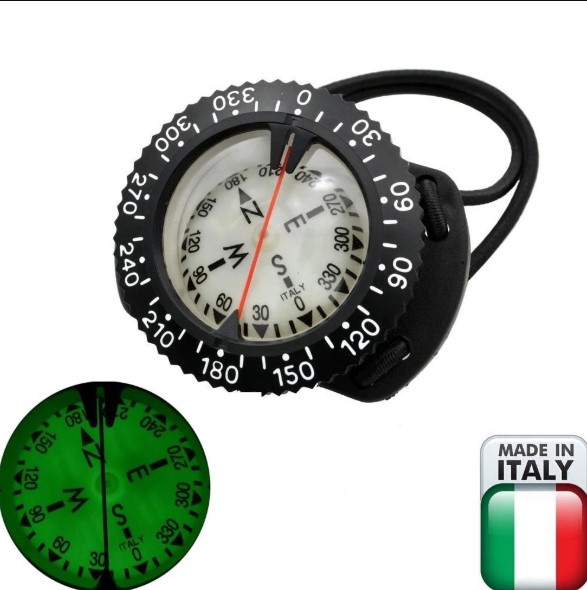
In this pilot 1 dive compass review, we will take a highly analytical, hands-on look at the PILOT 1 dive compass designed by Akuana. Engineered for recreational, professional, and technical divers alike, this instrument aims to deliver exceptional stability and effortless tracking. Its standout benefit is a generous tilt compensation window of up to 30 degrees, which prevents the internal dial from sticking or binding even when your wrist is not perfectly flat. If you need a durable navigation tool that can handle demanding marine environments, the PILOT 1 is certainly a model you should consider for your gear configuration.
Technical Specifications: How the PILOT 1 Measures Up
Before diving into how the compass performs in real-world environments, it is helpful to look at its structural and mechanical specifications. These details define how the instrument handles rapid depth changes, extreme temperatures, and rough handling on dive boats.
| Specification / Feature | PILOT 1 Details | Why This Matters to You |
|---|---|---|
| Housing Fluid | Highly viscous dampening oil | Prevents needle oscillation, providing a stable bearing when swimming in heavy surge or currents. |
| Maximum Tilt Angle | Up to ±30 degrees | Allows you to read your heading accurately without needing to keep your arm completely rigid and flat. |
| Bezel Design | Ratcheting bezel with deep-grooved dual rotation | Provides clear tactile feedback, making it easy to set and adjust your course even with thick 5mm or 7mm cold-water gloves. |
| Viewing Windows | Top-reading face with a dedicated side-reading window | Allows you to hold the compass directly in your line of sight to shoot highly accurate bearings across longer distances. |
| Luminescent Face | High-density phosphorescent coating | Absorbs light from your primary dive light rapidly and glows brightly during night dives or inside dark overhead environments. |
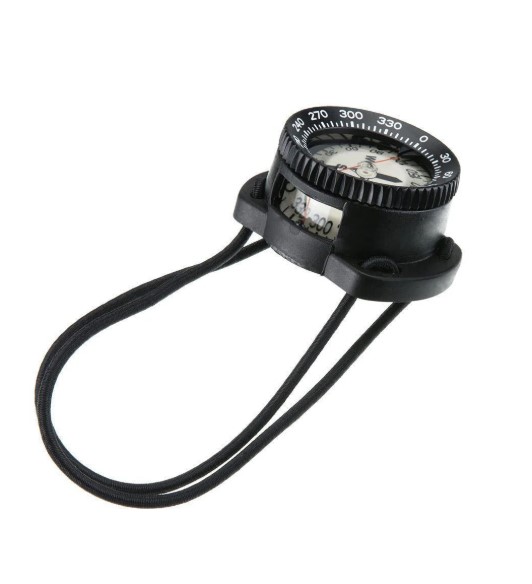
| Mounting Versatility | Modular boot compatible with wrist straps or bungee cords | Lets you customize how you secure the instrument, whether you prefer a classic buckle or low-profile, self-adjusting bungees over a drysuit. |
The Importance of Tilt Compensation in Underwater Navigation
One of the most frustrating experiences in underwater navigation is a sticky compass card. If you have ever used a cheap or poorly designed compass, you know that even a minor tilt of your arm can cause the internal disk to hit the top lens or bottom casing. When this happens, the dial stops rotating, giving you a frozen, incorrect reading. You might swim several hundred feet in the wrong direction before realizing the needle has been bound up the entire time.
The PILOT 1 addresses this vulnerability directly with its tilt tolerance of up to 30 degrees. This level of forgiveness is incredibly helpful when you are swimming through current, carrying a heavy underwater camera rig, or holding a dive light. You do not have to waste mental energy constantly checking to see if your wrist is perfectly parallel to the horizon. The card continues to float freely, aligning with magnetic north and letting you focus on your air supply, depth, and buddy contact.
Physical Build, Materials, and Durability
Dive gear must be rugged. It gets tossed into heavy gear bags, exposed to corrosive salt water, baked in the hot sun on the deck of a boat, and subjected to rapid pressure changes. The PILOT 1 is housed in a high-impact polycarbonate casing designed to withstand these realities. Polycarbonate is chosen for its superior shatter resistance and its ability to remain structurally stable under hydrostatic pressure.
The fluid inside the compass is an oil mixture carefully calibrated to resist temperature-induced expansion and contraction. Many cheap compasses develop large, annoying air bubbles inside the housing when brought from cold ocean depths into warm air. These bubbles can get trapped under the card, causing it to lean and bind. While the physical manual (which you can view in detail on the ADIP Official Manual on Scribd) outlines typical tolerances, the design of the PILOT 1 features a flexible bottom diaphragm that expands and contracts to prevent bubbles from forming under normal diving conditions.
Tactile Usability: Gloves vs. Bare Hands
If you dive in cold water, you know the frustration of trying to manipulate small, slick dials while wearing thick neoprene gloves. The bezel of the PILOT 1 features deep, aggressive ridges that provide excellent purchase for your fingers. The indexing clicks are crisp and heavy enough to feel through a 5mm glove, yet smooth enough to adjust with one hand when you are diving in temperate waters without hand protection.
Deep-Dive Performance: In the Water with the PILOT 1
To truly understand how this instrument behaves, we must evaluate it in various in-water scenarios. Let's break down how the design characteristics translate into practical benefits below.
1. Low-Light and Night Diving Legibility
Night diving and wreck exploration require highly visible markings. The PILOT 1 features a high-contrast black dial face with bright white, block-style markings. The luminescent compound used on the face of the compass holds a charge remarkably well. By shining your primary dive light directly onto the face for about ten seconds before you descend, you get a bright, clear glow that remains highly readable for the duration of a standard night dive.
Because the markings are sharp and clean, you do not have to squint or hold your dive light directly against the glass to read your bearing, which helps you maintain your night vision and keeps you from accidentally blinding your dive buddy.
2. Side-View Shooting for Precision Bearings
While looking straight down at the compass face is perfectly fine for basic heading checks, it is not the most accurate way to navigate a precise line over a distance. The PILOT 1 includes a robust side-reading window. By extending your arm and holding the compass directly in your line of sight, you can look straight through the window at your target while reading your numerical bearing simultaneously.
This technique is vital for search-and-recovery operations, underwater mapping, or swimming a direct line to a distant reef structure. It keeps your head up and your eyes on your surroundings, helping you spot underwater hazards or dive buddies without losing track of your bearing.
Comparing the PILOT 1 to Industry Standards
When looking at compass discussions across the diving community, particularly in the active Reddit Scuba Community, divers frequently compare different navigation styles and models. The conversation often circles back to classic models like the Suunto SK-8. Let's look at how the PILOT 1 stacks up against standard industry options:
The Standard SK-8 Benchmark
The SK-8 is widely respected for its fast response and tilt compensation. However, replacement boots and specialized bungee mounts for it can sometimes be expensive and hard to source when you need a quick repair before a trip.
The Akuana PILOT 1 Edge
The PILOT 1 provides equivalent tilt performance (up to 30 degrees) and a highly legible, clean luminescent display. Crucially, its modular boot is designed with standard channels, making it incredibly easy to configure with basic bungee cord without needing proprietary, high-priced accessories.
Mounting Options: Customizing Your Navigational Setup
Different types of diving call for different gear configurations. The PILOT 1 accommodates several popular styles of mounting:
- Wrist Strap: This is the classic setup. It uses a heavy-duty, adjustable strap that buckles securely around your arm. It is easy to put on, but can become loose as your wetsuit or drysuit compresses at depth.
- Bungee Mount (DIR Style): Highly favored by technical and cave divers. By threading surgical tubing or bungee cord through the integrated side channels, the compass becomes self-adjusting. As your exposure suit compresses under depth pressure, the bungee automatically tightens, keeping the compass securely in place on your forearm or back of your hand.
- Retractor Mount: For divers who prefer to keep their wrists free, the boot can be attached to a retractable cable clipped to a BCD D-ring. When you need to take a heading, you simply pull the compass out, hold it in front of you, and let it retract safely out of the way when you are finished.
Community Trust, Warranty, and Purchasing Security
Investing in safety-critical gear requires confidence in the manufacturer. Akuana has developed a solid track record for quality and support. On Trustpilot, customers consistently highlight the responsive customer service and rapid handling times of the company.
If you ever run into technical questions or require assistance setting up your gear, you can reach out directly via their Customer Support and Contact Page. Additionally, the company stands behind their manufacturing with a clear, straightforward terms of service policy, which you can read on their Warranty Policy and Terms page.
When you are ready to purchase, they offer a streamlined, encrypted checkout process supporting multiple global payment processors to ensure your details remain completely protected. You can view their secure gateway directly on the Official Payment Processing Portal.
Step-by-Step Guide: Executing a Reciprocal Course
The most fundamental navigation drill is swimming a reciprocal course—moving away from a point (like your anchor line) in a straight line, and then turning around and returning directly to your starting position. Here is how you execute this cleanly using the PILOT 1:
- Align Your Lubber Line: Point the physical center line of your compass directly in the direction you want to swim.
- Set Your Bezel: Rotate the outer bezel until the dual indicator marks (the double notches) are aligned directly over the North arrow on the rotating card.
- Swim Your Outward Leg: Swim forward while keeping the North arrow perfectly centered within those dual bezel marks. Count your kick cycles or monitor your elapsed time to keep track of your distance.
- Perform the Turn: When you are ready to head back, rotate your body until the North arrow points directly at the single index mark on the opposite side of your bezel (exactly 180 degrees from your starting position).
- Navigate Home: Swim back for the same number of kick cycles or minutes, keeping that new alignment steady. If your technique is correct, you will arrive right back at your starting point.
Video Demonstration and Review
For a visual breakdown of how to configure your compass, handle maintenance, and read headings under different light conditions, check out this comprehensive video review:
Maintenance and Care for Long-Term Reliability
A high-quality compass can last for years, if not decades, with basic care. Saltwater, UV radiation, and storage conditions are the primary factors that degrade dive instruments over time. To ensure your PILOT 1 remains perfectly calibrated and bubble-free, follow these standard practices:
- Freshwater Rinse: Always soak your compass in clean, fresh water after every day of diving. Salt crystals can build up under the rotating bezel, making it grind or stick.
- Avoid Direct Sun Exposure: Do not leave your compass sitting on the dash of your car or on the hot deck of a boat for extended periods. Intensive heat and UV exposure can age the internal dampening fluid, cause the plastic to become brittle, or encourage air bubbles to form inside the capsule.
- Keep Away from Magnetic Anomalies: Store your compass away from strong magnetic fields. High-power dive lights with magnetic switches, speakers, dive knife sheaths, or magnetic clip retainers can slowly depolarize or alter the alignment of the magnetic needle over time.
The Verdict: Is the PILOT 1 Right for Your Gear Bag?
After analyzing the design, materials, and real-world performance parameters, the Akuana PILOT 1 stands out as an incredibly reliable, highly functional underwater navigation tool. Its generous tilt compensation, durable polycarbonate housing, clear tactile feedback, and highly visible luminescent dial make it a dependable primary instrument or backup for technical setups.
By avoiding expensive, proprietary mounting boots and offering a rugged, straightforward layout, Akuana has made a premium-feeling navigation tool accessible to any diver. Whether you are navigating a zero-visibility quarry or charting a tropical reef, the PILOT 1 will keep you pointing in the right direction.
Frequently Asked Questions
Can the PILOT 1 be used in both the Northern and Southern Hemispheres?
Because of the dip angle of the Earth's magnetic field, standard mechanical compasses are balanced specifically for different geographic zones. While the PILOT 1's high 30-degree tilt compensation helps offset minor dipping issues, you should ensure you choose the correct regional calibration (Northern or Southern Hemisphere) upon purchase to guarantee absolute accuracy in your primary diving region.
What should I do if a tiny bubble appears inside the oil chamber?
Small micro-bubbles can occasionally form when changing altitude or diving in exceptionally cold water due to the natural contraction of the dampening fluid. These minor bubbles are completely normal and typically disappear once the instrument returns to room temperature and standard pressure. They will not affect the accuracy or rotation of the card unless they grow large enough to physically tilt the needle disk.
Why do technical divers prefer bungee mounts over standard wrist straps?
Standard rubber or nylon wrist straps do not compress. When you descend, the pressure compresses your wetsuit or drysuit, causing the strap to loosen and slip around your arm. Bungee cords are under constant tension, meaning they automatically shrink and adjust to your wrist size as your exposure suit compresses, keeping the compass facing upward in the exact same position throughout your entire dive profile.
How long does the luminescent glow last on a night dive?
The duration of the glow depends on how long and how intensely it was charged before descent. A ten-second charge with a modern, high-lumen LED dive light will provide highly legible luminescent glow for approximately 30 to 45 minutes of dark diving. You can easily recharge the face at any point during your dive by briefly shining your primary light onto the dial.

0 Comments