Understanding Underwater Navigation: The Crucial Role of a Reliable Analog Compass
Whether you're navigating a low-visibility muck dive in the Pacific Northwest, tracing the outer perimeter of an offshore wreck, or executing a precise search-and-recovery grid, underwater navigation is one of the most critical skills you can master. While modern dive computers are packed with advanced algorithms and digital sensors, they aren't infallible. Electronic compasses can freeze, lose calibration near metallic structures, or fail entirely when batteries run dry. That's why an analog backup is a mandatory safety item for serious divers.
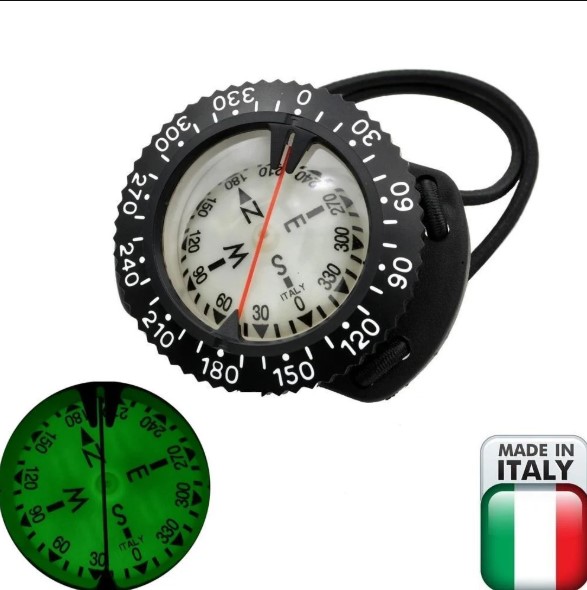
The Akuana Pilot 1 Dive Compass is a liquid-filled, mechanical navigation instrument engineered to deliver quick, reliable directional data under demanding conditions. Designed specifically for recreational, technical, and professional divers, this tool focuses heavily on high tilt tolerance and rapid response times. If you're looking for a dependable primary navigation device or a fail-safe backup that doesn't rely on battery power, the Pilot 1 is a remarkably robust choice that earns its place on your wrist or console.
We've spent hours analyzing technical drawings, diving deep into user feedback from online communities, and checking the Official ADIP Manual to verify proper instructional procedures. We also cross-referenced real-world experiences posted in popular diving communities like the Reddit r/scuba Dive Compass Discussion and customer ratings on the Akuana Trustpilot Page. We don't rely on generic marketing copy. Instead, we look at how the materials, mechanics, and design translate to actual underwater performance.
---
Technical Specifications and Build Quality of the Model PILOT 1
An underwater compass has to survive extreme environments: high hydrostatic pressure, abrasive saltwater, thermal shock, and the occasional impact against rocky ledges or steel wreck frames. The Akuana Pilot 1 is constructed to withstand these exact stressors.
Heavy-Duty Casing and Liqui-Core Damping
The compass module features a thick, pressure-resistant acrylic housing filled with a highly refined damping fluid. This liquid filling is critical for two reasons:
Pressure Equalization: Because liquid doesn't compress like air, the internal fluid prevents the outer acrylic dome from collapsing under pressure as you dive deeper. This allows the casing to remain perfectly intact even at depths well beyond standard recreational limits.
Card Stabilization: The viscosity of the fluid is precisely calibrated. It dampens the movement of the internal compass card, preventing it from spinning wildly when you change direction. This makes it much easier to read your heading while swimming through mild currents or surge.
The Luminescent Dial and Bezel Mechanics
The display face uses high-contrast markings that are easy to read in dark water. The cardinal points (North, South, East, West) are oversized, and the numerical degree indicators are spaced logically.
Phosphorescent Glow: The dial surface is coated with a luminescent compound that absorbs light. By shining your primary dive torch on the face for about ten seconds before a night dive, you get a clean, highly visible glow that remains readable in pitch-black conditions without causing glaring reflections that disrupt your night vision.
Positive-Click Bezel: The rotating bezel features deep, textured ridges. This design makes it easy to turn even when wearing thick 5mm neoprene gloves or drysuit mitts. The bezel clicks firmly into place, reducing the chance that an accidental bump against your gear will knock your set heading out of alignment.
---
The Mechanics of Tilt Tolerance: Why It Matters Underwater
One of the most frustrating aspects of cheap dive compasses is card binding. If you don't hold your arm perfectly flat, the internal compass card tilts, hits the top or bottom of the housing, and locks in place. When this happens, the compass stops rotating, giving you a frozen, false reading that can lead you completely off course.
The Model PILOT 1 address this issue with a generous tilt tolerance of up to 30 degrees.
The Advantages of a 30-Degree Tilt Range
In a perfect training pool, maintaining a perfectly horizontal posture (trim) is easy. In the real world, you're constantly dealing with external forces:
Surge and Swell: Swell pushes you back and forth, forcing you to use your hands or shift your body angle to maintain position.
Holding Other Gear: If you're holding a dive light, a camera tray, or a scooter, your wrist is rarely flat.
Natural Swim Posture: Divers naturally swim with a slight upward or downward wrist angle when checking their instruments.
The Pilot 1's internal card is balanced to rotate freely even when tilted up to 30 degrees in any direction. This design ensures that you get real-time, responsive tracking without constantly having to obsess over keeping your forearm perfectly parallel to the seabed.
---
Mounting Systems: Bungee Mount vs. Traditional Wrist Strap
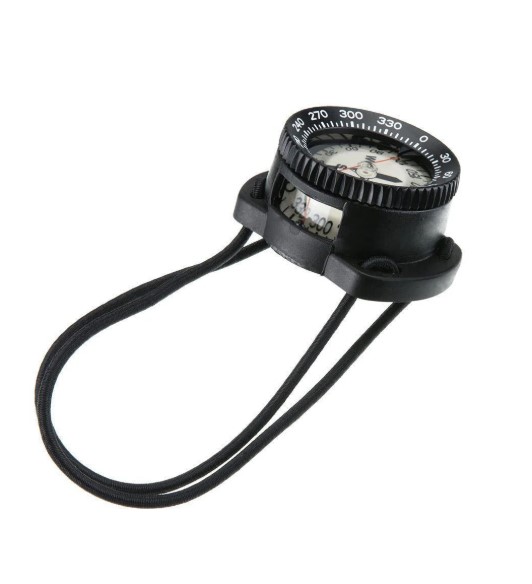
How you mount your compass can dictate how easily you can read it throughout a dive. The Akuana Pilot 1 is designed to support both traditional wrist strap setups and elastic bungee mounts, giving you the flexibility to customize your gear configuration.
Mounting Style
Pros
Cons
Best Suited For
Traditional Wrist Strap
Simple to don; secure buckle; classic styling.
Can become loose at depth as wetsuits compress.
Warm-water recreational diving with thin wetsuits or bare skin.
Bungee Mount Setup
Self-adjusting tension; fits over bulky drysuits; very low profile; easy to slip on/off.
Requires a specific boot housing; can feel bulky on bare wrists.
If you wear a traditional rubber or nylon strap over a thick 7mm neoprene wetsuit, the pressure at depth will compress the neoprene cells. What was a snug, secure fit on the surface becomes a loose, spinning strap at 90 feet. This can cause the compass to slip to the underside of your arm, making it impossible to read when you need it most.
By opting for a bungee mount, you solve this problem. The elastic bungee cords maintain continuous tension. As your suit compresses at depth, the bungees contract automatically, keeping the compass firmly anchored to your wrist or forearm. It's a simple, reliable solution favored by technical divers worldwide.
---
Real-World Scenarios: Putting the Pilot 1 to the Test
To understand the practical value of this navigation tool, let's look at how it performs in three common diving scenarios.
Scenario 1: Navigating a Reciprocal Course in Low Visibility
Imagine you're diving a local lake with a sandy bottom and visibility of less than six feet. Your goal is to swim from the entry point to a sunken training platform 100 feet away, then return safely.
Outward Leg: You align the lubber line (the fixed red line on the compass dome) with your center-line. You rotate the bezel until the double index marks frame the North arrow (or your target heading). You swim forward, keeping the arrow perfectly centered between those marks.
The Turn: Once you reach your destination and are ready to head back, you don't need to recalculate complex math. You simply rotate your body until the South arrow (or the single index mark on the opposite side of your bezel) aligns with your target.
The Pilot 1 Advantage: The smooth, liquid-dampened movement of the card ensures that even if you wobble or get pushed slightly off-balance by a kick cycle, the card settles instantly, letting you make micro-corrections before you wander off course.
Scenario 2: Drift Diving Along a Coastal Wall
During a drift dive in a moderate current, you're being swept along a wall at a steady pace. You need to keep track of your direction to ensure you don't drift too far out into open ocean where the currents can separate you from the dive boat.
Because you're drifting sideways, your body position is constantly changing as you look at the wall, check your gas, and monitor your depth.
With a standard, low-tolerance compass, you'd constantly have to correct your arm posture to keep the card from locking.
The Pilot 1's 30-degree tilt allowance lets you glance down at your wrist and get an accurate reading instantly, even if your arm is angled while you adjust your buoyancy or check your secondary instruments.
Scenario 3: Night Diving and Wreck Exploration
Navigating a wreck at night requires absolute concentration. You're managing a primary torch, keeping track of your buddy's light, and staying clear of sharp overhead hazards.
You don't have a spare hand to hold a light directly over your compass face constantly.
Because the Pilot 1 features a highly reactive luminescent dial, you can quickly sweep your dive torch across your wrist for a split second. The face glows brightly, allowing you to track your heading in your peripheral vision as you monitor the wreck's structure.
---
Step-by-Step Guide: How to Properly Hold and Align a Dive Compass
Even the finest compass in the world won't keep you on track if your physical alignment is incorrect. Most navigation errors aren't caused by the instrument; they're caused by the diver. Here is a step-by-step method to ensure precise readings:
Form a Square: Hold the compass with both hands. Extend your arms forward, keeping your elbows bent at a 90-degree angle. Clasp your hands together, or rest your compass-bearing arm on top of your opposite forearm. This forms a rigid, stable "control panel" directly in front of your chest.
Align the Lubber Line: The red lubber line running down the center of the compass dome must point exactly where your body is traveling. If the lubber line is angled even slightly to the left or right of your body's center-line, you will slowly swim in a circle, even if the compass card looks perfectly aligned.
Look Across the Face: Instead of staring straight down at the top of the dial, look across the top of the dome along the path of the lubber line. This helps you pick out a reference point in the distance—like a specific rock, coral head, or sea fan—so you can swim toward that target rather than staring blankly at your wrist.
Keep it Level (Within Reason): While the Pilot 1 has a generous 30-degree tilt limit, you should still aim to keep it as horizontal as possible. This minimizes mechanical drag on the pivot pin and ensures the card spins with maximum speed and responsiveness.
---
Analysing Community Feedback: Reddit and Trustpilot Insights
Before making any gear investment, it's smart to look at what the global diving community has to say. We've combed through various discussions and verified user portals to see where the Akuana Pilot 1 excels and where some divers might have reservations.
The Reddit Consensus
On the Reddit r/scuba Community, discussions about dive compasses usually center on three topics: tilt tolerance, mounting ease, and price-to-performance ratio.
The Verdict on Value: Many Redditors note that name-brand compasses from big-name manufacturers often carry a steep premium simply because of the logo. Users looking for reliable backup options frequently recommend looking at high-quality alternatives like the Pilot 1 because they offer the same mechanical reliability without the steep price tag.
Bungee Preference: Technical divers on the platform strongly advocate for bungee mounts, pointing out that the freedom to mount the device on either forearm, a hand mount, or even over a thick drysuit glove makes a massive difference in real-world usability.
The Trustpilot Perspective
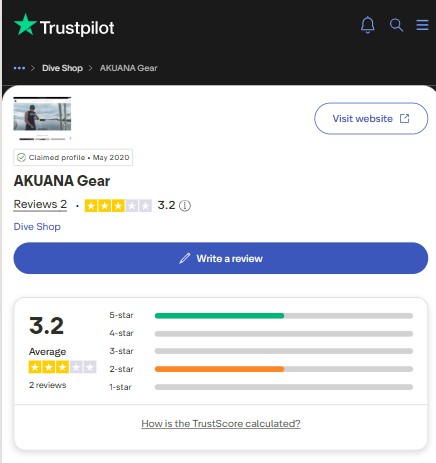
Akuana has built a positive reputation for customer service, as evidenced by user comments and structural feedback on their Trustpilot Profile.
Key takeaways from verified buyers include:
Responsive Support: Customers highlight that the support team is communicative, helping resolve shipping queries and tracking questions promptly.
Fast International Delivery: For a brand serving global diving markets, clear logistics tracking is essential. Divers have noted that packages arrive well-packed, preventing damage to the delicate, liquid-filled cores of instruments like the Pilot 1.
---
Video Walkthrough: Seeing the Mechanics in Action
For a visual demonstration of how a high-tilt dive compass responds to physical rotation and tilt under water, check out this video breakdown. It highlights the subtle movements of the internal card and the responsiveness of the bezel mechanics:
---
Head-to-Head Comparison: Akuana Pilot 1 vs. Industry Standards
To help you decide if this model is right for your gear bag, let's compare the Akuana Pilot 1 with two of the most recognizable analog compasses on the market: the Suunto SK-8 and the Scubapro FS-2.
Feature
Akuana Pilot 1
Suunto SK-8
Scubapro FS-2
Tilt Tolerance
Up to 30 degrees
Up to 30 degrees
Up to 35 degrees
Mounting Options
Wrist strap & Bungee ready
Wrist strap, Console, or Bungee
Wrist strap or Retractor
Luminescence
High-visibility phosphorescent
Standard phosphorescent
Moderate luminescence
Value Proposition
High (excellent balance of performance and cost)
Moderate (premium brand pricing)
Moderate (expensive housing options)
Analysis of the Matchup
Akuana Pilot 1 vs. Suunto SK-8: The Suunto SK-8 is widely regarded as an industry standard, but it carries a higher price tag. The Pilot 1 offers a nearly identical tilt tolerance and clean, responsive card dampening, making it an incredibly competitive alternative for divers who want reliable performance without paying a premium for a brand name.
Akuana Pilot 1 vs. Scubapro FS-2: The FS-2 boasts a slightly higher tilt tolerance of 35 degrees, but its unique, elongated profile can feel bulky on smaller wrists. The Pilot 1 maintains a more traditional, streamlined footprint that sits lower on your arm, reducing the risk of snagging on lines or gear straps.
---
Behind the Brand: Shipping, Warranties, and Customer Support
When you buy diving gear online, you need to know that the manufacturer stands behind their product. A compass is a life-safety tool, so solid customer support and a clear warranty policy are just as important as the physical build.
Shipping Policies and Delivery Reliability
According to the Akuana Shipping and Contact Policy, the company offers reliable global shipping. All packages are tracked, ensuring you can monitor your shipment from the warehouse directly to your doorstep. This tracking is particularly valuable for divers preparing for an upcoming trip who need their gear to arrive before their departure date.
Warranty Protection and Service Terms
Your purchase is protected by a structured return and warranty policy outlined in the Akuana Terms of Service. If your compass arrives with any manufacturing defect, such as a bubble in the liquid core (which can occasionally happen during rapid altitude changes in air shipping) or a stiff bezel, you can contact their support channel for assistance.
Customer Support Accessibility
Should you need help setting up your bungee mount or have questions about northern vs. southern hemisphere balancing, you can reach out directly via the Akuana Customer Support Channel. Their team is responsive and highly knowledgeable about their entire equipment lineup.
Secure Checkout and Payment Options
When ordering online, transactions are processed through a highly encrypted, secure portal. You can view the checkout environment and supported payment methods by visiting the Akuana Secure Payment Gateway, which supports major credit cards, PayPal, and modern digital wallets, keeping your personal and financial information completely safe.
---
The Verdict: Is the Akuana Pilot 1 Dive Compass Worth a Spot in Your Gear Bag?
After evaluating the technical design, material selection, and actual dive usability, it is clear that the Akuana Pilot 1 is a premier mechanical navigation tool.
What We Love:
High Tilt Tolerance: The 30-degree tilt allowance is highly forgiving, making navigation smoother and more intuitive in real-world conditions.
Robust Fluid Damping: The liquid core keeps the card steady in choppy water or current, eliminating frustrating needle wobble.
Versatile Mounting: Having the choice between a classic wrist strap and a technical bungee boot is a massive plus.
Excellent Glow: The highly reactive luminescent face is bright, clear, and perfectly suited for night dives or low-visibility wrecks.
Considerations:
Hemisphere Calibration: Like most high-quality mechanical compasses, the internal card must be balanced for either the Northern or Southern hemisphere to prevent the needle from dipping and rubbing against the housing. Make sure you select the correct version for your primary diving region.
Whether you are a newly certified open-water diver practicing your first reciprocal courses or an experienced technical diver exploring deep overhead environments, you need navigation data you can trust. The Akuana Pilot 1 delivers exceptional reliability, rugged durability, and flawless mechanical performance at a price point that makes sense. It is an investment that will keep you safely on course for years to come.


0 Comments