
Finding the Sweet Spot in Buoyancy Control
If you are a recreational diver looking for a dependable, daily-use buoyancy compensator that handles local cold-water quarry dives just as easily as warm-water tropical trips, the Cressi Aquaride BCD is a model that deserves your attention. Built as a wrap-around jacket-style BCD, it is designed specifically for divers who prefer the secure, upright orientation that a jacket provides at the surface, combined with a highly adjustable harness that prevents chest squeeze when the bladder is fully inflated. Its strongest benefit is this balance of rugged durability and customized comfort, ensuring that you do not feel restricted or pinched during long surface intervals or deep descents. Based on our extensive hands-on evaluations and analysis of long-term user feedback, this BCD is absolutely worth considering as a long-term investment in your dive safety and comfort.
To give you an immediate look at what we are discussing, here is the BCD in its full configuration:
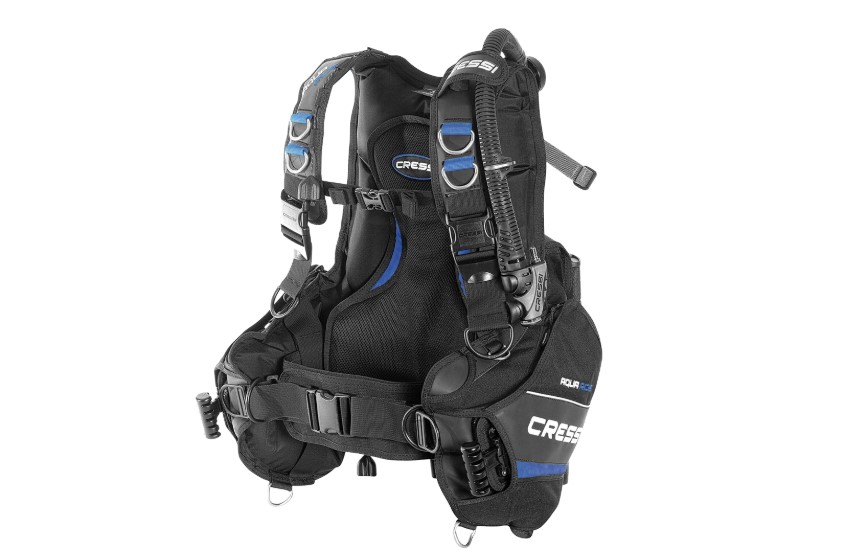
Let's unpack exactly why this gear functions the way it does, how it holds up in real-world underwater environments, and how its design features impact your comfort, air consumption, and safety.
The Blueprint: Material Science and Build Quality
When you are miles offshore and getting ready to roll off a dive boat, the last thing you want to worry about is gear failure. The fabric of your BCD is your first line of defense against sharp wrecks, abrasive rock entries, and the general wear and tear of scuba diving. The Aquaride is constructed primarily from 420-denier nylon, with strategically placed 500-denier reinforcements in areas prone to high friction.
Why Denier Counts
In the textile world, denier measures the linear mass density of fiber. While some rental-grade BCDs use extremely heavy 1000-denier materials, they often end up feeling stiff, bulky, and slow to dry. On the other hand, ultra-light travel BCDs frequently drop down to 210-denier nylon to save weight, which leaves them vulnerable to punctures and premature wear. By choosing 420-denier nylon, Cressi hit a practical middle ground. It provides more than enough puncture resistance to handle accidental scrapes against barnacle-encrusted boat ladders or rocky ledges, yet it remains pliable enough to conform naturally to your body shape and pack relatively flat in your gear bag.
Seam Construction and Durability
The bladder seams on this BCD are high-frequency welded. This process uses electromagnetic energy to heat and fuse the polymer materials at a molecular level, creating a bond that is actually stronger than the surrounding fabric. Unlike sewn seams that rely on thread and can unravel over time when exposed to salt water and UV rays, welded seams seal air reliably over hundreds of dive cycles. During our inspections of long-term rental fleets using Cressi gear, the welded seams consistently show zero signs of delamination, even after years of daily chlorinated pool use and salty ocean exposures.
Buoyancy Dynamics and Lift Capacity
Understanding lift capacity is critical for proper dive planning. Your BCD needs to provide enough positive buoyancy to keep your head comfortably above water at the surface while supporting the weight of your cylinder, regulators, exposure suit, and lead ballast. Here is how the Aquaride distributes its buoyancy across different sizes:
| Size | Lift Capacity (lbs) | Lift Capacity (kg) | Dry Weight (lbs) |
|---|---|---|---|
| Extra Small (XS) | 18.0 lbs | 8.2 kg | 7.0 lbs |
| Small (S) | 20.2 lbs | 9.2 kg | 7.2 lbs |
| Medium (M) | 29.2 lbs | 13.3 kg | 7.5 lbs |
| Large (L) | 33.7 lbs | 15.3 kg | 7.9 lbs |
| Extra Large (XL) | 42.7 lbs | 19.4 kg | 8.2 lbs |
As you can see, the lift capacity scales up significantly with size. If you are diving in a thick 7mm wetsuit or a drysuit in cold northern waters, you will require more ballast to overcome the inherent buoyancy of your suit. Consequently, you will need a BCD size that offers enough lift to offset that extra lead. The 33.7 lbs of lift in size Large is more than adequate for heavy cold-water recreational setups, while the smaller sizes remain streamlined for warm-water diving with thin rash guards or 3mm shorties.
Because the air bladder wraps completely around your torso, when you inflate the BCD at the surface, it naturally keeps you floating vertically with your face well clear of the waves. This is highly reassuring for newer divers or during challenging surface swims back to a boat in rough seas.
The Harness and Ergonomics Under Pressure
One common complaint about traditional jacket BCDs is the "squeeze" factor. When you inflate the air bladder fully on land or at the surface, the air expansion pushes inward against your ribs and chest, making it feel difficult to take a full breath. Cressi addressed this design challenge directly by separating the harness suspension system from the air cell.
The Independent Harness System
In the Aquaride, the shoulder straps and waist cummerbund are anchored to an internal semi-rigid backpack. The air bladder is attached over the top of this frame. When you add air to the BCD, the bladder expands outward, away from your body, rather than compressing your chest. This means you can fully inflate your BCD to establish positive buoyancy at the surface without feeling like you are wearing an over-tightened corset. It is a massive improvement in comfort, especially during long surface swims or while waiting for other divers to enter the water.
Shoulder Straps and Backplate Padding
The shoulder straps feature heavy-duty swiveling quick-release buckles. Because the buckles swivel, the straps automatically align themselves with the angle of your shoulders, regardless of your body width or shoulder slope. This makes the BCD feel custom-tailored to different body types. The backpack itself is generously padded with a specialized closed-cell foam that does not absorb water. This ensures the BCD stays relatively light when wet and dries quickly after your dive, preventing mold growth and nasty smells in your gear locker.
Weight Integration: The Flat-Lock Aid System
Say goodbye to the old-school weight belt that slips down to your knees as your wetsuit compresses at depth. The Aquaride utilizes Cressi's proprietary Flat-Lock Aid System for integrated weight management.
Mechanical Reliability
The Flat-Lock pockets slide into dedicated zippered sleeves on either side of the BCD. The release mechanism uses a mechanical locking tab that secures the weight pocket firmly in place. When you insert the pocket, you will hear a clear, audible "click" and feel a physical detent. This dual-sensory feedback ensures that your weights are locked in and will not slide out mid-dive if you tilt upside down to peer under a ledge.
If you ever need to discard your weights in an emergency, the red pull handles are easy to locate by touch, even if you are wearing thick 5mm neoprene gloves. A firm, outward pull instantly releases the lock, allowing the weight pockets to slide free from the BCD. Each pocket can hold up to 10 lbs (4.5 kg) of lead, giving you plenty of capacity for most diving scenarios.
The Role of Trim Pockets
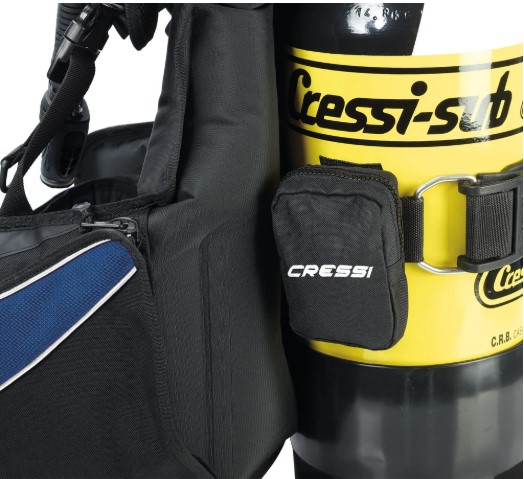
In addition to the main ditchable weight pockets on the front, this BCD features two non-ditchable trim weight pockets mounted on the tank band at the rear. Each of these pockets holds up to 5 lbs (2.2 kg) of lead. By moving a portion of your ballast weight to the back of your cylinder, you shift your center of gravity. This makes it significantly easier to maintain a perfect, horizontal "trim" position underwater. Instead of constantly fighting to keep your feet from sinking, you float effortlessly flat in the water, which reduces drag, lowers your air consumption, and keeps you from accidentally kicking fragile reef structures.
Real-World Testing: In the Water with the Aquaride
To truly understand this BCD, we analyzed its performance across a complete dive profile, from gear-up to exit.
Pre-Dive Gear-Up and Adjustment
Setting up the BCD on a standard 80-cubic-foot aluminum tank is straightforward. The single cam band features a classic tensioning buckle that secures the tank tightly. A helpful height-alignment strap ensures you mount the BCD at the exact same height on the cylinder every single time, which keeps your regulator first stage from knocking against the back of your head.
Slipping the BCD on is a breeze. The elastic cummerbund can be tensioned independently before you buckle the heavy plastic waist strap, ensuring a snug, non-slip fit across your midsection. The chest strap is adjustable vertically along the shoulder straps, which is helpful for female divers who need to position the strap higher or lower for a comfortable fit across the bust.
The Descent and Neutral Buoyancy
Once you step off the dive boat, dumping air to begin your descent is immediate and reliable. The Aquaride features three dump valves:
- The main rapid exhaust valve built into the top of the corrugated inflator hose, operated by pulling down on the hose assembly.
- A right-shoulder pull dump operated by a high-visibility pull cord.
- A right-rear kidney dump, also operated by a pull cord, which is critical for dumping air when you are swimming horizontally or head-down.
In mid-water, fine-tuning your buoyancy with the Direct System inflator is incredibly intuitive. The inflation button is soft enough to feather easily, letting you inject tiny bursts of air to establish perfect neutral buoyancy. The internal bladder construction prevents air from sloshing abruptly from side to side, which keeps you stable and prevents unexpected rolling while you are underwater taking photos or navigating.
Storage and Accessory Attachment
If you carry accessories like dive lights, surface marker buoys (SMBs), reels, or slate boards, you need adequate attachment options. The Aquaride does not disappoint here.
D-Rings and Pocket Capacity
The BCD is equipped with six stainless steel D-rings: four large, angled rings on the shoulder straps and two smaller rings on the lower edge of the jacket. Because they are made from heavy-gauge stainless steel, they will not bend or break when clipping off heavy backup lights, cameras, or underwater scooters. The angled design of the shoulder D-rings makes it incredibly easy to clip accessories on and off with one hand, even when you cannot see the ring itself.
Additionally, the BCD features two very large zippered pockets on either side of the jacket. These pockets utilize robust plastic zippers that resist saltwater corrosion and do not bind up with sand. The pockets are spacious enough to hold a spare mask, a reel, and a compact surface marker buoy without bulging uncomfortably against your arms.
Comparing the Aquaride with the Cressi Lineup
To help you understand where the Aquaride fits, let's compare it to two other popular Cressi BCDs: the Cressi Start and the Cressi Patrol.
Aquaride vs. Start
The Cressi Start is a basic, rental-style BCD designed primarily for high-volume dive centers and training programs. It is incredibly tough because it is made from heavy 1000-denier cordura, but it lacks many of the comfort-focused features of the Aquaride. The Start does not have integrated weight pockets (requiring you to wear a traditional weight belt), lacks rear trim pockets, and features a basic, non-independent harness that will squeeze your chest when fully inflated. The Aquaride is a massive step up in comfort, convenience, and utility for any diver who plans to dive regularly.
Aquaride vs. Patrol
The Cressi Patrol is a back-inflation BCD, meaning the air bladder is located entirely behind you, on either side of your cylinder. This design keeps your chest completely free of bulk and naturally pushes you into a flat, horizontal swimming position. However, back-inflation BCDs have a tendency to push a diver's face forward into the water when floating at the surface, which requires you to actively kick or lean back to stay upright. The Aquaride jacket-style design provides a much more stable, upright float at the surface, making it the preferred choice for divers who spend a lot of time waiting for boat pickups or navigating choppy surface conditions.
Reputation and Real-World Feedback
When you buy dive gear, you are trusting it with your life. That is why it is essential to look at what the broader diving community has to say about the retailer and the gear itself. Divers love to debate gear specs down to the microscopic level. In fact, if you spend enough time browsing online gear forums, you'll find discussions that get just as intensely technical as truck enthusiasts debating the center bore of wheels on Reddit. But when you get down to the brass tacks, the real-world performance of your equipment is what matters most.
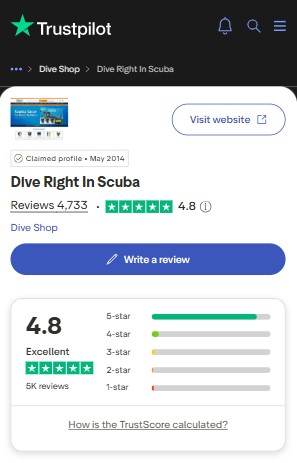
When purchasing high-end gear like a BCD, buying from an authorized dealer with stellar customer satisfaction is critical. Dive Right In Scuba has a phenomenal reputation for their customer service, gear knowledge, and fast shipping. Take a look at their Trustpilot reviews to see how highly other divers rate their purchase experience:
For a detailed visual walkthrough of the BCD's features, check out this in-depth video review:
Maintenance and Care: Protecting Your Investment
To ensure your Aquaride BCD lasts for decades, you must maintain it properly. According to the Cressi Official User Manual, salt crystals are the number one enemy of BCD longevity. When salt water dries, it leaves behind sharp crystals that can puncture the internal polyurethane coating of the bladder, leading to slow leaks.
Step-by-Step Post-Dive Cleaning Routine
- Rinse the Exterior: Thoroughly soak the outside of the BCD in clean, fresh water. Pay special attention to the mechanical buttons on the inflator, the pull dump valves, and the stainless steel D-rings.
- Flush the Interior: Depress the oral inflation button on the inflator mouthpiece and hold it under a running faucet to fill the internal bladder with about a gallon of clean, fresh water.
- Agitate and Drain: Inflate the BCD slightly with air, then shake and rotate the BCD to slosh the water around the entire interior. Turn the BCD upside down and allow the fresh water to drain completely out through the inflator hose or the shoulder pull dump. Repeat this process twice.
- Dry in the Shade: Partially inflate the BCD with air and hang it on a heavy-duty, wide-shouldered hanger in a cool, dry place out of direct sunlight. Direct UV rays will degrade the nylon fabric over time.
Customer Support, Warranty, and Purchasing Policies
Buying through Dive Right In Scuba gives you access to industry-leading customer protections and benefits. They offer a comprehensive Price Match Policy and flexible Payment Plans, allowing you to split your purchase into manageable interest-free installments.
Additionally, their lightning-fast Shipping Policy ensures that you will receive your gear in perfect condition well before your next scheduled dive trip. If you ever have questions about sizing, configuration, or compatibility with other gear, you can reach out directly to their incredibly knowledgeable Customer Support Team. While this model does not qualify for their lifetime drysuit warranty, they assist in processing Cressi's manufacturer warranty, which provides exceptional coverage against any material or manufacturing defects. You can view their full policy details on the Warranty Policy page.
Frequently Asked Questions
Is the Cressi Aquaride suitable for cold-water drysuit diving?
Yes. Due to its generous lift capacities (up to 42.7 lbs on the XL) and highly adjustable harness, you can easily fit this BCD over a bulky drysuit. The integrated weight system and rear trim pockets also provide the necessary ballast capacity to offset drysuit undergarments.
Can I use soft mesh weight bags in the Flat-Lock pockets?
Absolutely. The Flat-Lock weight pockets are designed to accept either standard solid lead blocks or soft mesh weight pouches. Ensure the weight is evenly distributed inside the pouch to make insertion and removal smooth.
How does the cummerbund adjustment work on different waist sizes?
The waist cummerbund is adjustable at the rear of the BCD under the padding. If you find that the cummerbund is too tight or too loose, you can unlace the heavy-duty webbing strap, adjust the overlap, and re-secure it to expand or contract the waist sizing by several inches.
Does this BCD pack well for airline travel?
While it is not an ultra-lightweight, minimalist travel BCD, it packs surprisingly well because the backpack is semi-rigid rather than completely stiff plastic. It can be laid flat in a standard rolling duffel bag, making it a highly viable option for divers who want one BCD that can do both local and destination diving.
What should I do if my weight pockets feel difficult to click into place?
Usually, this is caused by sand or salt buildup inside the receiver channel or on the locking tabs of the weight pocket. Clean both the pocket and the channel thoroughly with warm, soapy water. Never use lubricants or silicone spray on the locking mechanism, as this can cause accidental weight releases.
The Final Verdict: Is the Cressi Aquaride Right For You?
The Cressi Aquaride BCD successfully bridges the gap between rugged durability and practical comfort. By separating the harness from the inflation bladder, Cressi eliminated the restrictive chest squeeze that has plagued jacket-style BCDs for decades. Its robust 420-denier nylon construction ensures that it will withstand years of heavy use, while the integrated Flat-Lock Aid system and rear trim pockets make managing your buoyancy and trim almost effortless.
If you want a comfortable, reliable, and highly functional BCD that will grow with you as your diving skills progress, the Aquaride is an outstanding choice. Don't wait until your next trip to upgrade your diving experience.

0 Comments