
An Honest Assessment of the Cressi Aquaride Blue Pro BCD
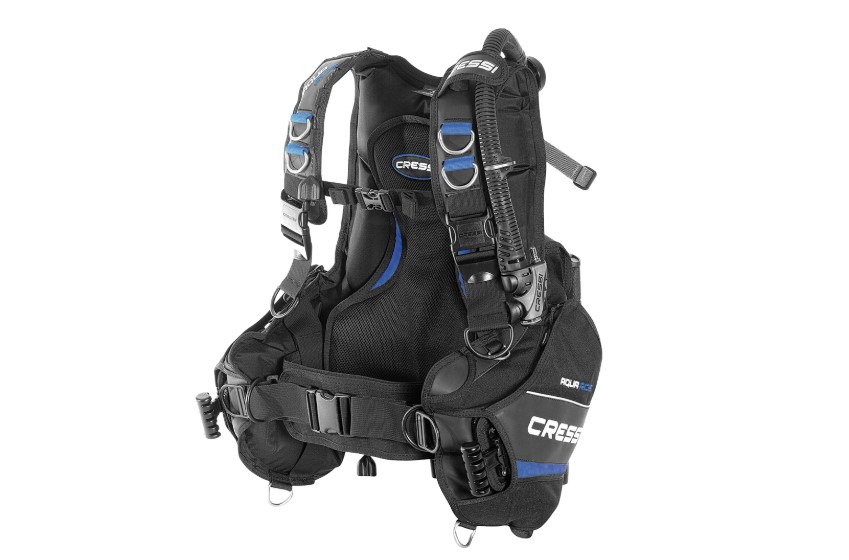
The Cressi Aquaride Blue Pro BCD is a robust, jacket-style buoyancy control device designed for recreational divers who demand a highly stable, dependable, and comfortable wrap-around jacket for both warm-water reef diving and colder-water drysuit configurations. Its strongest benefit is its wrap-around air bladder design, which provides exceptional vertical stability at the surface while keeping you perfectly horizontal and balanced underwater. If you're looking for an incredibly durable BCD that simplifies your buoyancy control and stands up to years of heavy salt-water use, this model is absolutely worth considering.
Why Your Buoyancy Control Device is Your Underwater Anchor
In my twenty-plus years of teaching open water courses and exploring shipwrecks, I've seen divers fight their gear more than they enjoy the ocean. Your BCD isn't just a harness to hold your tank; it's the command center for your entire dive. If your BCD doesn't fit correctly, or if the air migrates unpredictably inside the bladder, you'll spend your dive constantly adjusting your trim, wasting precious air, and tiring yourself out. The Aquaride BCD tackles this fundamental problem by focusing on structured stability.
A classic jacket-style BCD wraps the air bladder completely around your torso. When you inflate the jacket, the air distributes to the sides and front, as well as the back. This wrap-around design is highly favored by recreational divers because it keeps your head completely clear of the water when you're waiting on the surface for the dive boat to pick you up. Back-inflation BCDs, while excellent for horizontal trim, have a natural tendency to push your face forward into the water when fully inflated at the surface. For divers who spend substantial time at the surface or value vertical stability, the Aquaride’s jacket design is incredibly reassuring.
Material Integrity: The Physics of 420 vs. 1000 Denier Nylon
When you're gear-shopping, you'll see a lot of numbers thrown around, like "denier." Denier is a unit of measurement that determines the structural thickness of individual threads in a woven fabric. Cheap travel BCDs often use 200-denier or thin polyester fabrics to save weight. The problem is that these materials tear easily when brushed against sharp barnacles, rusted metal on a wreck, or even the rough edges of a dive boat's ladder.
Cressi didn't compromise on durability here. The main bladder of the Aquaride is constructed from a hybrid of 420-denier nylon and tough 1000-denier nylon on the high-wear exterior panels. 1000-denier nylon is incredibly tough; it's the same material used in tactical gear and heavy-duty luggage. By utilizing 1000-denier nylon on the outer pockets and shoulder strap interfaces, Cressi ensures that rubbing against your tank rack or scraping along a reef wall won't result in a catastrophic bladder puncture. Meanwhile, the 420-denier nylon used on the interior bladder keeps the BCD flexible enough to mold comfortably to your body shape without feeling like you're wearing a rigid suit of armor.
This material combination also resists fading from UV rays and limits the absorption of saltwater, which can weaken fibers over time. When you rinse this BCD after a dive, the water sheds off the fabric quickly, allowing it to dry much faster than pure canvas or heavy Cordura-only BCDs. This is a massive benefit if you're packing your gear into a gear bag at the end of a trip and want to avoid that musty, mildew smell.
The Flat-Lock-Aid Integrated Weight System: Mechanics and Safety
For decades, divers had to wear heavy, uncomfortable lead weight belts around their waists. These belts had a nasty habit of slipping down over your hips as your wetsuit compressed at depth, leading to frantic adjustments mid-dive. Integrated weight systems solved this, but they introduced a new issue: weight pockets accidentally slipping out and causing rapid, uncontrolled ascents.
The Aquaride features Cressi's proprietary Flat-Lock-Aid weight system. Unlike older models that relied solely on velcro to secure your weights, the Flat-Lock-Aid system utilizes a physical, mechanical buckle. When you slide the weight pouch into the pocket, you will hear a clear, audible "click." This click tells you that the mechanical latch has engaged. To release the weights in an emergency, you don't have to fumble around for a hidden clip; you simply grab the large, highly visible red handles and pull straight outward. The mechanical lock disengages instantly, allowing you to drop your weights and establish positive buoyancy.
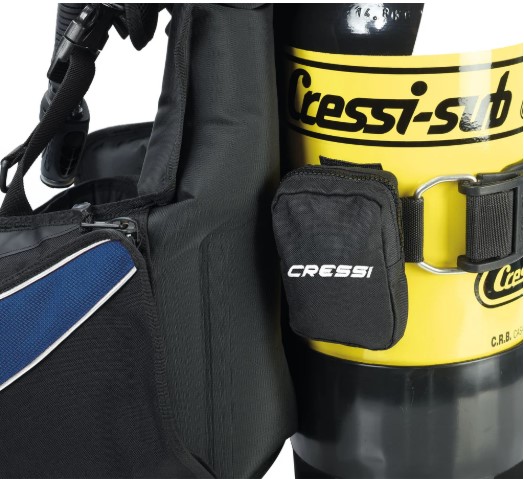
Each weight pocket can hold up to 20 pounds of lead in total (depending on the BCD size), which is more than enough for most cold-water drysuit divers. Because the pockets are flat, they don't stick out awkwardly from your sides. This streamlined profile reduces water resistance as you swim, saving you energy and reducing your air consumption rate. Additionally, there are two rear trim pockets located on the tank band. Placing a couple of pounds of non-releasable weight in these trim pockets helps position your center of gravity perfectly, keeping your hips up and your body in a hydrodynamic horizontal line while swimming.
Ergonomics and the Rigid Backplate Design
If you've ever dived with a BCD that has a soft, unreinforced backplate, you know how uncomfortable it is to feel a heavy steel tank pressing directly against your spine. A shifting cylinder can throw off your balance, making you feel unstable throughout the dive. Cressi addresses this with a fully rigid, anatomically shaped backplate.
This rigid backplate acts as the structural spine of the BCD. It distributes the weight of your cylinder evenly across your hips and shoulders, rather than letting it pull down on your lower back. The backplate is heavily padded with closed-cell foam that doesn't absorb water, ensuring that it remains comfortable and cushioned without adding extra, unwanted positive buoyancy. The padding extends over your shoulder blades and down to your lower lumbar region, providing a soft barrier between you and your gear.
The shoulder straps are designed with an anatomical curve that moves naturally with your arms. They are attached directly to the backplate, which means that when you adjust the shoulder straps, you are pulling the tank closer to your body for better stability, rather than squeezing your chest. A depth-compensating elastic cummerbund sits underneath the heavy-duty waist buckle. As you descend and your wetsuit compresses under pressure, the elastic cummerbund contracts automatically, keeping the BCD snug against your waist without restricting your breathing.
Valves, Controls, and Deflation Mechanics
Buoyancy control requires precise, incremental adjustments. The Aquaride utilizes Cressi’s classic Ergo Inflator, a highly reliable and intuitive control unit that fits naturally into your left hand. The inflation button is oversized and textured, making it easy to locate and operate even if you're wearing thick 5mm neoprene gloves. The deflation button provides a smooth, progressive release of air, allowing you to fine-tune your depth with absolute precision.
To ensure you can dump air quickly in any orientation, the BCD features three separate dump valves:
- The Left Shoulder Cable-Pull Dump: Activated by pulling down firmly on the corrugated inflator hose. This is the quickest way to vent air when you are swimming vertically or ascending.
- The Right Shoulder Rapid Exhaust Valve: Operated by a pull-cord located on your right shoulder. This is incredibly useful for venting air when you are swimming in a horizontal position and don't want to raise your left arm.
- The Rear Lower Right Dump Valve: Located on the lower right flank of the bladder. If you are swimming in a head-down position to inspect a crack in a reef, pulling this lower dump cord allows air to escape from the rear of the bladder, preventing an unwanted run-away ascent.
Understanding how and when to use these valves is critical for safe diving. Having three distinct options means you'll never have to struggle to get your body into an awkward vertical position just to vent air and control your rate of ascent.
Storage, Utility, and Accessory Integration
As a reviewer, one of my biggest pet peeves is a BCD with tiny, useless pockets. If you can't fit a spare mask, a folding snorkel, an SMB (Surface Marker Buoy), and a slate into your pockets, then the BCD isn't practical for real-world diving. Cressi designed the Aquaride with two massive, zippered utility pockets that wrap around the lower sides of the jacket.
These pockets are angled slightly downward, which makes opening and closing the heavy-duty zippers incredibly easy under water. The pockets are spacious enough to hold your gear without bulging out and catching on surrounding structures. Even when the air bladder is fully inflated, the outer pocket fabric remains flexible enough to allow easy access to your stored items.
For external gear attachment, the Aquaride is equipped with six D-rings: four 50mm stainless steel D-rings on the shoulder straps, and two 25mm D-rings on the top edge of the pockets. The shoulder D-rings are pre-bent (angled slightly outward), which makes clipping on your backup lights, camera lanyards, or pressure gauge consoles simple and intuitive. You don't have to pry the metal ring away from your chest to slide a bolt-snap on; the angled design keeps the ring standing proud of the webbing, ready for immediate attachment.
Insights from the Official User Manual
A deep dive into the Official Cressi BCD User Manual reveals several critical engineering details that divers must be aware of. Cressi stresses the importance of performing a pre-dive inspection before every single splash. This includes checking the overpressure valves to ensure the springs are operating freely and verify that no salt crystals have formed around the rubber gaskets, which could cause a slow air leak.
The manual also outlines the specific maintenance protocols required to protect your warranty and ensure the longevity of your gear. After diving, you must rinse the BCD both externally and internally. To rinse the interior of the bladder, you press the manual deflation button on the inflator head, hold it against a freshwater tap, and fill the bladder about one-third full of clean, fresh water. You then inflate the BCD orally, shake the water around to dissolve any salt crystals that have formed inside, and drain the water out through the lower dump valve. This simple routine prevents salt crystals from scratching the delicate inner lining of the bladder, ensuring your BCD remains airtight for years.
Verifiable Customer Experiences and Community Consensus
When purchasing life-support equipment, it's essential to look at the track record of the retailer and the experiences of other divers in the community. Dive Right In Scuba is highly respected in the diving industry, earning an outstanding rating on Trustpilot.
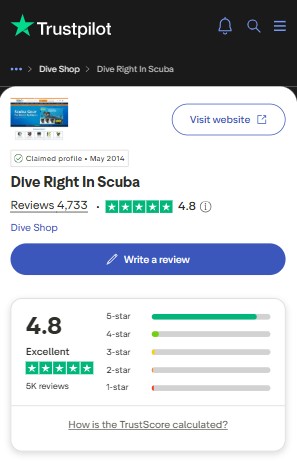
Customers consistently praise the dealer for their lightning-fast shipping, accurate sizing advice, and responsive customer support. If you're unsure which size to order, checking out the Dive Right In Scuba Trustpilot Reviews will show you that their staff is comprised of actual, active divers who can walk you through the sizing matrix to ensure you get the perfect fit on your first try.
While researching general community discussions, we did notice some funny, miscategorized forum links out there—like this highly random Reddit thread on Ford Ranger wheel center bores—but when you look at actual scuba forums like ScubaBoard, the consensus on the Aquaride is incredibly consistent. Divers highlight its durability as its standout feature. Many recreational instructors note that they use the Aquaride as their daily rental or teaching BCD because it can take a massive beating from students and continue to function flawlessly season after season.
For a complete visual walkthrough of the BCD's physical features, including how the weight pockets lock into place and the design of the shoulder straps, you can watch this highly detailed video analysis:
Check out the visual breakdown of the Aquaride's features on YouTube.
Sizing and Buoyancy Specifications Matrix
Choosing the correct size is crucial for ensuring proper lift and preventing the BCD from shifting while you're in the water. Below is the detailed sizing matrix for the Aquaride BCD, outlining the dry weight of the unit and the exact lift capacity (measured in both Newtons and Pounds) for each size configuration.
| Size | Diver Weight (lbs) | Buoyancy Lift (N) | Buoyancy Lift (lbs) | Dry BCD Weight (lbs) |
|---|---|---|---|---|
| XS | 100 - 130 | 80 N | 18.0 lbs | 6.8 lbs |
| S | 120 - 155 | 110 N | 24.7 lbs | 7.0 lbs |
| M | 150 - 185 | 130 N | 29.2 lbs | 7.2 lbs |
| L | 180 - 210 | 150 N | 33.7 lbs | 7.5 lbs |
| XL | 205 - 240+ | 190 N | 42.7 lbs | 7.7 lbs |
Note: If you fall right on the border between two sizes, we recommend sizing down if you primarily dive in thin warm-water wetsuits, or sizing up if you plan to wear a heavy drysuit with thick undergarments to ensure the straps have enough length to close comfortably.
Understanding Shipping, Warranties, and Purchase Security
Buying scuba gear is a significant investment, and you want to make sure you're protected. Purchasing through authorized dealers ensures that your life-support equipment is covered by full factory warranties and has been stored in a climate-controlled environment to protect the rubber components from dry-rotting.
When you purchase your gear through Dive Right In Scuba, you can take advantage of several highly customer-friendly policies:
- Efficient Deliveries: Their Shipping Policy outlines quick dispatch times, free domestic shipping options on qualifying orders, and robust tracking so you can monitor your gear's journey right to your front door before your next big dive trip.
- Solid Protection: Dive Right In Scuba is famous for its lifetime drysuit warranty programs, and they extend that same level of care and advocacy to standard manufacturer warranties for Cressi BCDs. You can read more about their approach to keeping your gear operational in their Warranty Policy Overview.
- Flexible Financing and Price Matching: Scuba gear can be expensive, which is why they offer structured payment options and a robust price-matching guarantee. If you find a lower advertised price from another authorized dealer, they will match it. You can check out the details on their Payment Methods & Price Match Page.
- Direct Access to Experts: If you have questions about sizing, configuration, or accessory compatibility, you can contact their team directly. They are responsive and knowledgeable active divers. Reach out via their Customer Support Page.
Pros and Cons of the Cressi Aquaride Blue Pro BCD
What We Like
- Strategic Hybrid Build: 1000-denier and 420-denier nylon mix offers elite-level durability without making the jacket feel overly stiff.
- Flat-Lock-Aid Weight System: Reassuring physical click lock prevents accidental weight loss while allowing fast emergency extraction.
- Incredible Utility: Two large, zippered side pockets are angled perfectly for effortless underwater access.
- Surface Stability: Jacket-style design keeps you resting completely upright at the surface with no face-forward tipping.
- Bent Shoulder D-Rings: Simplifies clipping on heavy gear, lights, or consoles, even when wearing thick winter gloves.
Points to Consider
- Bulkier for Travel: The rigid backplate and heavy-duty 1000D materials mean this BCD weighs slightly more in your luggage than ultra-light, minimalist travel models.
- Slight Torso Squeeze: Fully inflating a jacket-style BCD at the surface causes the air bladder to squeeze your chest slightly, unlike back-inflate models which expand outward away from your body.
The Final Expert Verdict
The Cressi Aquaride Blue Pro BCD is a workhorse in the recreational diving world. It does not try to reinvent the wheel with unnecessary, over-engineered gimmicks that can fail in remote diving destinations. Instead, it refines a classic jacket-style design by utilizing exceptionally durable materials, an incredibly secure integrated mechanical weight system, and a highly comfortable, supportive backplate.
For divers who value being completely stable and upright at the surface, who want the utility of massive, accessible zippered pockets, and who need a BCD that can withstand years of rough boat decks and rocky entries, the Aquaride is an exceptional choice. It is comfortable, durable, and highly intuitive to use, making it a piece of gear you can depend on for hundreds of dives to come.

0 Comments