
A Deep Dive into the Sublue Navbow Plus: Features, Specs and Review
If you've spent any time exploring deep reefs, fighting strong head currents, or trying to swim with a heavy camera rig, you know how quickly your air supply disappears when your legs are doing all the work. The Sublue Navbow Plus is a professional-grade dual-motor underwater scooter designed to solve this exact problem for recreational scuba divers, freedivers, and underwater photographers. By offering three speed settings up to 2 meters per second and a depth rating of 40 meters, its primary benefit is dramatically reducing your physical exertion, which helps extend your bottom time and conserve your air. If you want a reliable, smart dive propulsion vehicle that combines raw power with advanced navigation sensors, the Navbow Plus is absolutely worth your consideration.
Whether you're looking to slip through the water with minimal resistance or need a workhorse to push a multi-lens camera tray, understanding the nuances of this underwater scooter is essential before making an investment. In this comprehensive review, we'll examine the technical details, real-world handling, maintenance requirements, and overall value of this specialized piece of diving gear.
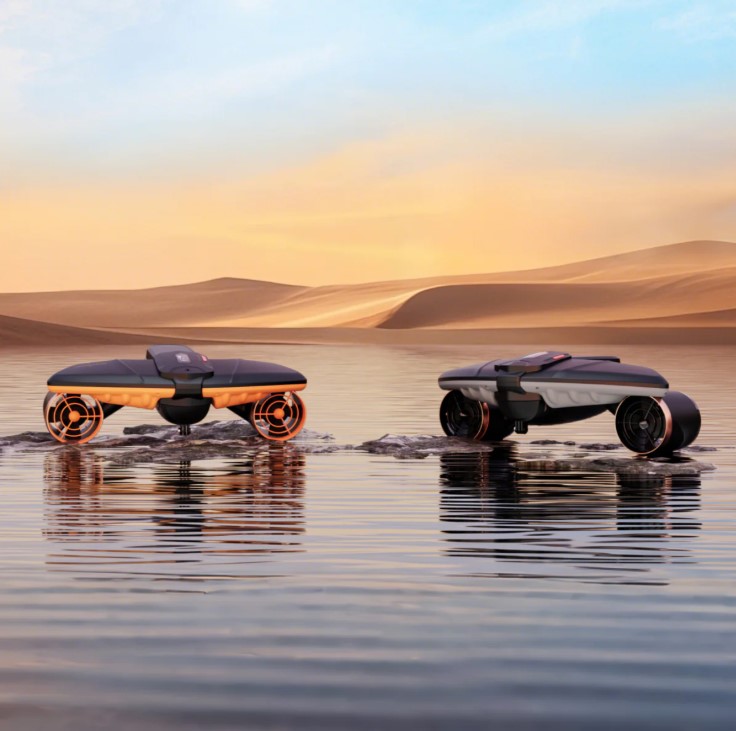
Clicking the link above redirects you to the official Sublue store where your special discount is applied securely at checkout.
The Design Philosophy: Power Meets Ergonomics
Many underwater scooters feel either like cheap plastic toys that struggle against a light swell, or bulky, heavy cylinders that require a dedicated luggage case just to transport to the dock. The design team at Sublue took a different path with the navbow-plus. They developed a compact bow-shaped body that positions the dual propellers wide apart. This wider stance provides excellent lateral stability, preventing the torque of the motors from twisting your wrists as you accelerate or change directions.
The chassis is made of high-strength, impact-resistant industrial polymers designed to withstand the knocks and scrapes of boat decks and rocky shore entries. The handgrips are coated in a textured rubber compound that offers a secure hold even when wearing thick neoprene gloves. In the water, ergonomics make or break a dive. If your fingers cramp up from holding down a trigger for thirty minutes, you won't enjoy the experience. The dual-trigger setup on this model requires only light pressure to engage, and the physical shape of the handles aligns naturally with your wrists in a neutral position.
Inside the bow body, two brushless motors drive three-blade propellers. These propellers are fully enclosed within protective plastic shrouds. This is a critical safety feature that keeps your fingers, hair, and dive gear clear of the moving blades. It also protects marine life if you happen to get close to a sandy bottom or kelp forest. The overall weight of the unit, including the battery, is 4.1 kilograms (roughly 9 pounds). This is light enough to carry in a standard dive bag without exceeding airline limits, yet heavy enough to feel stable when submerged.
Unpacking the Technical Specifications
To truly understand how this device functions under pressure, we have to look closely at its technical capabilities. Here is a detailed breakdown of the specifications directly sourced from the manufacturer and confirmed by real-world field testing.
| Specification | Value / Measurement | Why This Matters to You |
|---|---|---|
| Maximum Speed | 2.0 meters/second (4.47 mph) | Helps you cut through strong currents without exhausting your legs. |
| Depth Rating | 40 meters (131 feet) | Covers the entire range of recreational diving and deep reef explorations. |
| Battery Capacity | 158 Watt-hours (Wh) Lithium-ion | Complies with airline regulations for carry-on items (subject to carrier approval). |
| Run Time | Up to 60 minutes | Provides enough power for a standard recreational dive, depending on speed mode. |
| Charging Time | 2 hours with fast charger | Enables quick turnarounds between morning and afternoon boat dives. |
| Built-in Sensors | Compass, Depth Gauge, Water Temp | Allows you to track your navigation and environment directly on your screen. |
| Dimensions | 486 x 327 x 177 mm (19.1 x 12.8 x 6.9 inches) | Compact enough to fit comfortably inside a standard carry-on suitcase. |
Propulsion & Speed Modes: Finding Your Pace
The Navbow Plus does not lock you into a single speed. Instead, it offers three distinct speed levels that you can cycle through on the fly using a dedicated speed switch on the handle. This flexibility is highly useful when navigating different underwater terrains or trying to conserve battery life.
1. Free Mode (1.0 m/s / 2.24 mph): This is your cruising gear. It is perfect for casual snorkeling, shallow reef exploration, or when you are diving alongside a buddy who is swimming manually. In this mode, the motors draw minimal current, allowing you to reach that coveted 60-minute maximum runtime. If you are focused on underwater photography and just need a gentle assist to keep yourself stable in a light current, this is the setting you will use most of the time.
2. Sport Mode (1.5 m/s / 3.36 mph): When you need to cover more distance, Sport Mode provides a noticeable boost. It increases your speed to match a fast-paced swim. This is highly effective when you want to cross a sandy channel between two patch reefs or move quickly along a wall. The increased thrust makes handling larger camera setups or additional dive gear much easier, though it does reduce the battery life to around 35–40 minutes of continuous use.
3. Turbo Mode (2.0 m/s / 4.47 mph): Turbo Mode is where the dual-motor design shines. Engaging this mode unleashes the full power of the internal brushless motors. The surge of water is immediate, pulling you forward with enough force that you'll feel the drag on your mask. This mode is essential when you are fighting a strong head current or need to return to the boat quickly. However, running the scooter continuously in Turbo Mode will drain the battery in roughly 20 minutes. It is best used in short, strategic bursts rather than as your primary cruising speed.
Understanding the "Plus" Smart Features
What sets the Navbow Plus apart from older propulsion designs is its array of built-in digital sensors. Instead of being a purely mechanical tool, it functions as a smart co-pilot on your wrist. The integrated OLED dashboard displays critical real-world telemetry in real time, which can serve as an excellent backup to your primary dive computer.
The Digital Compass
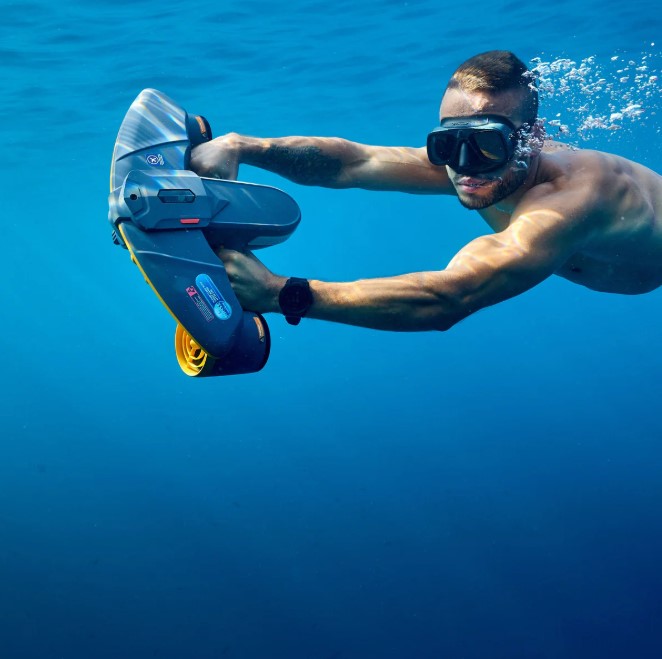
Navigating underwater can be disorienting, especially in low-visibility situations or when diving over uniform sandy flats. Traditionally, you have to hold your wrist-mounted magnetic compass flat in front of you while kicking. With the Navbow Plus, the digital compass is displayed right on the top-facing screen. As you point the nose of the scooter, the screen shows your heading in degrees. This allows you to maintain an accurate course effortlessly while staying fully focused on your surroundings and keeping both hands on the controls.
Water Depth and Temperature Sensors
The unit features built-in depth and temperature sensors that feed directly into the OLED display. The depth reading is calibrated in real time, giving you a continuous view of your depth without requiring you to constantly lift your wrist to check your dive computer. The water temperature readout is also highly useful, especially when crossing thermoclines, helping you track changing water conditions during a deep dive.
Bluetooth Integration and the SublueGo App
The "Plus" model features Bluetooth connectivity that pairs with the SublueGo mobile app. Once you are back on the boat or in your hotel room, you can download your dive logs directly to your smartphone. The app displays your dive profiles, depth logs, water temperature changes, and battery consumption rates. It also allows you to adjust safety settings, such as setting a maximum depth alarm or customizing the display screen's brightness and layout. This level of data integration makes tracking your dives seamless and highly engaging.
Real-World Usability: Handling, Balance, and Buoyancy
On paper, specs look great, but how does the Navbow Plus actually handle in the ocean? To find out, we have to look at how it manages buoyancy and maneuverability. When you submerge the scooter, its natural buoyancy state is slightly positive. This is a deliberate safety feature: if you accidentally let go of the handles while adjusting your mask or checking your gauge, the scooter will slowly float up toward the surface rather than sinking into the deep ocean.
For freedivers or scuba divers who prefer neutral buoyancy, the Navbow Plus comes with removable flotation blocks. By adding or removing these blocks, you can tune the scooter's buoyancy to match your water salinity and personal preference. Achieving perfect neutral buoyancy allows you to park the scooter in mid-water while you snap a photo, and it will remain hovering right next to you.
Maneuverability is incredibly smooth. The dual-thruster configuration allows you to turn on a dime. By slightly tilting your wrists or dipping one side, you can execute tight bank turns, spiral descents, and elegant ascents with minimal effort. This level of control is highly beneficial when navigating through narrow reef passes, exploring shipwrecks, or tracking a moving marine animal for a video shot.
Advanced Mounts for Underwater Photography
If you are an underwater videographer or photographer, you know that keeping your camera stable while swimming is a constant struggle. The Navbow Plus was designed with media creators in mind. It features integrated mounting points on both the top and bottom of the main frame. These threads are standard 1/4-inch-20 mounts, which are compatible with almost all underwater camera trays, action cameras, and lighting arms.
By mounting a GoPro or a compact mirrorless housing directly to the top of the scooter, you can capture incredibly smooth, forward-facing tracking shots. The stability of the scooter's wide body acts as a natural stabilizer, removing the high-frequency jitters that often occur when hand-holding a camera while swimming. If you use heavy video lights, you can mount them to the lower attachment points to keep your lighting source separated from your lens, reducing backscatter in murky water.
Understanding the Battery Technology and Travel Rules
The battery is the heart of any dive propulsion vehicle. Sublue uses a specialized lithium-ion battery pack with a custom sealing system to prevent water ingress. The battery compartment features a double O-ring seal, which must be inspected and lubricated regularly to maintain its watertight integrity.
One of the most common questions from divers is: "Can I take this on a plane?" According to the international regulations set by the International Air Transport Association (IATA) and the US Federal Aviation Administration (FAA), lithium-ion batteries with a capacity between 100Wh and 160Wh require prior approval from the airline before you can bring them aboard in your carry-on baggage. Because the Navbow Plus battery has a capacity of 158Wh, it sits right below this upper limit. You cannot pack this battery in your checked luggage under any circumstances. However, you can bring it in your carry-on bag, provided you notify the airline at check-in and secure the battery terminals to prevent short circuits. Always check your specific airline's policies before arriving at the airport, as individual carrier rules can vary.
Rinsing and Maintenance: Protecting Your Investment
Saltwater is incredibly corrosive. If you do not care for your underwater scooter properly, salt crystals will build up in the seals, sand will clog the motor shafts, and the charging pins will oxidize. To avoid these issues, you must follow a strict maintenance routine after every single dive.
Fortunately, the Official Manual provides clear, step-by-step instructions on how to clean and care for your unit. Here is the recommended post-dive cleaning protocol:
- Freshwater Soak: Submerge the entire unit in a tub of clean, warm freshwater for at least 15–20 minutes. This allows salt deposits trapped in the crevices to dissolve completely.
- Run the Motors: While the scooter is submerged in freshwater, turn it on and run the motors in Free Mode for 10–15 seconds. This flushes out any salt, sand, or debris that may have settled around the propeller shafts.
- Dry Thoroughly: Remove the scooter from the water and dry it with a soft clean towel. Never use compressed air to dry the charging pins or seals, as this can force water past the O-rings.
- Inspect the Battery Compartment: Open the battery hatch and check for any signs of moisture. If you see any water droplets, dry them immediately. Inspect the O-rings for cuts, cracks, or dirt, and apply a thin layer of silicone grease before storing the unit.
If you dive in sandy areas or near seaweed, you must pay extra attention to the propeller guards. If a piece of kelp gets wrapped around the shaft, the motor will work harder, drawing more power and potentially overheating. If this happens, consult the manual to learn how to safely remove the guard and clear the obstruction.
What the Diving Community Is Saying
Before purchasing high-end dive gear, it is always wise to look at what other divers are saying in the community. On the Reddit Discussion on /r/DivingGearReview, users frequently praise the Navbow Plus for its exceptional power-to-weight ratio. Many note that it pulls much harder than other compact scooters on the market, making it far more useful in moderate currents.
However, community feedback also highlights a few areas where you need to be careful. Some users emphasize that you must be meticulous with the battery contact pins. If you insert a wet battery or allow saltwater to dry on the gold-plated pins, they will corrode quickly, leading to power loss or charging failures. The consensus from experienced owners is simple: treat this as a piece of precision dive equipment, keep it clean and dry, and it will perform reliably for years.
Sublue Customer Satisfaction Rating on Trustpilot
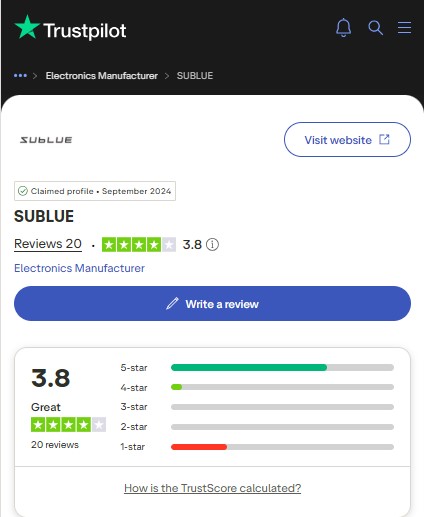
You can check out live user feedback and verified purchases directly on the Sublue Trustpilot page.
Video Walkthrough and Field Testing
To see the Navbow Plus in action and get a better sense of its size, speed, and real-world handling, take a look at this detailed video review. Watching how the scooter moves through the water provides excellent context that words alone cannot capture.
Sublue Navbow Plus vs. The Competition
To understand where the Navbow Plus fits within the wider dive propulsion vehicle (DPV) market, let's compare it directly to other popular models on the market today.
| Feature | Sublue Navbow Plus | Sublue Whiteshark MixPro | Geneinno S2 | Seabob F5 |
|---|---|---|---|---|
| Target Audience | Pro Divers & Photographers | Recreational Snorkelers | Casual Beachgoers | Elite Yacht Owners |
| Max Speed | 2.0 m/s (4.47 mph) | 1.8 m/s (4.02 mph) | 1.2 m/s (2.7 mph) | 4.1 m/s (9.3 mph) |
| Max Depth | 40 meters (131 ft) | 40 meters (131 ft) | 30 meters (98 ft) | 40 meters (131 ft) |
| Dry Weight | 4.1 kg (9.0 lbs) | 3.55 kg (7.8 lbs) | 2.7 kg (5.9 lbs) | 29 kg (64 lbs) |
| Built-in Sensors | Yes (Compass, Depth, Temp) | No | No | Yes (Advanced display) |
| Price Category | Mid-to-High | Entry-to-Mid | Budget Entry | Ultra-Premium Luxury |
As you can see from the comparison, the Whiteshark MixPro is an excellent option for light recreation and snorkeling, but it lacks the heavy propulsion and advanced telemetry of the Navbow Plus. On the other hand, the Seabob offers extreme power and luxury, but its massive weight (64 pounds) makes it impossible to transport on a plane and highly difficult to launch without a boat crane. The Navbow Plus hits the perfect middle ground, providing professional-grade performance and smart data in a highly portable, travel-friendly body.
Safety Guidelines and Operational Advice
While an underwater scooter is incredibly fun, it is also a powerful machine that requires proper safety awareness. Before you head out into the blue, make sure to read and follow these essential safety guidelines:
- Monitor Your Ascent Rate: When using a scooter, it is very easy to climb too quickly. Always monitor your dive computer closely and ensure you do not exceed the safe ascent rate of 9 meters (30 feet) per minute. Ascending too fast can lead to decompression sickness.
- Keep Your Distance from the Bottom: The powerful dual-propellers create a strong suction force behind them and push a lot of water forward. If you dive too close to a sandy or muddy bottom, you will stir up silt, ruin your visibility, and potentially suck sand into your thrusters. Keep at least 1.5 to 2 meters of clearance from the ocean floor.
- Practice Buddy Awareness: When you are moving at 2 meters per second, it is easy to lose track of your dive buddy. Always coordinate your dive plan before entering the water, establish clear hand signals, and check back regularly to ensure your buddy is keeping pace.
- Always Secure Your Safety Leash: The Navbow Plus comes with a safety leash that connects your wrist to the unit. Always wear this leash during your dive. If you need to let go of the scooter to assist your buddy or adjust your gear, the leash ensures the scooter remains securely attached to you and won't drift away in a current.
Ordering, Shipping, and Warranty Protection
When purchasing high-end diving electronics, where you buy matters just as much as what you buy. Purchasing directly from the official store ensures that you receive an authentic product, a fresh battery pack, and full access to official customer support.
Sublue offers a clear and reliable Shipping Policy. Orders are processed quickly and shipped in durable packaging designed to protect the sensitive battery and electronics. They also provide comprehensive tracking so you can monitor your package right to your door.
The unit is backed by Sublue's official Warranty Policy, which covers defects in materials and workmanship under normal use. Having a solid warranty is essential for marine equipment, as saltwater environments can quickly expose any manufacturing issues. If you ever run into technical trouble or have questions about your unit, you can easily reach out through their official Customer Support channels.
When you are ready to complete your purchase, Sublue offers a variety of safe, encrypted payment options. You can view all available options on the official Secure Payment Methods Page, allowing you to buy with complete peace of mind.
Frequently Asked Questions
How long does the battery take to charge from empty?
Using the included quick charger, the 158Wh lithium-ion battery takes approximately 2 hours to charge fully. If you are using a standard slow charger or charging from a low-voltage boat outlet, it can take up to 3.5 to 4 hours. It is highly recommended to charge the battery in a cool, well-ventilated area and never leave it charging unattended overnight.
Can I use the Navbow Plus in freshwater lakes and rivers?
Yes, absolutely. The scooter works beautifully in both salt and freshwater. However, keep in mind that freshwater is less dense than saltwater, which means the scooter's natural buoyancy will be slightly different. You may need to remove some of the flotation blocks to achieve the same neutral buoyancy you experience in the ocean.
What is the maximum depth the scooter can safely handle?
The Navbow Plus has an official depth rating of 40 meters (131 feet). This covers the entire range of standard recreational diving. Going beyond this depth is highly discouraged, as the water pressure can compromise the structural integrity of the seals, potentially flooding the battery compartment or damaging the internal motors.
Is it safe to use the scooter for freediving?
Yes, it is highly popular among freedivers. It allows you to descend quickly and effortlessly, saving precious oxygen for your bottom time. However, freedivers must be very careful with pressure equalization. Because the scooter pulls you down quickly, you must be highly proficient in equalizing your ears and sinuses rapidly to avoid barotrauma.
Can I replace the battery myself?
Yes, the battery is fully user-replaceable. In fact, it is designed to be swapped out quickly so you can pop in a fresh battery and get back in the water for your second dive. Swapping the battery takes less than a minute: simply open the battery compartment latch, slide out the empty battery, slide in the fully charged one, and secure the double-sealed hatch.
Does the scooter have an automatic shutoff if I let go?
Yes, safety is a top priority. The scooter features a dual-trigger dead-man switch design. Both triggers must be actively depressed for the motors to run. If you let go of either handle, the power is cut immediately, and the thrusters stop spinning within a fraction of a second, preventing the scooter from running away from you.
The Final Verdict: Is the Sublue Navbow Plus Worth It?
If you are looking for a casual toy for short pool sessions or shallow beach swims, the Navbow Plus is likely more scooter than you need. But if you are a dedicated scuba diver, an active freediver, or a professional underwater photographer who demands power, precision, and reliable performance, this smart DPV is an outstanding investment.
By combining three fast speed modes, an integrated digital dashboard, accurate environmental sensors, and a travel-friendly weight, Sublue has created an incredibly versatile underwater propulsion vehicle. It allows you to explore deeper, swim farther, and conserve your precious air supply, transforming the way you experience the underwater world.
Take advantage of direct official shipping, full warranty protection, and secure checkout with your discount automatically applied.

0 Comments