
Is the Sublue Vapor the Ultimate Diver Propulsion Vehicle for Your Next Dive?
If you're looking to explore deeper reefs, cover more distance on a single tank, or simply fly through the water without exhausting yourself, finding a reliable diver propulsion vehicle (DPV) is a top priority. In this comprehensive sublue vapor review, we're diving deep into Sublue's premium underwater scooter: the vapor. Designed specifically for recreational scuba divers, technical divers, passionate freedivers, and demanding snorkelers, this underwater scooter aims to deliver some of the highest thrust profiles and depth ratings in its class. By drastically reducing your kicking effort, it lowers your air consumption rate, meaning you get more bottom time to explore. If you want a rugged, fast, and highly maneuverable underwater scooter that handles moderate ocean currents without breaking a sweat, the Sublue Vapor is absolutely worth your consideration.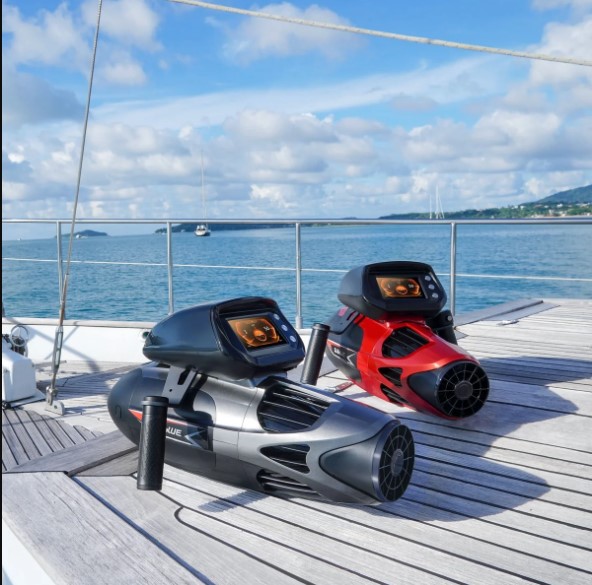
The Physics of Underwater Propulsion: Why the Vapor Design Matters
To truly understand how a diver propulsion vehicle behaves, we have to look past the marketing hype and examine the actual fluid dynamics. When you're swimming underwater, your body acts as a major source of hydrodynamic drag. The faster you try to kick, the more drag you create, and the more oxygen your muscles consume. This increases your respiratory rate, which rapidly depletes your scuba cylinder.
The dual-thruster configuration of the Sublue Vapor is engineered to address this drag equation directly. By positioning two high-output propellers parallel to one another, the scooter creates a wide, balanced column of thrust. Unlike single-propeller scooters that can produce a rotational torque effect—forcing you to constantly correct your wrist positioning to stay on course—the counter-rotating dual propellers of this unit cancel out rotational torque. This means you can guide the scooter with a relaxed grip, minimizing muscle fatigue in your forearms and wrists during long drift dives or extensive reef surveys.
Furthermore, the hydrodynamic housing is shaped to guide the water intake cleanly through the thruster ducts. This ducting design prevents the water from spilling off the tips of the blades, which increases thruster efficiency and protects delicate marine life or your fingers from coming into contact with the spinning blades.
Understanding Dynamic Thrust vs. Static Pull
Many manufacturers advertise speed without discussing thrust, but as any experienced diver knows, speed is highly subjective. It depends on your gear configuration, your physical cross-section, and whether you're wearing a bulky drysuit or a hydrodynamic skin. The Vapor focus lies on delivering constant dynamic thrust. This refers to the continuous pushing force the scooter can maintain even when fighting an oncoming tidal current. In practical terms, it means you can carry extra gear, such as an underwater camera rig with dual strobes, without seeing a massive drop in your forward speed.
Detailed Technical Specifications: Under the Hood of the Vapor
We don't believe in cutting corners when analyzing technical hardware. Let's look at the exact engineering specifications of the vapor so you can see how it matches up against your dive profiles.
Analyzing these parameters, we can see that Sublue didn't build this to be a basic pool toy. A 40-meter depth rating requires highly robust sealing rings and structural integrity to withstand 5 atmospheres of absolute pressure (ATA). At these depths, inferior plastics warp, which can compress O-rings and lead to catastrophic housing floods. The choice of reinforced materials in the chassis ensures that structural tolerances remain completely stable even at the maximum depth limit.
Real-World Usability: From Shallow Reefs to Technical Depth
How does the scooter actually feel when you're in the water? It's one thing to look at a spec sheet, but it's another entirely to operate a DPV when you're fully geared up with a BCD, regulator, and dive computer.
Ergonomics and Hand Control
The control scheme utilizes a highly intuitive dual-trigger configuration. To run the scooter, you depress both triggers. This design is a critical safety feature: if you lose your grip on the scooter, releasing either trigger instantly cuts power to the motors. This prevents a "runaway DPV" scenario where your scooter could speed away into the deep blue or crash into delicate coral formations.
The handles are spaced at an angle that allows your shoulders to remain in a natural, neutral position. When you're towed through the water, your body should form a straight, hydrodynamic line. If the handles are spaced too narrowly, your arms will tire quickly; if they're too wide, you increase your frontal surface area, adding unnecessary drag. The spacing on this model is optimized for an average adult shoulder width, offering an excellent balance of control, comfort, and hydrodynamics.
Managing Buoyancy and Trim
One of the most common mistakes new DPV users make is ignoring their trim. If your scooter is significantly heavy or buoyant, you'll find yourself constantly fighting to maintain your depth, either pointing the nose up or down to compensate. This wastes energy and can cause rapid depth fluctuations, which is dangerous for nitrogen loading and ear equalization.
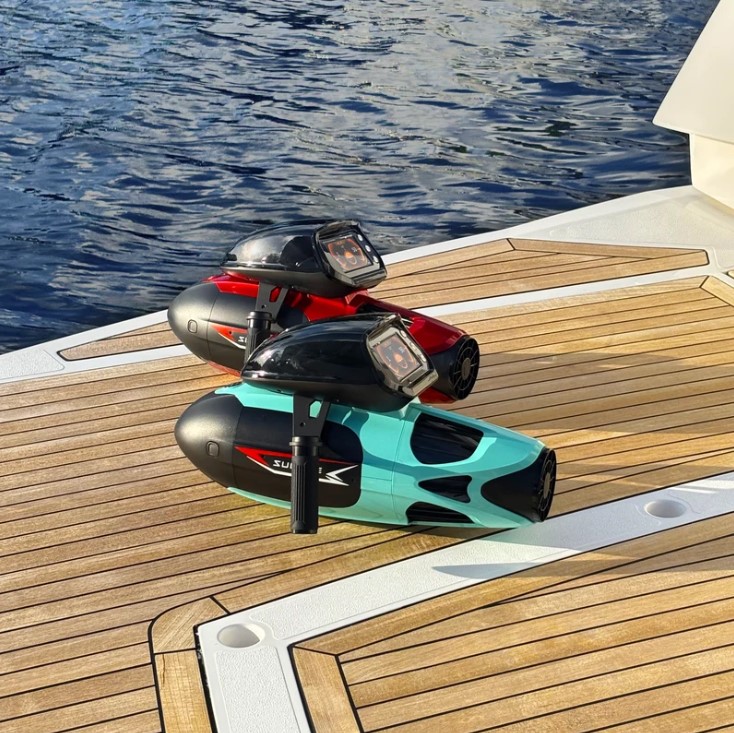
The Vapor features an internal buoyancy chamber. By adding or removing air or specific ballast weights, you can tune the scooter to be perfectly neutral in both freshwater and saltwater environments. When you achieve perfect neutral buoyancy, you can let go of the scooter during a safety stop, and it will hover right next to you, neither sinking to the seafloor nor rising to the surface.
Deep Dive: Scuba, Freediving, and Snorkeling Applications
Not every diver has the same needs. Let's look at how the scooter performs across different underwater disciplines.
For Recreational Scuba Divers
If you're a recreational diver, your main enemies are gas consumption and cold. When you kick continuously, you generate heat, but you also breathe faster. In cooler water, heavy breathing quickly cools down your core templates. Using this scooter allows you to glide effortlessly. Your heart rate remains close to your resting pulse, which can easily extend your 50-bar reserve window, turning a 40-minute dive into a 55-minute dive. It also allows you to perform shore dives that would otherwise be exhausting, such as navigating long sand flats to reach an outer reef drop-off.
For Freedivers
For freedivers, conserving oxygen during the descent is everything. Every bit of energy saved during the downward phase translates directly into more time at the target depth and a safer ascent. The Vapor speed settings allow you to descent quickly without the muscle-burning effort of constant finning. This lets you focus entirely on your equalization and mental relaxation. Because of its reliable depth capabilities, advanced freedivers can trust it to perform during deep breath-hold dives.
For Snorkelers and Marine Observers
If you prefer staying on or near the surface, you'll love how easy it is to cover vast distances. Instead of fighting tidal currents or wind drift, you can cruise along the surface at a fraction of the effort. The bright, clear LED screen remains visible even in direct sunlight, ensuring you always know exactly how much battery power you have left before you need to head back to the shore or boat.
Battery Performance, Management, and Charging Safety
The heart of any modern underwater scooter is its battery pack. Let's look at how the lithium-ion battery in this model is designed to handle the challenges of marine environments.
Thermal Regulation and Sealing
Lithium-ion cells perform best when they're kept within a stable temperature range. High-output motors generate significant heat when run on the maximum speed setting for extended periods. Sublue engineered the battery compartment with thermal conductivity in mind. The heat generated by the cells is transferred efficiently to the surrounding aluminum housing, which is cooled continuously by the surrounding water. This prevents thermal throttling and protects the lifespan of the lithium cells.
Double O-ring seals protect the battery compartment from water intrusion. When you swap batteries on a dive boat, it is vital to inspect these O-rings for any stray hairs, grains of sand, or salt crystals. A single hair can create a micro-channel that allows high-pressure saltwater to bypass the seal at depth, which would flood the electronics. Always apply a thin film of quality silicone grease to keep the O-rings supple and seated properly, as directed in the Official Manual.
Battery Transport and Airline Compliance
If you plan to travel internationally with your DPV, you must pay close attention to aviation rules. The International Air Transport Association (IATA) restricts carry-on lithium batteries based on their Watt-hour (Wh) capacity. Batteries under 100Wh are generally allowed without issue, while batteries between 100Wh and 160Wh require airline approval. Any battery over 160Wh cannot be transported on passenger aircraft under any circumstances.
Based on the available information regarding the high-power output of the Vapor, its primary high-capacity battery pack is designed for maximum runtime and exceeds the 100Wh limit. Therefore, if you are planning to fly to a remote dive destination with this unit, you should check with Sublue or your airline beforehand, or look into shipping the battery separately via certified ground/sea cargo services. You can find more details on shipping guidelines directly on the Shipping Policy page.
Camera Mounts and Capturing Stable Footage
For underwater photographers and videographers, a DPV is more than just a propulsion tool; it's a mobile camera dolly. The stable, continuous forward movement of the scooter helps eliminate the micro-shakes and wobbles that occur when you're swimming and kicking.
The scooter includes built-in mounting interfaces that are fully compatible with standard action camera mounts and underwater lighting arms. By mounting your camera directly to the nose of the scooter, you get a clean, unobstructed field of view. To capture the best footage, we recommend following these setup guidelines:
- Keep the Mount Tight: Use a wrench tool to tighten your camera’s thumbscrew. The drag force from moving at high speeds can cause the camera to tilt downward if it's only hand-tightened.
- Position Your Lights Properly: If you're using underwater video lights, use extension arms to position them out and to the sides. This minimizes backscatter—the reflection of light off suspended particles in the water column directly in front of your lens.
- Maintain a Constant Speed: Sudden speed changes can cause the nose of the scooter to pitch. Use a mid-level speed gear to get smooth, cinematic tracking shots of reefs, turtles, or fellow divers.
What the Diving Community Thinks: Real Feedback and Forums
No honest review is complete without checking what real divers are saying on community hubs like Reddit and consumer platforms like Trustpilot.
Analysis of the Reddit Scuba Community
Over on the popular Reddit Discussion on Sea Scooters, seasoned divers frequently debate the pros and cons of recreational DPVs versus commercial-grade technical exploration units. The general consensus is that while heavy technical scooters offer massive ranges, they're incredibly bulky, heavy to haul out of the water, and cost several thousand dollars.
For the average diver, units like the Vapor offer the perfect middle ground. Redditors appreciate that you don't need a large boat or a crane to launch it. It's light enough to carry down a sandy beach or a rocky entry point single-handedly, yet it has more than enough thrust to pull a fully geared-up diver through moderate current—a feat that cheaper entry-level plastic pool scooters simply cannot manage.
Trustpilot Reputation and Customer Support
When investing in high-end marine electronics, knowing that the company stands behind their gear is crucial. If you review the feedback on the Sublue Trustpilot Page, you'll find that customers highlight the build quality and responsive customer service. Below is a reference screenshot showing their standing:
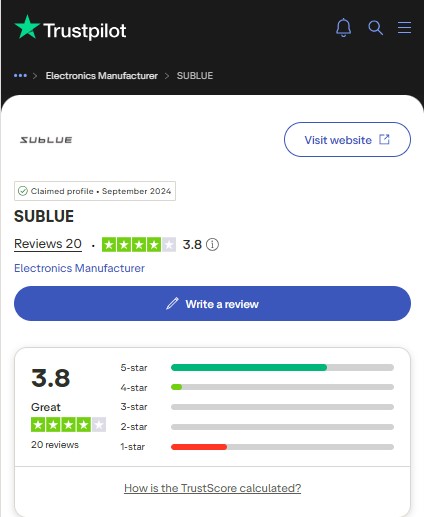
If you ever experience issues with seal integrity, battery diagnostics, or motor performance, you can reach out directly via their official channel at Customer Support. They also provide a solid manufacturer coverage program, which you can read about in detail on the official Warranty Policy page.
Step-by-Step Post-Dive Maintenance: Protecting Your Investment
Saltwater is incredibly corrosive. If you want your scooter to last for years, you must establish a rigorous post-dive maintenance routine. Neglecting maintenance is the number one cause of DPV failure.
- Freshwater Soak: As soon as you exit the water, submerge the entire unit in a clean tub of fresh water. If possible, let it soak for 15 to 20 minutes to dissolve salt crystals that have formed around the triggers, seals, and prop shafts.
- Run the Motors in Fresh Water: While submerged in the freshwater rinse tank, run the motors for 10-15 seconds. This helps flush out any trapped saltwater, sand, or debris inside the dual thruster ducts.
- Dry Thoroughly Before Opening: Never open the battery compartment while the scooter is wet. Use a clean, lint-free towel to dry the entire exterior of the unit. Position the scooter so that any remaining water droplets flow away from the battery compartment seam when opened.
- Inspect and Grease O-Rings: Carefully remove the battery compartment O-rings using a plastic O-ring tool (never use a metal screwdriver, which can scratch the groove and cause permanent leaks). Wipe them clean and inspect them for cracks. Apply a tiny, match-head-sized dab of high-grade silicone grease, spread it evenly, and reseat the O-rings.
- Store at the Right Charge Level: If you aren't going to use the scooter for several weeks, don't store the battery completely empty or fully charged. Store it at approximately 50% to 60% capacity in a cool, dry place out of direct sunlight to prevent cell degradation.
How the Vapor Compares to Other Scooters in Its Class
To give you a clear picture of where this model fits in the market, let's compare its design and features with other types of DPVs you might find online.
Entry-Level Plastic Scooters vs. The Vapor
Many cheap underwater scooters utilize single-speed motors, low-grade plastic housings, and lead-acid batteries. These units are heavy on land, slow in the water, and often fail after a few saltwater exposures because of inadequate shaft seals. In contrast, this model utilizes advanced brushless motors, lightweight yet robust composite materials, and a balanced dual-propeller design. The difference in usability is massive; while an entry-level scooter will struggle to pull you against a mild current, this unit moves you effortlessly through the water column.
High-End Technical DPVs vs. The Vapor
At the far end of the spectrum are technical-grade exploration scooters. These are designed for cave exploration and deep wreck penetration, offering runtimes of several hours and depths of over 100 meters. However, they are incredibly heavy (often weighing 40 to 60 lbs), highly complex to maintain, and cost several thousand dollars. This model bridges the gap perfectly, providing the high speed, reliability, and depth capabilities needed for demanding dives in a compact, user-friendly package that fits easily into a standard gear bag.
Video Walkthrough: Seeing the Scooter in Action
Sometimes, seeing the gear in action is worth a thousand words. To help you visualize the scale, speed, and real-world handling of the scooter, take a look at this detailed community review video:
Pros and Cons: A Honest Breakdown
Every piece of dive gear involves design trade-offs. Here is a balanced look at what makes this scooter exceptional, along with a few points you should keep in mind before purchasing.
The Positives
- Exceptional Thrust: The dual-propeller setup provides impressive pushing power, making it easy to cut through headcurrents.
- Ergonomic Balanced Design: Eliminates wrist-twisting rotational torque, allowing for comfortable, single-handed or double-handed control.
- Robust Depth Rating: The 40m (131 ft) capability fully supports advanced recreational and deep specialty diving.
- Excellent Safety Features: Dual-trigger dead-man switch prevents runaway scooter scenarios instantly.
- Highly Adaptable: Easy to mount action cameras, lights, and adjust buoyancy to match freshwater or saltwater.
Points to Consider
- Aviation Restrictions: The high-capacity battery packs exceed the standard 100Wh limit, which requires advanced travel planning or ground/sea cargo shipping.
- Initial Cost: It is a serious piece of machinery, meaning it represents a larger upfront investment than basic recreational pool toys.
- Maintenance Commitment: Like all professional marine gear, it requires careful post-dive cleaning and O-ring care to prevent water ingress.
Purchasing and Payment Safety
When you're ready to buy, security is incredibly important. You want to make sure your financial details are processed securely and that you're getting genuine manufacturer gear. By buying through the official store, your transaction is processed with industry-standard encryption protocols. The checkout page supports multiple secure payment methods, including credit cards, shop pay, and other verified digital wallets. You can review the secure checkout environment and accepted payments on the official Payment Processing Portal.
Final Verdict: Should You Buy the Sublue Vapor?
After analyzing the physics, the build materials, the battery management, and the community feedback, the verdict is clear: the Sublue Vapor is an outstanding choice for any diver looking to step up their underwater game. It successfully combines the power and build quality of high-end professional DPVs with the portability and user-friendly ergonomics required by recreational divers.
Whether you want to extend your bottom time by lowering your air consumption, explore offshore reefs that were previously too far to reach by swimming, or capture ultra-smooth cinematic video footage of marine life, this scooter delivers on all fronts. It's a rugged, reliable tool that makes diving more relaxing, safer, and infinitely more fun.

0 Comments